Bouchami Ons, Fraqueza Maria João, Faria Nuno Alexandre, Alves Valquíria, Lawal Opeyemi Uwangbaoje, de Lencastre Herminia, Miragaia Maria
Laboratory of Bacterial Evolution and Molecular Epidemiology, Instituto de Tecnologia Química e Biológica (ITQB-NOVA) António Xavier, 2780-157 Oeiras, Portugal.
Laboratory of Molecular Genetics, Instituto de Tecnologia Química e Biológica (ITQB-NOVA) António Xavier, 2780-157 Oeiras, Portugal.
Microorganisms. 2020 Nov 29;8(12):1892. doi: 10.3390/microorganisms8121892.
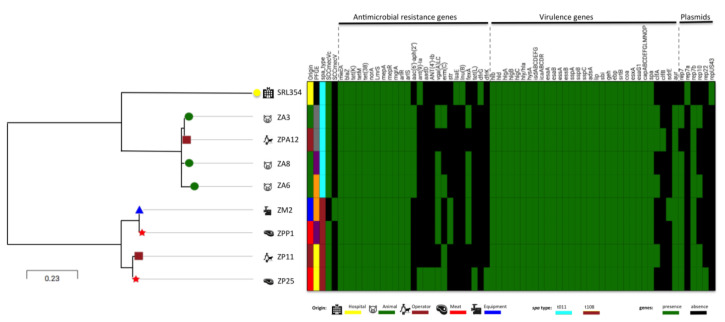
Livestock-associated methicillin-resistant (LA-MRSA) ST398 was recovered from infections in humans exposed to animals, raising public health concerns. However, contact with food producing chain as a means of transmission of LA-MRSA to humans remains poorly understood. We aimed to assess if pork production chain is a source of MRSA ST398 for human colonization and infection. MRSA from live pigs, meat, the environment, and slaughterhouse workers were analyzed by Pulsed-Field Gel Electrophoresis (PFGE), , MLST typing, SNPs and for antibiotic resistance and virulence gene profiles. We compared core and accessory genomes of MRSA ST398 isolated from slaughterhouse and hospital. We detected MRSA ST398 (t011, t108, t1451) along the entire pork production chain (live pigs: 60%; equipment: 38%; meat: 23%) and in workers (40%). All MRSA ST398 were multidrug resistant, and the majority carried genes encoding biocide resistance and enterotoxins. We found 23 cross-transmission events between live pigs, meat, and workers (6-55 SNPs). MRSA ST398 from infection and slaughterhouse environment belonged to the same clonal type (ST398, t011, SCC V), but differed in 321-378 SNPs. Pork production chain can be a source of MRSA ST398 for colonization of human slaughterhouse workers, which can represent a risk of subsequent meat contamination and human infection.
从接触动物的人类感染病例中分离出了与牲畜相关的耐甲氧西林金黄色葡萄球菌(LA-MRSA)ST398,这引发了公众对健康的担忧。然而,作为LA-MRSA传播给人类的一种途径,与食品生产链的接触仍未得到充分了解。我们旨在评估猪肉生产链是否是人类定植和感染MRSA ST398的来源。通过脉冲场凝胶电泳(PFGE)、多位点序列分型(MLST)、单核苷酸多态性(SNPs)以及抗生素耐药性和毒力基因谱分析,对来自生猪、猪肉、环境和屠宰场工人的耐甲氧西林金黄色葡萄球菌进行了分析。我们比较了从屠宰场和医院分离出的MRSA ST398的核心基因组和辅助基因组。我们在整个猪肉生产链(生猪:60%;设备:38%;猪肉:23%)以及工人(40%)中检测到了MRSA ST398(t011、t108、t1451)。所有的MRSA ST398都具有多重耐药性,并且大多数携带编码抗杀菌剂和肠毒素的基因。我们发现生猪、猪肉和工人之间存在23起交叉传播事件(6 - 55个单核苷酸多态性)。来自感染病例和屠宰场环境的MRSA ST398属于同一克隆型(ST398,t011,SCC V),但在321 - 378个单核苷酸多态性上存在差异。猪肉生产链可能是MRSA ST398定植于人类屠宰场工人的来源,这可能代表着随后肉类污染和人类感染的风险。