Genetics of Cognitive Dysfunction Laboratory, i3S- Instituto de Investigação e Inovação em Saúde, Universidade do Porto, 4200-135 Porto, Portugal.
IBMC-Institute for Molecular and Cell Biology, Universidade do Porto, 4200-135 Porto, Portugal.
Genes (Basel). 2020 Nov 27;11(12):1418. doi: 10.3390/genes11121418.
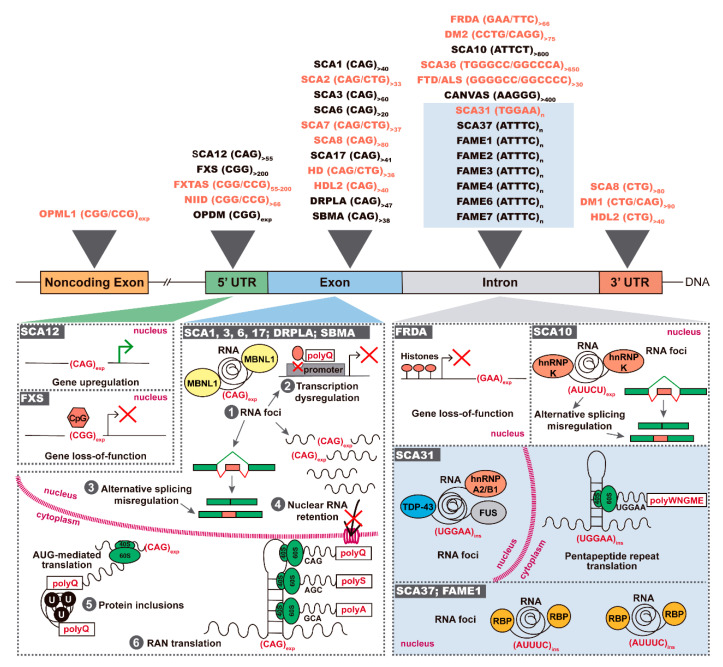
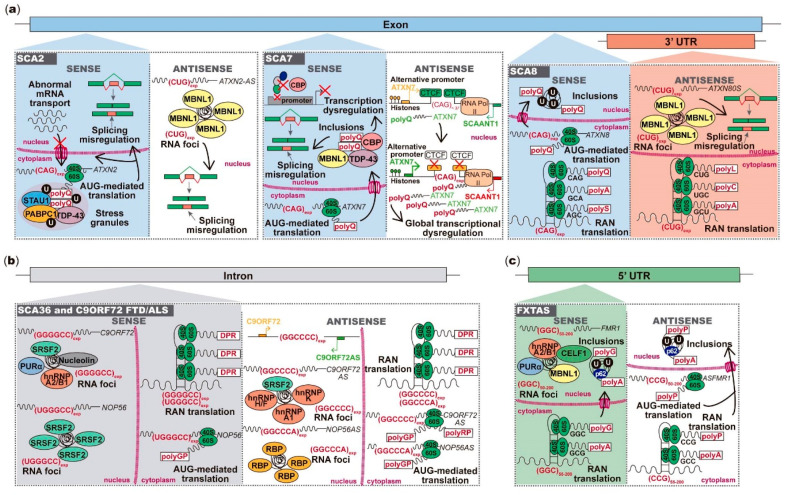
Unstable repeat expansions and insertions cause more than 30 neurodegenerative and neuromuscular diseases. Remarkably, bidirectional transcription of repeat expansions has been identified in at least 14 of these diseases. More remarkably, a growing number of studies has been showing that both sense and antisense repeat RNAs are able to dysregulate important cellular pathways, contributing together to the observed clinical phenotype. Notably, antisense repeat RNAs from spinocerebellar ataxia type 7, myotonic dystrophy type 1, Huntington's disease and frontotemporal dementia/amyotrophic lateral sclerosis associated genes have been implicated in transcriptional regulation of sense gene expression, acting either at a transcriptional or posttranscriptional level. The recent evidence that antisense repeat RNAs could modulate gene expression broadens our understanding of the pathogenic pathways and adds more complexity to the development of therapeutic strategies for these disorders. In this review, we cover the amazing progress made in the understanding of the pathogenic mechanisms associated with repeat expansion neurodegenerative and neuromuscular diseases with a focus on the impact of antisense repeat transcription in the development of efficient therapies.
不稳定的重复扩展和插入会导致 30 多种神经退行性和神经肌肉疾病。值得注意的是,在至少 14 种这些疾病中已经鉴定出重复扩展的双向转录。更值得注意的是,越来越多的研究表明,有意义和反义重复 RNA 都能够扰乱重要的细胞途径,共同导致观察到的临床表型。值得注意的是,来自脊髓小脑共济失调 7 型、肌萎缩性侧索硬化症 1 型、亨廷顿病和额颞叶痴呆/肌萎缩侧索硬化症相关基因的反义重复 RNA 已被牵连到有意义基因表达的转录调控中,无论是在转录水平还是转录后水平。反义重复 RNA 可以调节基因表达的最新证据拓宽了我们对与重复扩展神经退行性和神经肌肉疾病相关的致病途径的理解,并为这些疾病的治疗策略的发展增加了更多的复杂性。在这篇综述中,我们涵盖了在理解与重复扩展神经退行性和神经肌肉疾病相关的致病机制方面所取得的惊人进展,重点关注反义重复转录对开发有效治疗方法的影响。