Center for Human and Clinical Genetics, Leiden University Medical Center, Leiden, The Netherlands.
PLoS One. 2011;6(9):e24308. doi: 10.1371/journal.pone.0024308. Epub 2011 Sep 1.
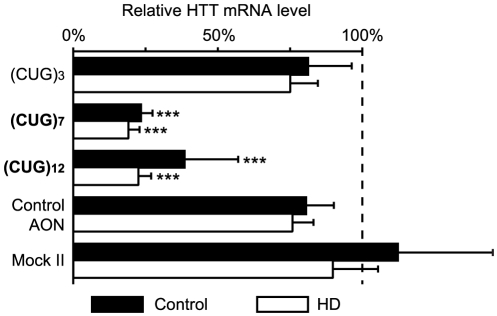
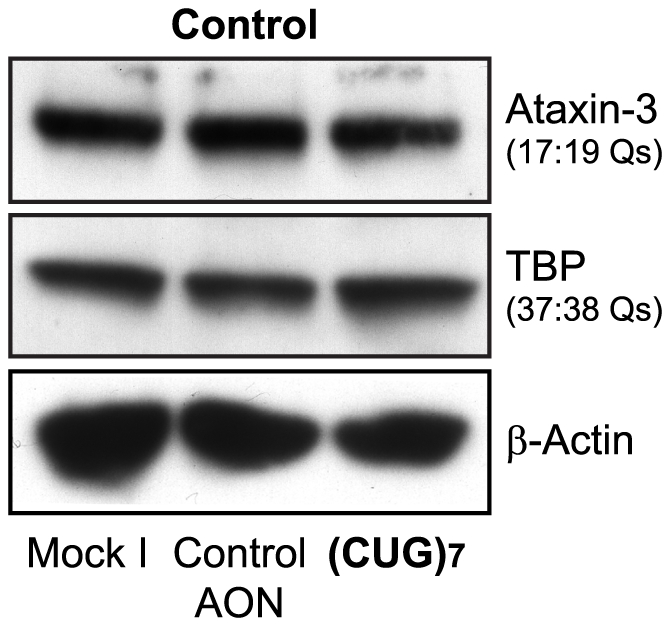
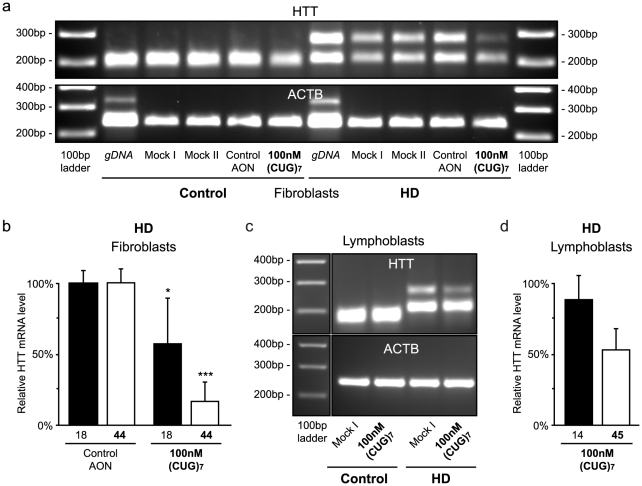
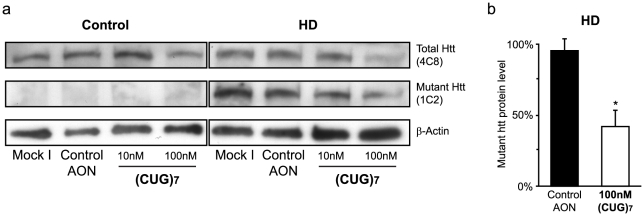
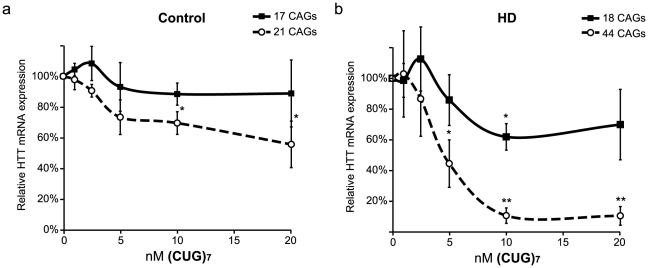
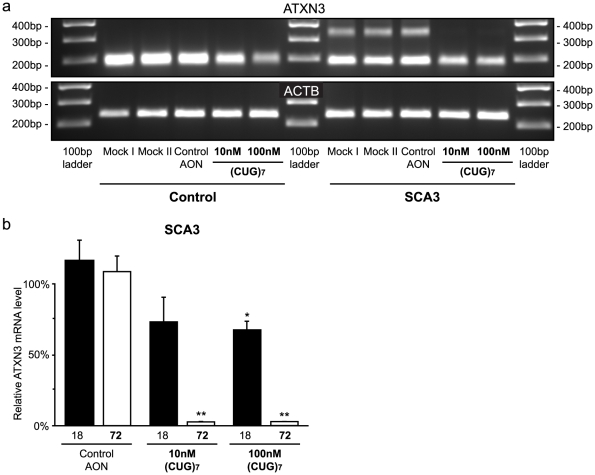
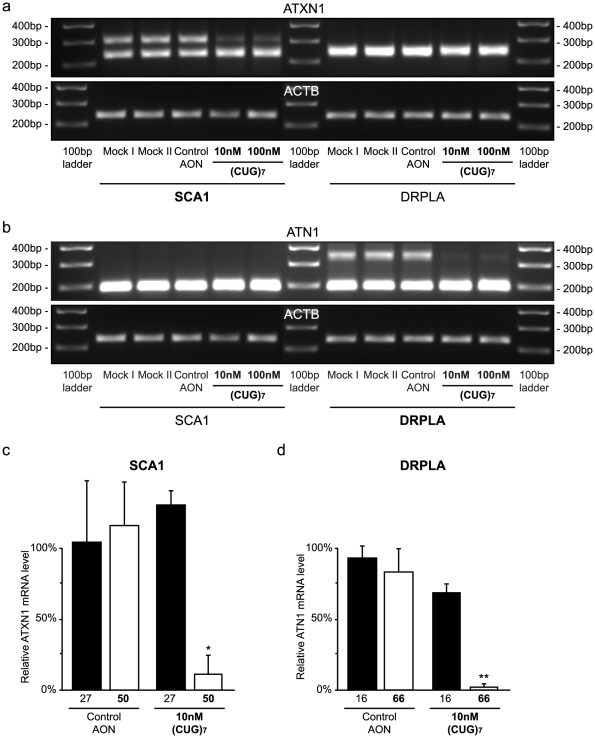
To date there are 9 known diseases caused by an expanded polyglutamine repeat, with the most prevalent being Huntington's disease. Huntington's disease is a progressive autosomal dominant neurodegenerative disorder for which currently no therapy is available. It is caused by a CAG repeat expansion in the HTT gene, which results in an expansion of a glutamine stretch at the N-terminal end of the huntingtin protein. This polyglutamine expansion plays a central role in the disease and results in the accumulation of cytoplasmic and nuclear aggregates. Here, we make use of modified 2'-O-methyl phosphorothioate (CUG)n triplet-repeat antisense oligonucleotides to effectively reduce mutant huntingtin transcript and protein levels in patient-derived Huntington's disease fibroblasts and lymphoblasts. The most effective antisense oligonucleotide, (CUG)(7), also reduced mutant ataxin-1 and ataxin-3 mRNA levels in spinocerebellar ataxia 1 and 3, respectively, and atrophin-1 in dentatorubral-pallidoluysian atrophy patient derived fibroblasts. This antisense oligonucleotide is not only a promising therapeutic tool to reduce mutant huntingtin levels in Huntington's disease but our results in spinocerebellar ataxia and dentatorubral-pallidoluysian atrophy cells suggest that this could also be applicable to other polyglutamine expansion disorders as well.
迄今为止,已经有 9 种由扩展的多聚谷氨酰胺重复引起的疾病,其中最常见的是亨廷顿病。亨廷顿病是一种进行性常染色体显性神经退行性疾病,目前尚无治疗方法。它是由 HTT 基因中的 CAG 重复扩展引起的,导致亨廷顿蛋白 N 端的谷氨酰胺延伸扩展。这种多聚谷氨酰胺扩展在疾病中起着核心作用,导致细胞质和核聚集体的积累。在这里,我们利用修饰的 2'-O-甲基硫代磷酸酯(CUG)n 三重复反义寡核苷酸,有效地降低了患者来源的亨廷顿病成纤维细胞和淋巴母细胞中突变亨廷顿蛋白的转录和蛋白水平。最有效的反义寡核苷酸(CUG)(7)还降低了脊髓小脑共济失调 1 和 3 中突变的ataxin-1 和 ataxin-3 mRNA 水平,以及齿状核红核苍白球路易体萎缩症患者来源的成纤维细胞中的萎缩蛋白-1。这种反义寡核苷酸不仅是一种有前途的治疗工具,可以降低亨廷顿病中的突变亨廷顿蛋白水平,而且我们在脊髓小脑共济失调和齿状核红核苍白球路易体萎缩症细胞中的结果表明,这也可能适用于其他多聚谷氨酰胺扩展疾病。