Department of Electrical and Information Engineering, Seoul National University of Science and Technology, Seoul 01811, Korea.
Sensors (Basel). 2020 Nov 27;20(23):6782. doi: 10.3390/s20236782.
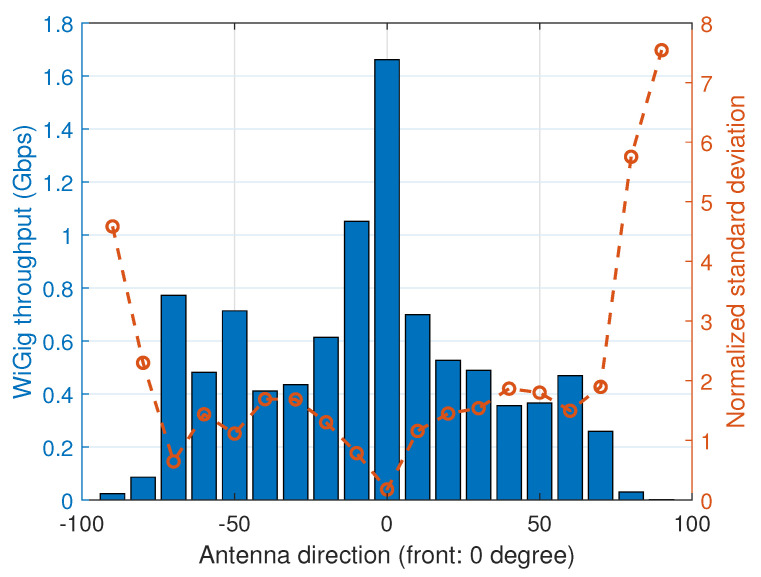
Wireless virtual reality (VR) is a promising direction for future VR systems that offloads heavy computation to a remote processing entity and wirelessly receives high-quality streams. WiGig and WiFi are representative solutions to implement wireless VR; however, they differ in communication bandwidth and reliability. Our testbed experiments show that the performance of WiGig and VR traffic generation strongly correlates with and consequently can be predicted from a user's motion. Based on this observation, we develop a wireless VR system that exploits the benefits of both links by switching between them and controlling the VR frame encoding for latency regulation and image quality enhancement. The proposed system predicts the performance of the links and selects the one with a higher capacity in an opportunistic manner. It adjusts the encoding rate of the host based on the motion-aware prediction of the frame size and estimated latency of the selected link. By evaluating the testbed data, we demonstrate that the proposed system outperforms a WiGig-only system with a fixed encoding rate in terms of latency regulation and image quality.
无线虚拟现实(VR)是未来 VR 系统的一个很有前途的方向,它可以将繁重的计算任务卸载到远程处理实体,并通过无线方式接收高质量的数据流。WiGig 和 WiFi 是实现无线 VR 的代表性解决方案,但它们在通信带宽和可靠性方面有所不同。我们的测试平台实验表明,WiGig 和 VR 流量生成的性能与用户的运动密切相关,因此可以从用户的运动中预测出来。基于这一观察,我们开发了一种无线 VR 系统,通过在两者之间切换并控制 VR 帧编码来调节延迟和增强图像质量,从而利用两种链路的优势。所提出的系统通过对链路性能进行预测,并以机会方式选择具有更高容量的链路。它根据对所选链路的帧大小和估计延迟的运动感知预测,调整主机的编码速率。通过评估测试平台数据,我们证明了所提出的系统在延迟调节和图像质量方面优于具有固定编码速率的 WiGig 系统。