Serkova Natalie J, Glunde Kristine, Haney Chad R, Farhoud Mohammed, De Lille Alexandra, Redente Elizabeth F, Simberg Dmitri, Westerly David C, Griffin Lynn, Mason Ralph P
Department of Radiology, University of Colorado Anschutz Medical Campus, Aurora, Colorado.
Animal Imaging Shared Resource, University of Colorado Cancer Center, Aurora, Colorado.
Cancer Res. 2021 Mar 1;81(5):1189-1200. doi: 10.1158/0008-5472.CAN-20-0373. Epub 2020 Dec 1.
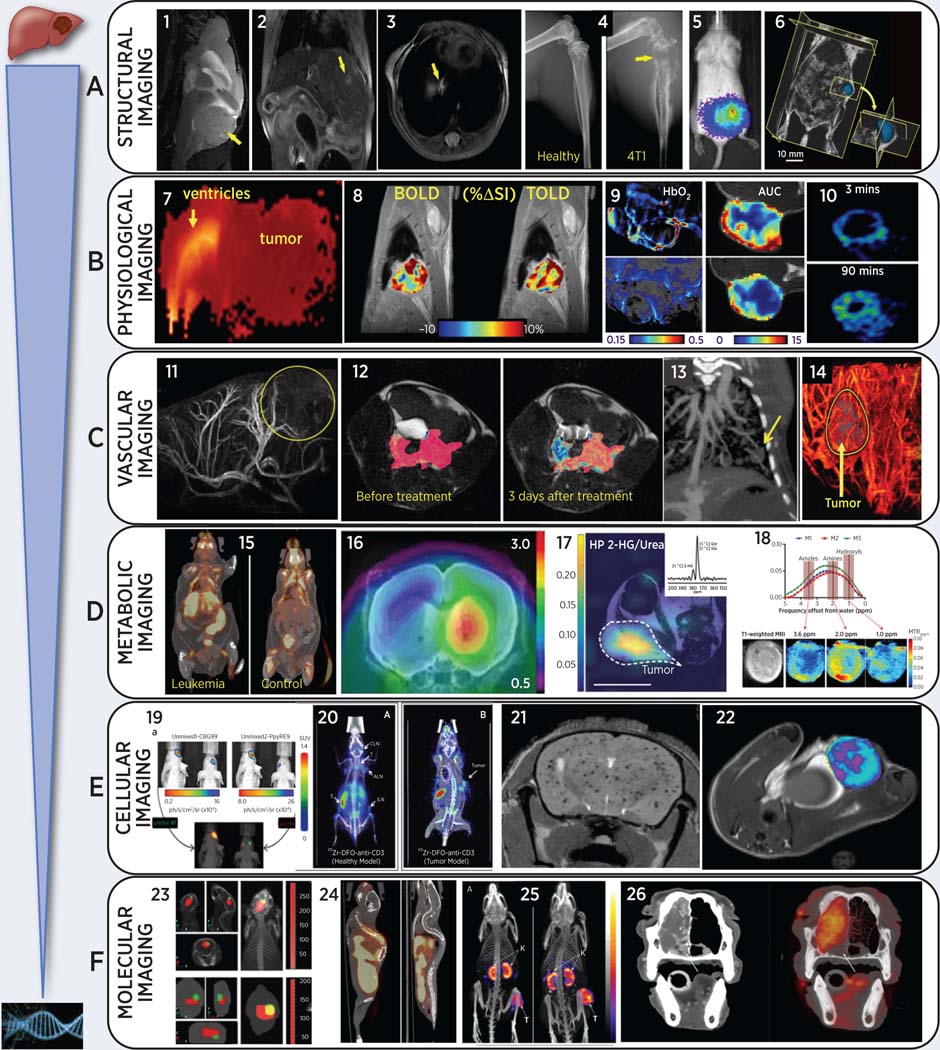
In animal models of cancer, oncologic imaging has evolved from a simple assessment of tumor location and size to sophisticated multimodality exploration of molecular, physiologic, genetic, immunologic, and biochemical events at microscopic to macroscopic levels, performed noninvasively and sometimes in real time. Here, we briefly review animal imaging technology and molecular imaging probes together with selected applications from recent literature. Fast and sensitive optical imaging is primarily used to track luciferase-expressing tumor cells, image molecular targets with fluorescence probes, and to report on metabolic and physiologic phenotypes using smart switchable luminescent probes. MicroPET/single-photon emission CT have proven to be two of the most translational modalities for molecular and metabolic imaging of cancers: immuno-PET is a promising and rapidly evolving area of imaging research. Sophisticated MRI techniques provide high-resolution images of small metastases, tumor inflammation, perfusion, oxygenation, and acidity. Disseminated tumors to the bone and lung are easily detected by microCT, while ultrasound provides real-time visualization of tumor vasculature and perfusion. Recently available photoacoustic imaging provides real-time evaluation of vascular patency, oxygenation, and nanoparticle distributions. New hybrid instruments, such as PET-MRI, promise more convenient combination of the capabilities of each modality, enabling enhanced research efficacy and throughput.
在癌症动物模型中,肿瘤成像已从对肿瘤位置和大小的简单评估发展到对微观到宏观层面的分子、生理、遗传、免疫和生化事件进行复杂的多模态探索,且以非侵入性方式进行,有时甚至是实时的。在此,我们简要回顾动物成像技术和分子成像探针,并结合近期文献中的选定应用进行阐述。快速且灵敏的光学成像主要用于追踪表达荧光素酶的肿瘤细胞、用荧光探针成像分子靶点,以及使用智能可切换发光探针报告代谢和生理表型。微型正电子发射断层扫描/单光子发射计算机断层扫描已被证明是癌症分子和代谢成像中最具转化性的两种模态:免疫正电子发射断层扫描是一个有前景且发展迅速的成像研究领域。先进的磁共振成像技术可提供小转移灶、肿瘤炎症、灌注、氧合和酸度的高分辨率图像。微型计算机断层扫描能轻松检测出扩散至骨骼和肺部的肿瘤,而超声可实时显示肿瘤血管系统和灌注情况。最近出现的光声成像可对血管通畅性、氧合和纳米颗粒分布进行实时评估。新型混合仪器,如正电子发射断层扫描 - 磁共振成像,有望更便捷地结合每种模态的功能,提高研究效率和通量。