Nagano Mayuko, Saito Kanako, Kozuka Yuji, Ichishi Masako, Yuasa Hiroto, Noro Aya, Imai Nao, Shibusawa Mai, Kimoto Mao, Ishitobi Makoto, Tono Yasutaka, Oda Hiroyasu, Ishihara Mikiya, Mizuno Toshiro, Ogawa Tomoko, Katayama Naoyuki
Department of Breast Surgery, Mie University Graduate School of Medicine, Mie 514-8507, Japan.
Department of Hematology and Oncology, Mie University Graduate School of Medicine, Mie 514-8507, Japan.
Oncol Lett. 2021 Jan;21(1):36. doi: 10.3892/ol.2020.12297. Epub 2020 Nov 12.
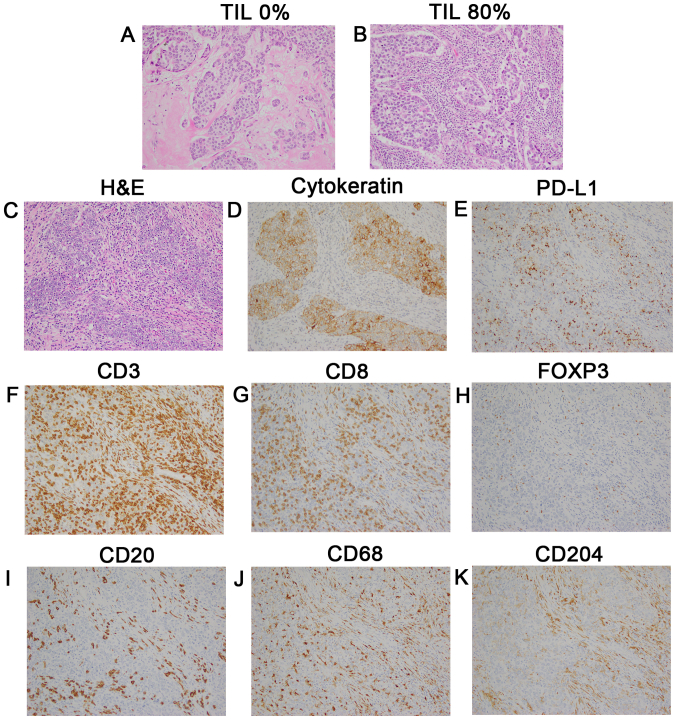
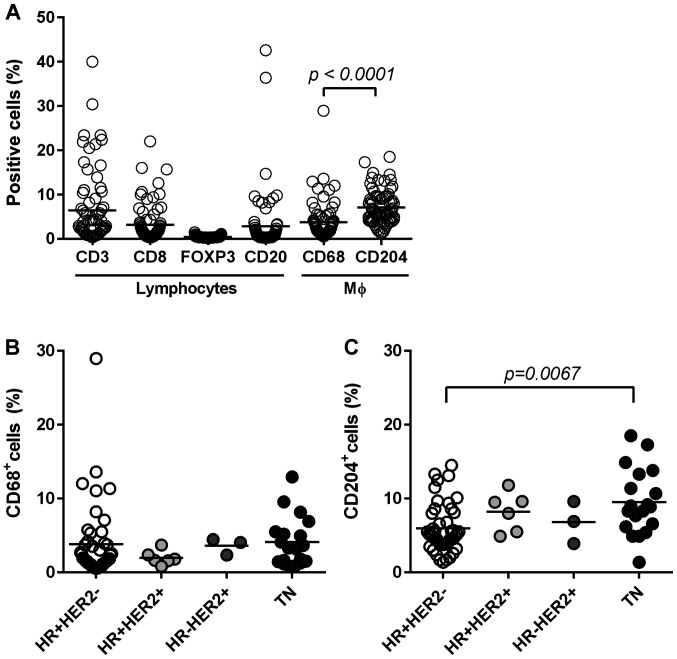
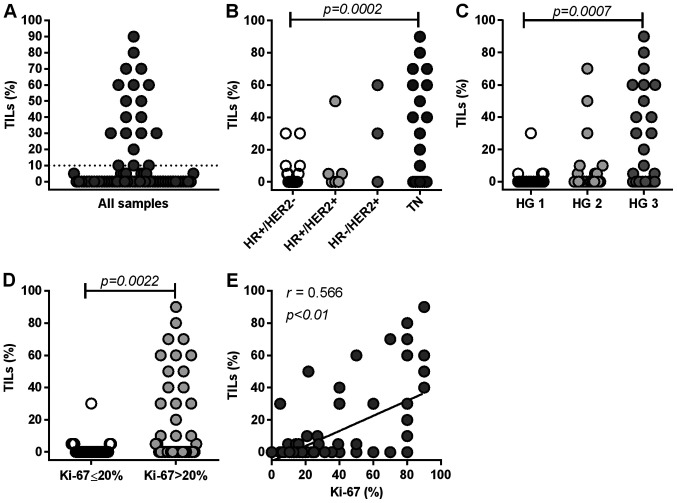
Although immunotherapy has been demonstrated to be promising in triple-negative (TN) breast cancer (BC), most BC cases are classified as non-TN. To enrich the responders for immunotherapy regardless of their subtypes, classification based on tumor-infiltrating lymphocyte (TIL) levels and programmed death ligand-1 (PD-L1) status may be useful. However, this classification has not been fully applied to BC. Furthermore, suppressive subsets in the local tumor microenvironment, such as tumor-associated macrophages (TAMs), which promote tumor progression, cannot be ignored to overcome immunotherapy resistance. The aims of the present study were to classify primary BC cases based on the TIL levels and PD-L1 status, and to identify suppressive immune subsets in each categorized group. A retrospective analysis of 73 patients with invasive BC was performed. The frequency of TILs was evaluated in HE-stained slides (10% cutoff), and PD-L1 levels (SP142; 1% cutoff), as well as immune subsets (CD3, CD8, FOXP3, CD20, CD68 and CD204 cells) were assessed using immunohistochemistry. It was revealed that 22% (16/73) of the tumors were categorized as TILPD-L1, of which 69% (11/16) were TN type. By contrast, 66% (48/73) of the tumors were categorized as TILPD-L1, of which 77% (37/48) were HR and HER2 types. The number of CD204 M2-type macrophages was significantly associated with high histological grade (P=0.0246) and high Ki-67 (P=0.0152), whereas CD68 macrophages were not associated with these factors. Furthermore, CD204 macrophages and FOXP3 Tregs accumulated in 88% (14/16) and 63% (10/16) of TILPD-L1 tumors, respectively, compared with 20.8% (10/48) and 27.1% (13/48) of TILPD-L1 tumors. In conclusion, 22% of BC tumors were classified as TILPD-L1 (69% were TN), which were enriched with suppressive immune subsets. These cell types may serve as potential novel immunotherapeutic targets.
尽管免疫疗法已被证明在三阴性(TN)乳腺癌(BC)中具有前景,但大多数BC病例被归类为非TN型。为了使免疫疗法的应答者不受其亚型影响而得到富集,基于肿瘤浸润淋巴细胞(TIL)水平和程序性死亡配体-1(PD-L1)状态进行分类可能会有所帮助。然而,这种分类尚未完全应用于BC。此外,局部肿瘤微环境中的抑制性亚群,如促进肿瘤进展的肿瘤相关巨噬细胞(TAM),在克服免疫疗法耐药性方面也不容忽视。本研究的目的是根据TIL水平和PD-L1状态对原发性BC病例进行分类,并在每个分类组中识别抑制性免疫亚群。对73例浸润性BC患者进行了回顾性分析。在苏木精-伊红(HE)染色切片中评估TIL的频率(临界值为10%),并使用免疫组织化学评估PD-L1水平(SP142;临界值为1%)以及免疫亚群(CD3、CD8、FOXP3、CD20、CD68和CD204细胞)。结果显示,22%(16/73)的肿瘤被归类为TIL低PD-L1,其中69%(11/16)为TN型。相比之下,66%(48/73)的肿瘤被归类为TIL高PD-L1,其中77%(37/48)为HR和HER2型。CD204 M2型巨噬细胞的数量与高组织学分级(P = 0.0246)和高Ki-67(P = 0.0152)显著相关,而CD68巨噬细胞与这些因素无关。此外,与TIL高PD-L1肿瘤的20.8%(10/48)和27.1%(13/48)相比,CD204巨噬细胞和FOXP3调节性T细胞(Treg)分别在88%(14/16)和63%(10/16)的TIL低PD-L1肿瘤中积聚。总之,22%的BC肿瘤被归类为TIL低PD-L1(69%为TN型),这些肿瘤富含抑制性免疫亚群。这些细胞类型可能是潜在的新型免疫治疗靶点。