Rasidovic Damir, Ahmed Imran, Thomas Christopher, Kimani Peter K-U, Wall Peter, Mangat Karanjit
South Warwickshire NHS Foundation Trust, Warwick, UK.
University Hospital Coventry and Warwickshire NHS Trust, Coventry, UK.
Bone Jt Open. 2020 Nov 4;1(11):697-705. doi: 10.1302/2633-1462.111.BJO-2020-0132.R1.
There are reports of a marked increase in perioperative mortality in patients admitted to hospital with a fractured hip during the COVID-19 pandemic in the UK, USA, Spain, and Italy. Our study aims to describe the risk of mortality among patients with a fractured neck of femur in England during the early stages of the COVID-19 pandemic.
We completed a multicentre cohort study across ten hospitals in England. Data were collected from 1 March 2020 to 6 April 2020, during which period the World Health Organization (WHO) declared COVID-19 to be a pandemic. Patients ≥ 60 years of age admitted with hip fracture and a minimum follow-up of 30 days were included for analysis. Primary outcome of interest was mortality at 30 days post-surgery or postadmission in nonoperative patients. Secondary outcomes included length of hospital stay and discharge destination.
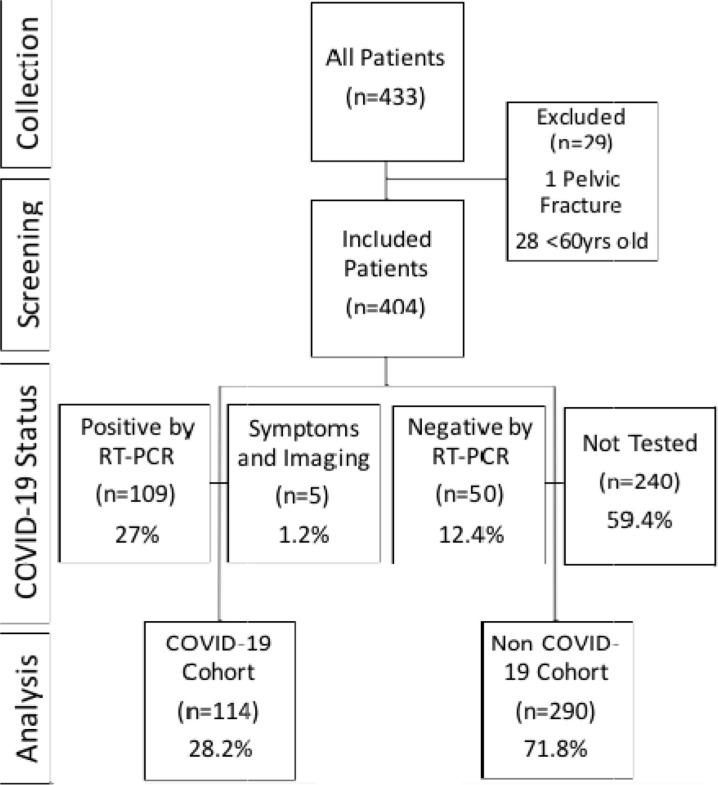
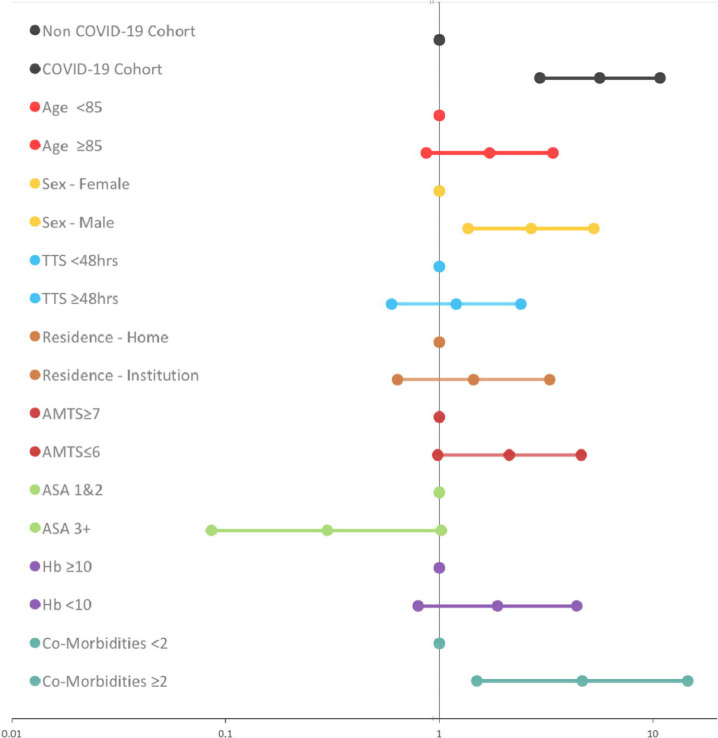
In total, 404 patients were included for final analysis with a COVID-19 diagnosis being made in 114 (28.2%) patients. Overall, 30-day mortality stood at 14.4% (n = 58). The COVID-19 cohort experienced a mortality rate of 32.5% (37/114) compared to 7.2% (21/290) in the non-COVID cohort (p < 0.001). In adjusted analysis, 30-day mortality was greatest in patients who were confirmed to have COVID-19 (odds ratio (OR) 5.64, 95% confidence interval (CI) 2.95 to 10.80; p < 0.001) with an adjusted excess risk of 20%, male sex (OR 2.69, 95% CI 1.37 to 5.29; p = 0.004) and in patients with ≥ two comorbidities (OR 4.68, CI 1.5 to 14.61; p = 0.008). Length of stay was also extended in the COVID-19 cohort, on average spending 17.6 days as an inpatient versus 12.04 days in the non-COVID-19 group (p < 0.001).
This study demonstrates that patients who sustain a neck of femur fracture in combination with COVID-19 diagnosis have a significantly higher risk of mortality than would be normally expected.Cite this article: 2020;1-11:697-705.
在英国、美国、西班牙和意大利,有报告称在新冠疫情期间因髋部骨折入院的患者围手术期死亡率显著增加。我们的研究旨在描述在新冠疫情早期英格兰股骨颈骨折患者的死亡风险。
我们在英格兰的十家医院完成了一项多中心队列研究。数据收集时间为2020年3月1日至2020年4月6日,在此期间世界卫生组织(WHO)宣布新冠疫情为大流行。纳入年龄≥60岁、因髋部骨折入院且至少随访30天的患者进行分析。主要关注结局是手术后30天或非手术患者入院后30天的死亡率。次要结局包括住院时间和出院去向。
共有404例患者纳入最终分析,其中114例(28.2%)患者被诊断为新冠。总体而言,30天死亡率为14.4%(n = 58)。新冠队列的死亡率为32.5%(37/114),而非新冠队列的死亡率为7.2%(21/290)(p < 0.001)。在多因素分析中,确诊感染新冠的患者30天死亡率最高(比值比(OR)为5.64,95%置信区间(CI)为2.95至10.80;p < 0.001),调整后的额外风险为20%,男性(OR为2.69,95%CI为1.37至5.29;p = 0.004)以及患有≥两种合并症的患者(OR为4.68,CI为1.5至14.61;p = 0.008)。新冠队列的住院时间也延长了,平均住院17.6天,而非新冠组为12.04天(p < 0.001)。
本研究表明,股骨颈骨折合并新冠诊断的患者死亡风险显著高于正常预期。引用本文:2020;1 - 11:697 - 705。