Department of Urology, TU Dresden, Fetscherstrasse 74, 01307, Dresden, Germany.
Department of Health Services Research, Carl Von Ossietzky University, Ammerlaender Heerstrasse 140, 26111, Oldenburg, Germany.
World J Urol. 2021 Aug;39(8):2929-2936. doi: 10.1007/s00345-020-03526-z. Epub 2020 Dec 1.
Treatment of post-prostatectomy urinary incontinence (UI) and erectile dysfunction (ED) increases quality of life (QoL). Aim of our study was to evaluate the utilisation of care among patients with post-prostatectomy UI and ED in Germany.
The HAROW study documented treatment of patients with localised prostate cancer (≤ T2c) in Germany. 1260 patients underwent radical prostatectomy (RP). Patients answered validated questionnaires after a median follow-up of 6.3 years. Response rate was 76.8%.
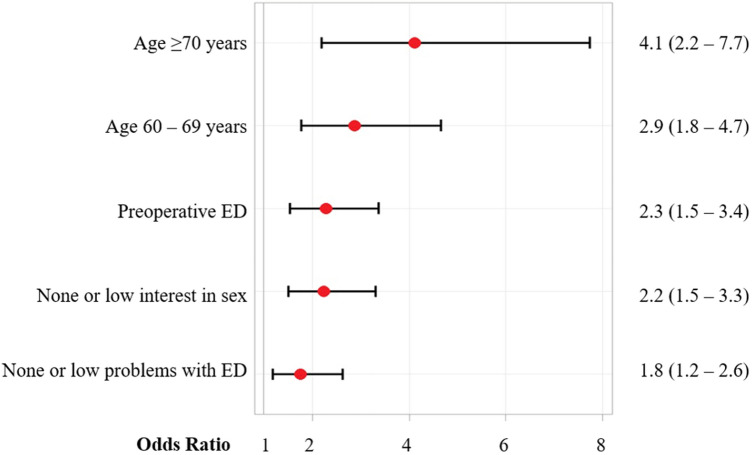
Median age at RP was 65 (IQR 60-69) years. 14% (134/936) used more than one pad per day for UI. 25% (26/104, 30 missing) of UI patients underwent surgery to improve continence. Of patients without surgery, 41% (31/75) reported a moderate-to-severe issue concerning their incontinence with worse mental health and QoL. 81% (755/936) patients were unable to have an erection firm enough for sexual intercourse. Of all ED patients, 40% (319/793) used ED treatment regularly or tried it at least once. 49% (243/499) of patients with interest in sex never tried ED treatment. In multivariate analysis, patients not using ED treatments were older (≥ 70 years OR 4.1), and more often had preoperative ED (OR 2.3) and less interest in sex (OR 2.2). Nevertheless, 30% (73/240) of these patients had moderate-to-severe issues with their ED reporting worse mental health and QoL.
Almost half of the patients without post-prostatectomy UI and ED treatment reported moderate-to-severe issues with a significant decrease in QoL. This indicates an insufficient utilisation of care in Germany.
治疗前列腺切除术后尿失禁(UI)和勃起功能障碍(ED)可提高生活质量(QoL)。我们的研究旨在评估德国前列腺切除术后 UI 和 ED 患者的护理利用情况。
HAROW 研究记录了德国局限性前列腺癌(≤T2c)患者的治疗情况。1260 名患者接受了根治性前列腺切除术(RP)。患者在中位随访 6.3 年后回答了经过验证的问卷。应答率为 76.8%。
RP 时的中位年龄为 65(IQR 60-69)岁。14%(134/936)每天使用超过一个尿垫用于 UI。25%(26/104,30 例缺失)的 UI 患者接受手术改善控尿。未手术的患者中,41%(31/75)报告其失禁问题中度至重度,心理健康和 QoL 更差。81%(755/936)的患者无法进行足够坚硬的勃起以进行性交。所有 ED 患者中,40%(319/793)定期使用 ED 治疗或至少尝试过一次。49%(243/499)有性兴趣的患者从未尝试过 ED 治疗。多变量分析显示,未使用 ED 治疗的患者年龄较大(≥70 岁 OR 4.1),术前 ED 更常见(OR 2.3),性兴趣较低(OR 2.2)。然而,这些患者中有 30%(73/240)报告其 ED 中度至重度,心理健康和 QoL 显著下降。
近一半未接受前列腺切除术后 UI 和 ED 治疗的患者报告存在中度至重度问题,生活质量显著下降。这表明德国护理的利用不足。