European Molecular Biology Laboratory (EMBL), Hamburg Outstation, Notkestrasse 85, 22607 Hamburg, Germany.
Unit for Structural Biology, Department of Biochemistry and Microbiology, Ghent University, Technologiepark-Zwijnaarde 71, 9052 Ghent, Belgium.
Acta Crystallogr D Struct Biol. 2020 Dec 1;76(Pt 12):1244-1255. doi: 10.1107/S2059798320013753. Epub 2020 Nov 24.
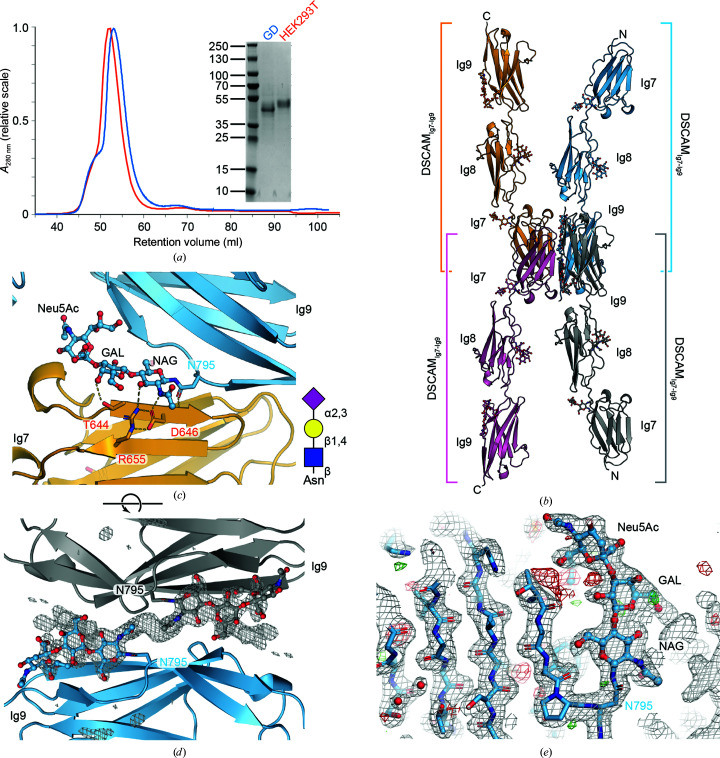
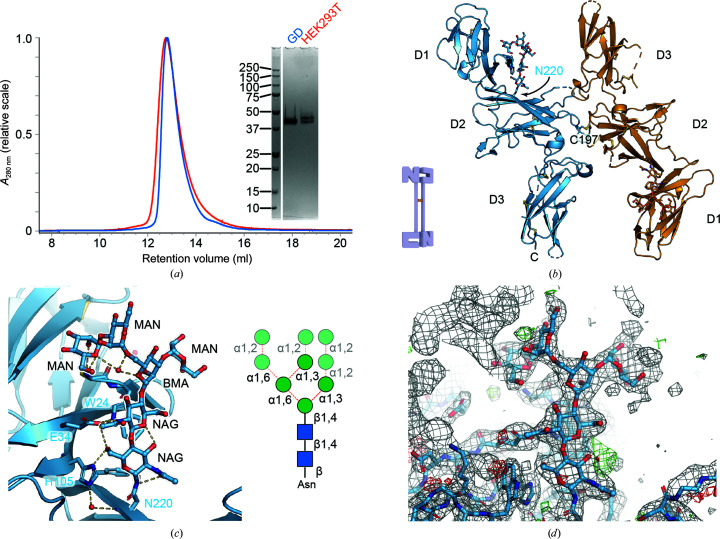
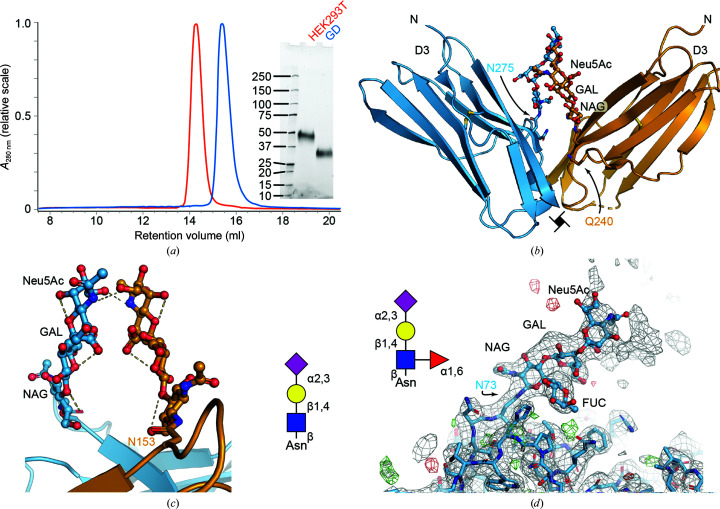
Structural studies of glycoproteins and their complexes provide critical insights into their roles in normal physiology and disease. Most glycoproteins contain N-linked glycosylation, a key post-translation modification that critically affects protein folding and stability and the binding kinetics underlying protein interactions. However, N-linked glycosylation is often an impediment to yielding homogeneous protein preparations for structure determination by X-ray crystallography or other methods. In particular, obtaining diffraction-quality crystals of such proteins and their complexes often requires modification of both the type of glycosylation patterns and their extent. Here, we demonstrate the benefits of producing target glycoproteins in the GlycoDelete human embryonic kidney 293 cell line that has been engineered to produce N-glycans as short glycan stumps comprising N-acetylglucosamine, galactose and sialic acid. Protein fragments of human Down syndrome cell-adhesion molecule and colony-stimulating factor 1 receptor were obtained from the GlycoDelete cell line for crystallization. The ensuing reduction in the extent and complexity of N-glycosylation in both protein molecules compared with alternative glycoengineering approaches enabled their productive deployment in structural studies by X-ray crystallography. Furthermore, a third successful implementation of the GlycoDelete technology focusing on murine IL-12B is shown to lead to N-glycosylation featuring an immature glycan in diffraction-quality crystals. It is proposed that the GlycoDelete cell line could serve as a valuable go-to option for the production of homogeneous glycoproteins and their complexes for structural studies by X-ray crystallography and cryo-electron microscopy.
糖蛋白及其复合物的结构研究为它们在正常生理和疾病中的作用提供了重要的见解。大多数糖蛋白都含有 N 连接糖基化,这是一种关键的翻译后修饰,它严重影响蛋白质的折叠和稳定性以及蛋白质相互作用的结合动力学。然而,N 连接糖基化通常是阻碍通过 X 射线晶体学或其他方法获得同质蛋白质制剂进行结构测定的一个障碍。特别是,获得此类蛋白质及其复合物的衍射质量晶体通常需要修饰糖基化类型及其程度。在这里,我们展示了在 GlycoDelete 人胚肾 293 细胞系中生产目标糖蛋白的好处,该细胞系经过工程改造,可产生短聚糖残基作为 N-乙酰葡萄糖胺、半乳糖和唾液酸的 N-糖。人唐氏综合征细胞黏附分子和集落刺激因子 1 受体的蛋白质片段从 GlycoDelete 细胞系中获得,用于结晶。与替代糖基工程方法相比,这两种蛋白质分子中 N-糖基化的程度和复杂性降低,使它们能够在 X 射线晶体学结构研究中得到有效利用。此外,还成功实施了第三次 GlycoDelete 技术,重点是鼠 IL-12B,导致在衍射质量晶体中具有不成熟聚糖的 N-糖基化。有人提出,GlycoDelete 细胞系可以作为生产同质糖蛋白及其复合物进行 X 射线晶体学和冷冻电子显微镜结构研究的有价值的首选方法。