Department of Global Public Health and Primary Care, University of Bergen, Bergen, Norway
Department of Global Public Health and Primary Care, University of Bergen, Bergen, Norway.
BMJ. 2020 Dec 2;371:m4060. doi: 10.1136/bmj.m4060.
To examine associations between birth defects and cancer from birth into adulthood.
Population based nested case-control study.
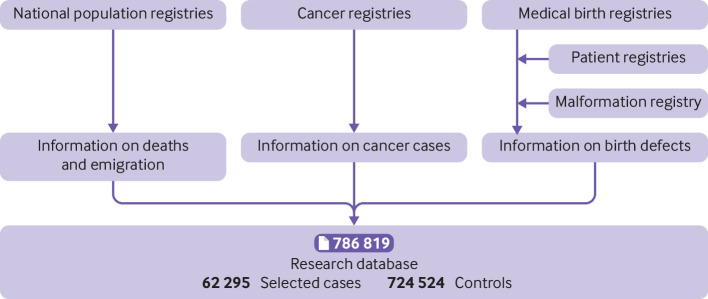
Nationwide health registries in Denmark, Finland, Norway, and Sweden.
62 295 cancer cases (0-46 years) and 724 542 frequency matched controls (matched on country and birth year), born between 1967 and 2014.
Relative risk of cancer in relation to major birth defects, estimated as odds ratios with 99% confidence intervals from logistic regression models.
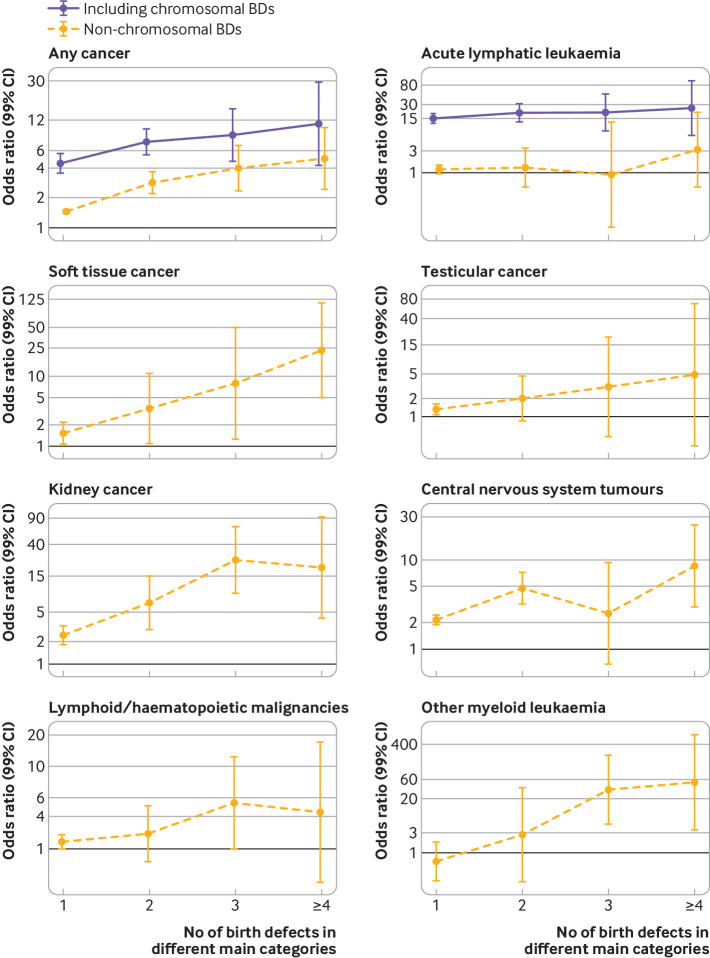
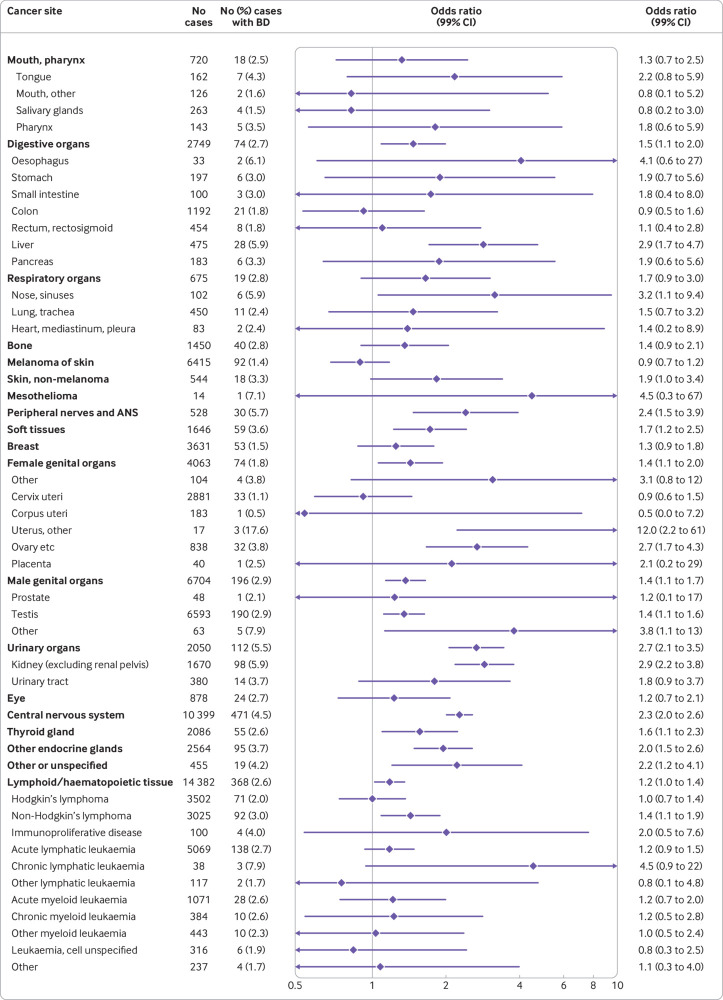
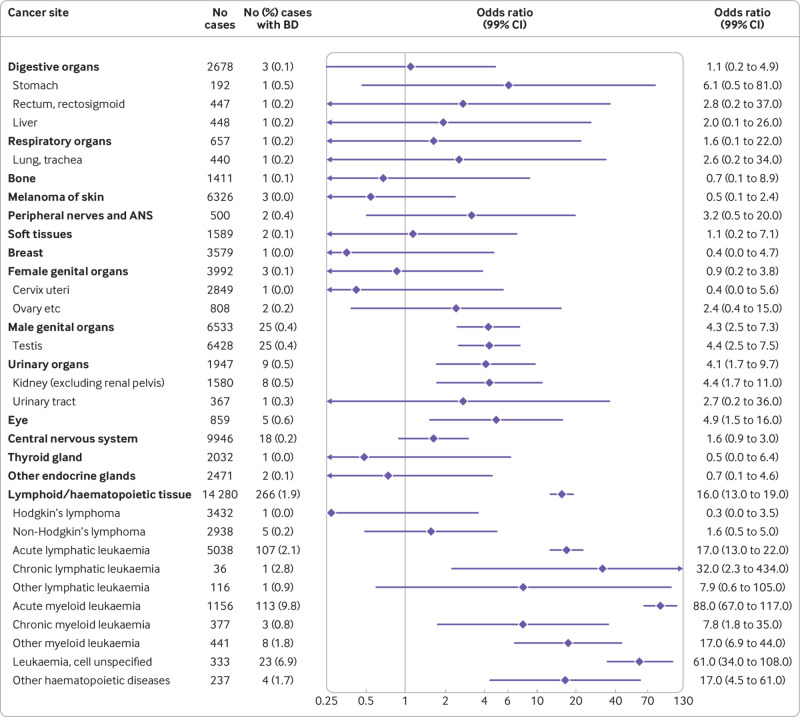
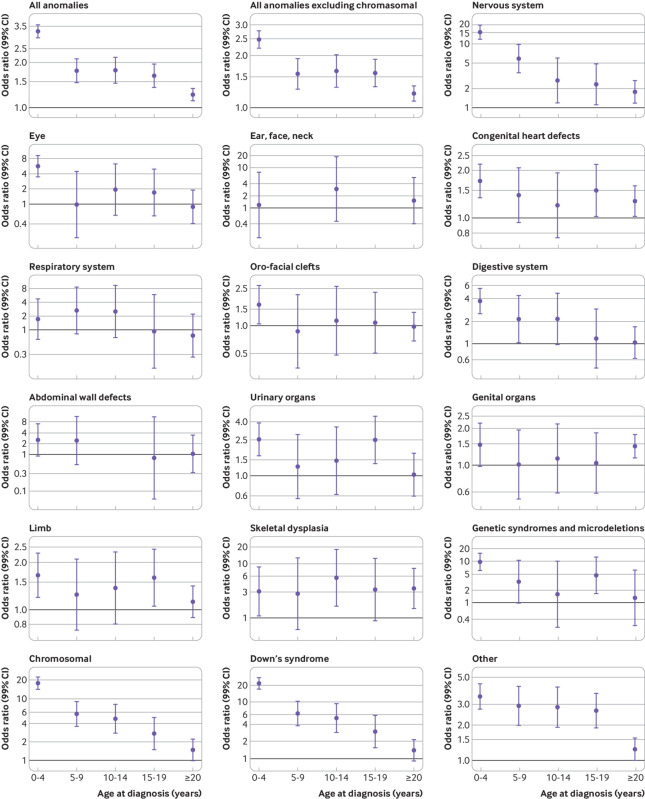
Altogether, 3.5% (2160/62 295) of cases and 2.2% (15 826/724 542) of controls were born with major birth defects. The odds ratio of cancer for people with major birth defects compared with those without was 1.74 (99% confidence interval 1.63 to 1.84). For individuals with non-chromosomal birth defects, the odds ratio of cancer was 1.54 (1.44 to 1.64); for those with chromosomal anomalies, the odds ratio was 5.53 (4.67 to 6.54). Many structural birth defects were associated with later cancer in the same organ system or anatomical location, such as defects of the eye, nervous system, and urinary organs. The odds ratio of cancer increased with number of defects and decreased with age, for both non-chromosomal and chromosomal anomalies. The odds ratio of cancer in people with any non-chromosomal birth defect was lower in adults (≥20 years: 1.21, 1.09 to 1.33) than in adolescents (15-19 years: 1.58, 1.31 to 1.90) and children (0-14 years: 2.03, 1.85 to 2.23). The relative overall cancer risk among adults with chromosomal anomalies was markedly reduced from 11.3 (9.35 to 13.8) in children to 1.50 (1.01 to 2.24). Among adults, skeletal dysplasia (odds ratio 3.54, 1.54 to 8.15), nervous system defects (1.76, 1.16 to 2.65), chromosomal anomalies (1.50, 1.01 to 2.24), genital organs defects (1.43, 1.14 to 1.78), and congenital heart defects (1.28, 1.02 to 1.59) were associated with overall cancer risk.
The increased risk of cancer in individuals with birth defects persisted into adulthood, both for non-chromosomal and chromosomal anomalies. Further studies on the molecular mechanisms involved are warranted.
研究出生缺陷与出生至成年期癌症之间的关联。
基于人群的巢式病例对照研究。
丹麦、芬兰、挪威和瑞典的全国健康登记处。
62295 例癌症病例(0-46 岁)和 724542 例频率匹配对照(按国家和出生年份匹配),出生于 1967 年至 2014 年之间。
主要出生缺陷与癌症的相对风险,采用 logistic 回归模型估计比值比及其 99%置信区间。
共有 3.5%(2160/62295)的病例和 2.2%(15826/724542)的对照出生时患有重大出生缺陷。与无出生缺陷者相比,有重大出生缺陷者罹患癌症的比值比为 1.74(99%置信区间 1.63 至 1.84)。非染色体出生缺陷者癌症的比值比为 1.54(1.44 至 1.64);染色体异常者为 5.53(4.67 至 6.54)。许多结构性出生缺陷与同一器官系统或解剖部位的后续癌症相关,如眼部、神经系统和泌尿系统缺陷。非染色体和染色体异常者的癌症比值比均随缺陷数量的增加而升高,随年龄的增长而降低。任何非染色体出生缺陷者的癌症比值比在成年期(≥20 岁:1.21,1.09 至 1.33)均低于青少年期(15-19 岁:1.58,1.31 至 1.90)和儿童期(0-14 岁:2.03,1.85 至 2.23)。成年期染色体异常者的总体癌症相对风险明显降低,从儿童期的 11.3(9.35 至 13.8)降至 1.50(1.01 至 2.24)。在成年人中,骨骼发育不良(比值比 3.54,1.54 至 8.15)、神经系统缺陷(1.76,1.16 至 2.65)、染色体异常(1.50,1.01 至 2.24)、生殖器官缺陷(1.43,1.14 至 1.78)和先天性心脏病(1.28,1.02 至 1.59)与总体癌症风险相关。
有出生缺陷者的癌症风险持续到成年期,非染色体和染色体异常者均如此。有必要进一步研究相关的分子机制。