Moghadas Seyed M, Vilches Thomas N, Zhang Kevin, Wells Chad R, Shoukat Affan, Singer Burton H, Meyers Lauren Ancel, Neuzil Kathleen M, Langley Joanne M, Fitzpatrick Meagan C, Galvani Alison P
Agent-Based Modelling Laboratory, York University, Toronto, Ontario, M3J 1P3 Canada.
Institute of Mathematics, Statistics and Scientific Computing, University of Campinas, Campinas SP, Brazil.
medRxiv. 2021 Jan 2:2020.11.27.20240051. doi: 10.1101/2020.11.27.20240051.
Global vaccine development efforts have been accelerated in response to the devastating COVID-19 pandemic. We evaluated the impact of a 2-dose COVID-19 vaccination campaign on reducing incidence, hospitalizations, and deaths in the United States (US).
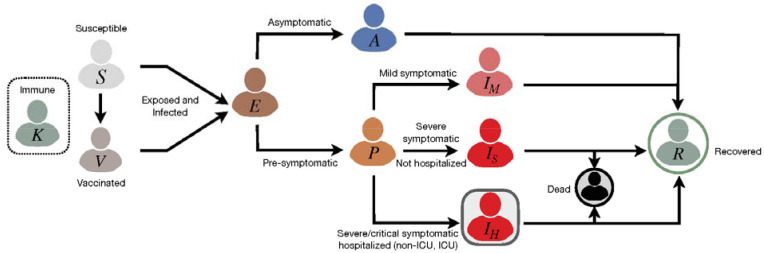
We developed an agent-based model of SARS-CoV-2 transmission and parameterized it with US demographics and age-specific COVID-19 outcomes. Healthcare workers and high-risk individuals were prioritized for vaccination, while children under 18 years of age were not vaccinated. We considered a vaccine efficacy of 95% against disease following 2 doses administered 21 days apart achieving 40% vaccine coverage of the overall population within 284 days. We varied vaccine efficacy against infection, and specified 10% pre-existing population immunity for the base-case scenario. The model was calibrated to an effective reproduction number of 1.2, accounting for current non-pharmaceutical interventions in the US.
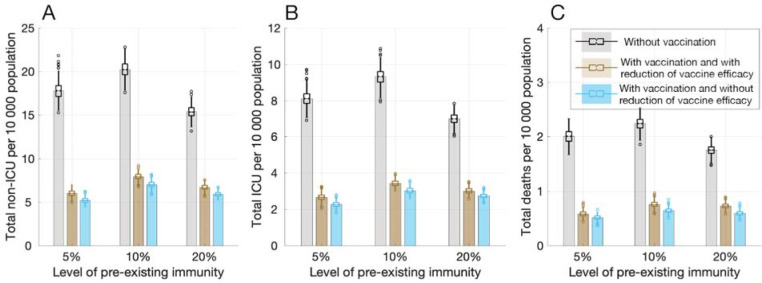
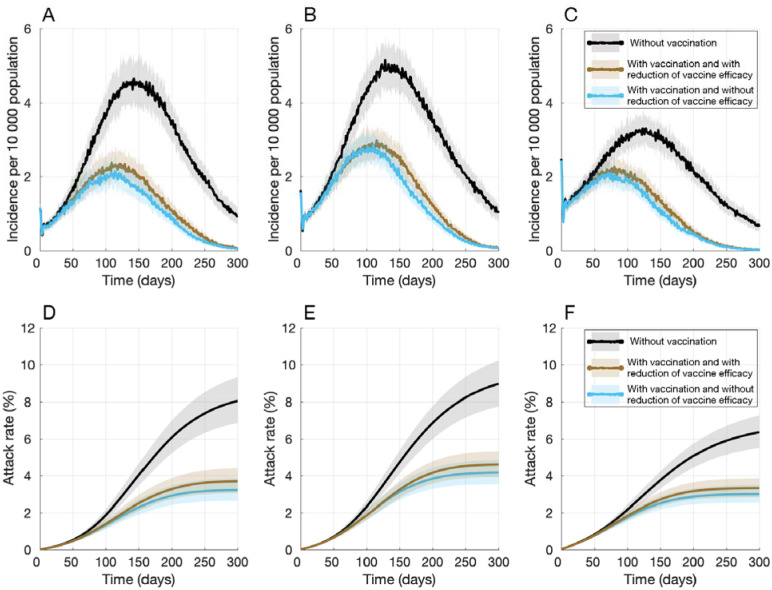
Vaccination reduced the overall attack rate to 4.6% (95% CrI: 4.3% - 5.0%) from 9.0% (95% CrI: 8.4% - 9.4%) without vaccination, over 300 days. The highest relative reduction (54-62%) was observed among individuals aged 65 and older. Vaccination markedly reduced adverse outcomes, with non-ICU hospitalizations, ICU hospitalizations, and deaths decreasing by 63.5% (95% CrI: 60.3% - 66.7%), 65.6% (95% CrI: 62.2% - 68.6%), and 69.3% (95% CrI: 65.5% - 73.1%), respectively, across the same period.
Our results indicate that vaccination can have a substantial impact on mitigating COVID-19 outbreaks, even with limited protection against infection. However, continued compliance with non-pharmaceutical interventions is essential to achieve this impact.
为应对毁灭性的新冠疫情,全球疫苗研发工作加速推进。我们评估了两剂新冠疫苗接种运动对降低美国新冠发病率、住院率和死亡率的影响。
我们构建了一个基于主体的新冠病毒传播模型,并根据美国人口统计学数据和特定年龄的新冠疫情结果对其进行参数化。医护人员和高危人群被优先接种疫苗,而18岁以下儿童未接种疫苗。我们考虑了间隔21天接种两剂疫苗后对疾病的疫苗效力为95%,在284天内实现总体人群40%的疫苗接种覆盖率。我们改变了疫苗对感染的效力,并在基线情景中设定了10%的人群既往免疫力。该模型根据美国当前的非药物干预措施校准为有效繁殖数1.2。
在300天内,接种疫苗使总体感染率从未接种疫苗时的9.0%(95%可信区间:8.4% - 9.4%)降至4.6%(95%可信区间:4.3% - 5.0%)。65岁及以上人群的相对降低率最高(54 - 62%)。接种疫苗显著降低了不良后果,同期非重症监护病房住院率、重症监护病房住院率和死亡率分别下降了63.5%(95%可信区间:60.3% - 66.7%)、65.6%(95%可信区间:62.2% - 68.6%)和69.3%(95%可信区间:65.5% - 73.1%)。
我们的结果表明,即使对感染的保护有限,接种疫苗也能对减轻新冠疫情产生重大影响。然而,持续遵守非药物干预措施对于实现这一影响至关重要。