Department of Medicine, Columbia University Irving Medical Center, New York, New York.
Herbert Irving Comprehensive Cancer Center, Columbia University Irving Medical Center, New York, New York.
JAMA Netw Open. 2020 Dec 1;3(12):e2026946. doi: 10.1001/jamanetworkopen.2020.26946.
Financial toxicity resulting from cancer care poses a substantial public health concern, leading some patients to turn to online crowdfunding. However, the practice may exacerbate existing socioeconomic cancer disparities by privileging those with access to interpersonal wealth and digital media literacy.
To test the hypotheses that higher county-level socioeconomic status and the presence (vs absence) of text indicators of beneficiary worth in campaign descriptions are associated with amount raised from cancer crowdfunding.
DESIGN, SETTING, AND PARTICIPANTS: This cross-sectional analysis examined US cancer crowdfunding campaigns conducted between 2010 and 2019 and data from the American Community Survey (2013-2017). Data analysis was performed from December 2019 to March 2020.
Neighborhood deprivation index of campaign location and campaign text features indicating the beneficiary's worth.
Amount of money raised.
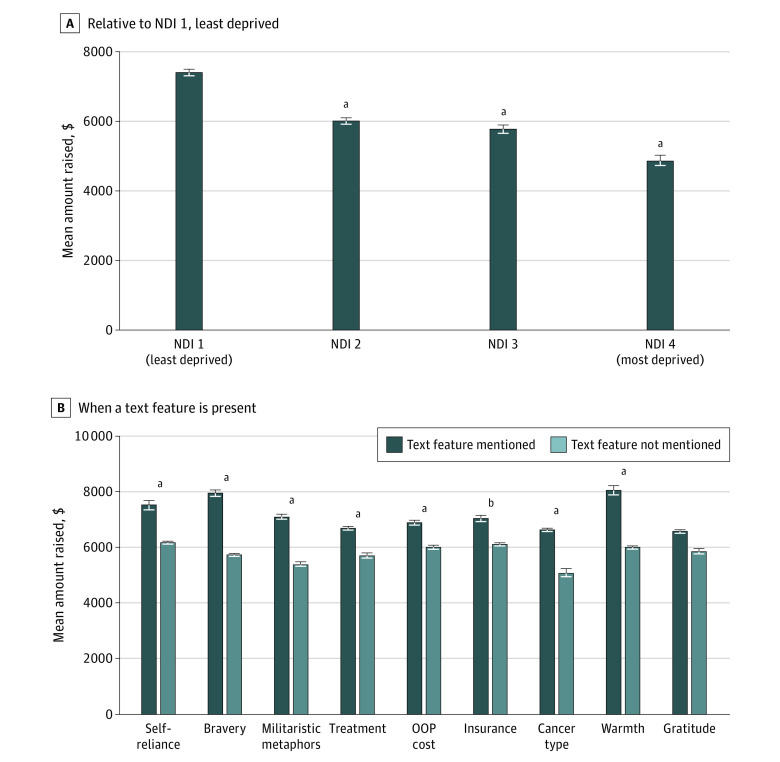
This study analyzed 144 061 US cancer crowdfunding campaigns. Campaigns in counties with higher neighborhood deprivation raised less (-26.07%; 95% CI, -27.46% to -24.65%; P < .001) than those in counties with less neighborhood deprivation. Campaigns raised more funds when legitimizing details were provided, including clinical details about the cancer type (9.58%; 95% CI, 8.00% to 11.18%; P < .001) and treatment type (6.58%; 95% CI, 5.44% to 7.79%; P < .001) and financial details, such as insurance status (1.39%; 95% CI, 0.20% to 2.63%; P = .02) and out-of-pocket costs (7.36%; 95% CI, 6.18% to 8.55%; P < .001). Campaigns raised more money when beneficiaries were described as warm (13.80%; 95% CI, 12.30% to 15.26%; P < .001), brave (15.40%; 95% CI, 14.11% to 16.65%; P < .001), or self-reliant (5.23%; 95% CI, 3.77% to 6.72%; P < .001).
These findings suggest that cancer crowdfunding success ay disproportionately benefit those in high-socioeconomic status areas and those with the internet literacy necessary to portray beneficiaries as worthy. By rewarding those with existing socioeconomic advantage, cancer crowdfunding may perpetuate socioeconomic disparities in cancer care access. The findings also underscore the widespread nature of financial toxicity resulting from cancer care.
癌症治疗带来的经济毒性是一个重大的公共卫生问题,导致一些患者求助于在线众筹。然而,这种做法可能会通过优先考虑那些有机会获得人际财富和数字媒体素养的人,从而加剧现有的社会经济癌症差异。
检验以下假设,即较高的县社会经济地位和活动描述中存在(与不存在相比)表明受益人价值的文本指标与癌症众筹的筹款金额有关。
设计、地点和参与者:这项横断面分析研究了美国在 2010 年至 2019 年间进行的癌症众筹活动以及美国社区调查(2013-2017 年)的数据。数据分析于 2019 年 12 月至 2020 年 3 月进行。
活动地点的社区剥夺指数和活动文本特征表明受益人的价值。
筹集的资金数额。
本研究分析了 144061 项美国癌症众筹活动。位于社区剥夺程度较高的县的活动筹集的资金较少(-26.07%;95%置信区间,-27.46%至-24.65%;P<0.001),而社区剥夺程度较低的县的活动筹集的资金较多。当提供合法化细节时,活动会筹集更多资金,包括癌症类型(8.00%至 11.18%;P<0.001)和治疗类型(5.44%至 7.79%;P<0.001)的临床细节以及财务细节,如保险状况(0.20%至 2.63%;P=0.02)和自付费用(6.18%至 8.55%;P<0.001)。当受益人被描述为热情(12.30%至 15.26%;P<0.001)、勇敢(14.11%至 16.65%;P<0.001)或自力更生(3.77%至 6.72%;P<0.001)时,活动会筹集更多资金。
这些发现表明,癌症众筹的成功可能会不成比例地使那些处于高社会经济地位地区的人和那些具有必要的互联网素养来描绘有价值的受益人的人受益。通过奖励那些具有现有社会经济优势的人,癌症众筹可能会使癌症护理获得方面的社会经济差异永久化。这些发现还强调了癌症护理导致经济毒性的普遍存在。