Instituto de Investigaciones Biomédicas Alberto Sols CSIC-UAM, 28029, Madrid, Spain.
Departamento de Bioquímica y Biología Molecular, Facultad de Medicina, Universidad Complutense de Madrid, Madrid, Spain.
Sci Rep. 2020 Dec 3;10(1):21043. doi: 10.1038/s41598-020-77992-1.
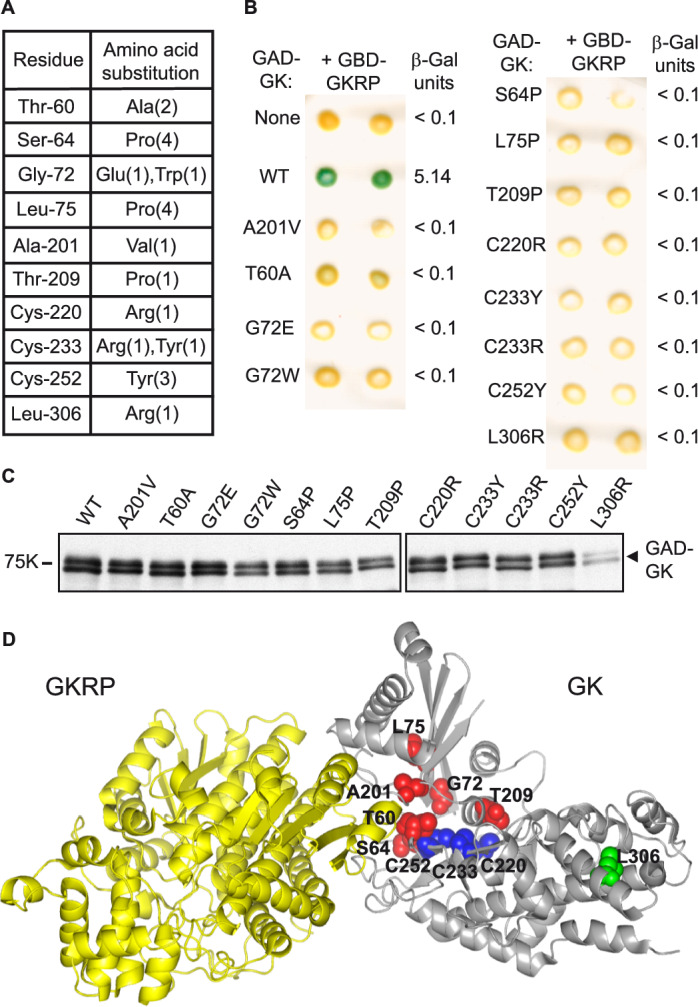
The reverse two-hybrid system is a powerful method to select mutations that disrupt the interaction between two proteins and therefore to identify the residues involved in this interaction. However, the usefulness of this technique has been limited by its relative complexity when compared to the classical two-hybrid system, since an additional selection step is required to eliminate the high background of uninformative truncation mutants. We have developed a new method that combines the classical and reverse two-hybrid systems to select loss-of-binding missense mutations in a single step. The strategy used to select against truncation mutants is based on the two-hybrid interaction between a C-terminal fusion peptide and the Tsg101 protein. We have applied this method to identify mutations in human glucokinase (GK) that disrupt glucokinase regulatory protein (GKRP) binding. Our results indicate that this method is very efficient and eliminates all the truncation mutants and false positives. The mutated residues identified in GK are involved in the GKRP binding interface or in stabilizing the super-open conformation of GK that binds GKRP. This technique offers an improvement over existing methods in terms of speed, efficiency and simplicity and can be used to study any detectable protein interaction in the two-hybrid system.
反向双杂交系统是一种强大的方法,用于选择破坏两个蛋白质之间相互作用的突变体,从而鉴定参与这种相互作用的残基。然而,与经典的双杂交系统相比,该技术的相对复杂性限制了其应用,因为需要额外的选择步骤来消除大量无信息的截短突变体的背景。我们开发了一种新的方法,将经典的和反向的双杂交系统结合起来,在单个步骤中选择结合缺失的错义突变体。用于选择截短突变体的策略基于 C 末端融合肽与 Tsg101 蛋白之间的双杂交相互作用。我们已经应用这种方法来鉴定人葡萄糖激酶(GK)中的突变,这些突变会破坏葡萄糖激酶调节蛋白(GKRP)的结合。我们的结果表明,该方法非常有效,消除了所有的截短突变体和假阳性。在 GK 中鉴定出的突变残基参与 GKRP 结合界面或稳定结合 GKRP 的超开放构象的GK。与现有方法相比,该技术在速度、效率和简单性方面都有所提高,可用于研究双杂交系统中任何可检测的蛋白质相互作用。