Medical Research Council Unit The Gambia at London School of Hygiene & Tropical Medicine, Fajara, The Gambia.
Department of Paediatrics: Child & Youth Health, University of Auckland, Auckland, New Zealand.
J Glob Health. 2020 Dec;10(2):020425. doi: 10.7189/jogh.10.020425.
Oxygen reduces mortality from severe pneumonia and is a vital part of case management, but achieving reliable access to oxygen is challenging in low and middle-income country (LMIC) settings. We developed and field tested two oxygen supply solutions suitable for the realities of LMIC health facilities.
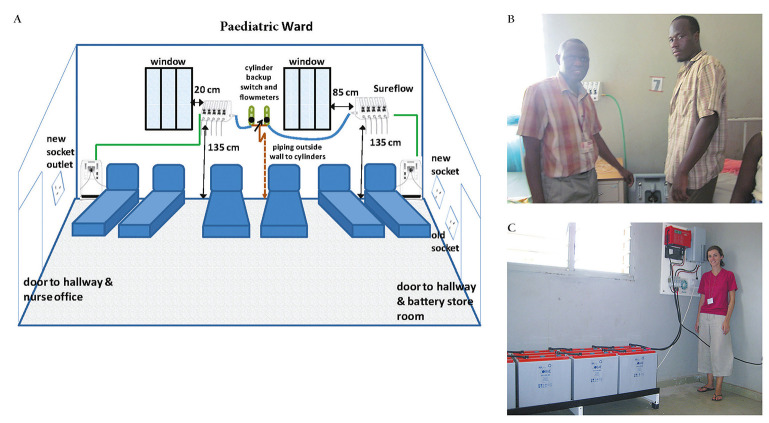
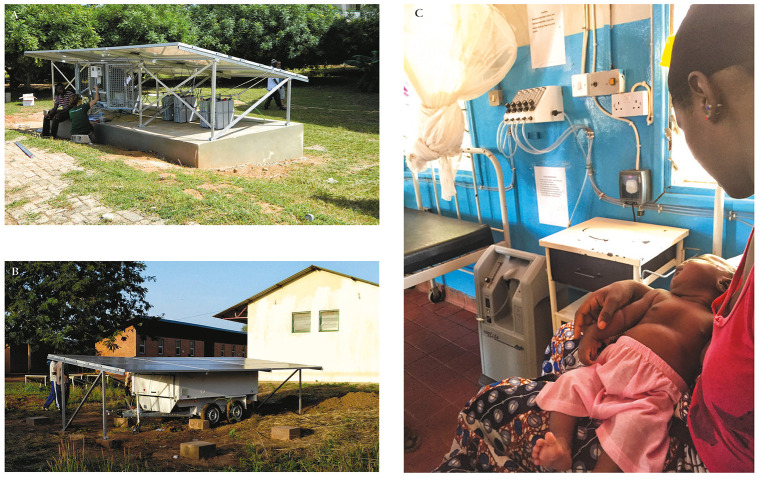
A Health Needs Assessment identified a technology gap preventing reliable oxygen supplies in Gambian hospitals. We used simultaneous engineering to develop two solutions: a Mains-Power Storage (Mains-PS) system consisting of an oxygen concentrator and batteries connected to mains power, and a Solar-Power Storage (Solar-PS) system (with batteries charged by photovoltaic panels) and evaluated them in health facilities in The Gambia and Fiji to assess reliability, usability and costs.
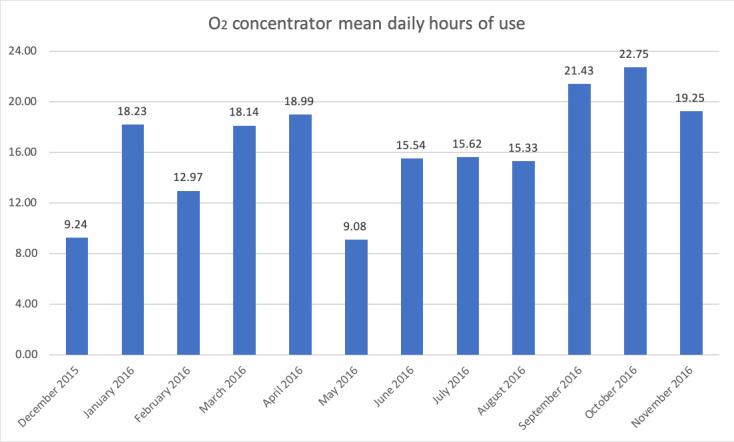
The Mains-PS system delivered the specified ≥85% (±3%) oxygen concentration in 100% of 1-2 weekly measurements over 12 months, which was available to 100% of hypoxaemic patients, and 100% of users rated ease-of-use as at least 'good' (90% very good or excellent). The Solar-PS system delivered ≥85% ± 3%) oxygen concentration in 100% of 1-2 weekly measurements, was available to 100% of patients needing oxygen, and 100% of users rated ease-of-use at least very good.Costs for the systems (in US dollars) were: PS$9519, Solar-PS standard version $20 718. The of oxygen for a standardised 30-bed health facility using 1.7 million litres of oxygen per year was: for cylinders 3.2 cents (c)/L in The Gambia and 6.8 c/L in Fiji, for the PS system 1.2 c/L in both countries, and for the Solar-PS system 1.5 c/L in both countries.
The oxygen systems developed and tested delivered high-quality, reliable, cost-efficient oxygen in LMIC contexts, and were easy to operate. Reliable oxygen supplies are achievable in LMIC health facilities like those in The Gambia and Fiji.
氧气可降低重症肺炎的死亡率,是病例管理的重要组成部分,但在中低收入国家(LMIC)的医疗环境中,可靠地获取氧气具有挑战性。我们开发并现场测试了两种适合 LMIC 卫生机构实际情况的供氧解决方案。
健康需求评估发现了一项阻止冈比亚医院可靠供氧的技术差距。我们采用同步工程开发了两种解决方案:一种是由氧气浓缩器和电池组成的主电源存储(Mains-PS)系统,连接到主电源;另一种是太阳能电源存储(Solar-PS)系统(由光伏板充电的电池),并在冈比亚和斐济的卫生设施中评估其可靠性、可用性和成本。
Mains-PS 系统在 12 个月的 1-2 周测量中,100%达到了规定的≥85%(±3%)氧气浓度,100%的低氧血症患者都能获得氧气,100%的用户将易用性评为至少“良好”(90%为很好或优秀)。Solar-PS 系统在 100%的 1-2 周测量中,100%达到了≥85%(±3%)氧气浓度,100%需要氧气的患者都能获得氧气,100%的用户将易用性评为至少很好。系统的成本(美元)为:PS$9519,标准 Solar-PS 版本$20718。一个标准的 30 张病床的卫生机构每年使用 170 万升氧气的成本为:冈比亚的钢瓶为 3.2 美分/升,斐济为 6.8 美分/升;PS 系统在两国均为 1.2 美分/升;Solar-PS 系统在两国均为 1.5 美分/升。
开发和测试的氧气系统在 LMIC 环境中提供了高质量、可靠、具有成本效益的氧气,且易于操作。冈比亚和斐济等 LMIC 卫生机构可以实现可靠的氧气供应。