Rakotomanana Hasina, Hildebrand Deana, Gates Gail E, Thomas David G, Fawbush Fanjaniaina, Stoecker Barbara J
Department of Nutritional Sciences, Oklahoma State University, Stillwater, OK, USA.
Department of Psychology, Oklahoma State University, Stillwater, OK, USA.
Curr Dev Nutr. 2020 Oct 20;4(11):nzaa162. doi: 10.1093/cdn/nzaa162. eCollection 2020 Nov.
Data are limited on how feeding knowledge and practices relate to child undernutrition in the highlands of Madagascar.
This study assessed maternal knowledge and practices of complementary feeding and their associations with anthropometrics of children aged 6-23 mo in the Vakinankaratra region of Madagascar.
Knowledge was assessed using WHO recommendations on child feeding, and WHO infant and young child feeding (IYCF) indicators were used to evaluate feeding practices. Child growth was measured as length-for-age, weight-for-age, and weight-for-length -scores using the 2006 WHO growth standards. A -score less than -2 was classified as child undernutrition. Logistic regression models were used to determine associations between independent variables and outcomes. Focus group discussions among mothers and in-depth interviews with key informants were conducted; barriers and facilitators of optimal feeding practices were identified using a thematic analysis approach.
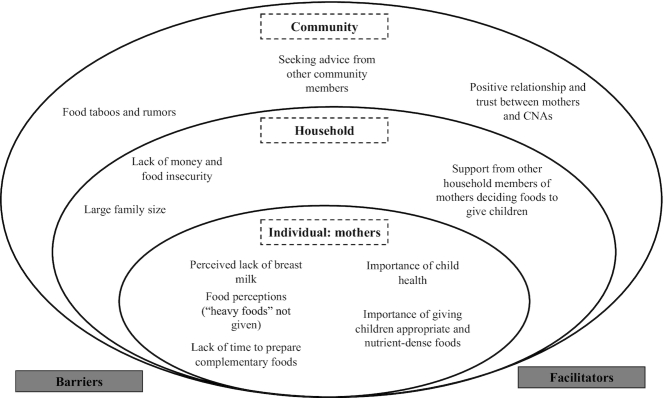
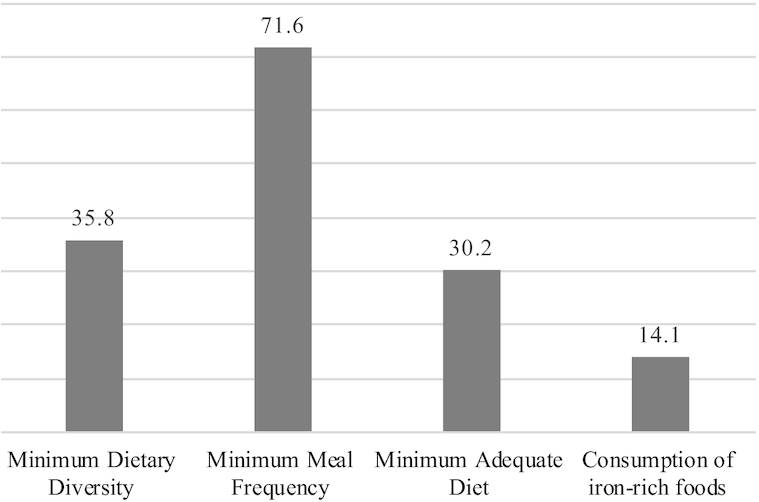
Maternal knowledge scores regarding child feeding averaged 6.4 of 11. Better knowledge scores were associated with higher odds of appropriate complementary feeding practices before and after covariate adjustments. The proportions of children achieving the minimum dietary diversity (35.8%), minimum acceptable diet (30.2%), and consuming meat, fish, and poultry (14.1%) were low. Only consumption of iron-rich foods was associated with lower odds of underweight (adjusted OR = 0.3; 95% CI: 0.1, 0.7; < 0.05). None of the IYCF indicators were associated significantly with stunting or wasting. Maternal attitudes about complementary foods, as well as mothers' workload and very low income, were identified as barriers to optimal feeding practices. Maternal perceived benefits of giving appropriate complementary foods as well as their positive relationship with the community health workers were the main facilitators of optimal child feeding.
Integrated nutrition-sensitive interventions addressing these barriers while enhancing the facilitators are critical in promoting better feeding practices in the Vakinankaratra region.
关于马达加斯加高地地区喂养知识和行为与儿童营养不良之间的关系,数据有限。
本研究评估了马达加斯加瓦基南卡拉特拉地区母亲们的辅食喂养知识和行为,以及它们与6至23个月儿童人体测量指标之间的关联。
使用世界卫生组织关于儿童喂养的建议评估知识,并使用世界卫生组织婴幼儿喂养(IYCF)指标评估喂养行为。采用2006年世界卫生组织生长标准,将儿童生长情况测量为年龄别身长、年龄别体重和身长别体重分数。分数低于-2被归类为儿童营养不良。使用逻辑回归模型确定自变量与结果之间的关联。开展了母亲们的焦点小组讨论以及对关键信息提供者的深入访谈;采用主题分析方法确定了最佳喂养行为的障碍和促进因素。
母亲们关于儿童喂养的知识得分平均为11分中的6.4分。在进行协变量调整前后,更好的知识得分与适当辅食喂养行为的较高几率相关。实现最低饮食多样性(35.8%)、最低可接受饮食(30.2%)以及食用肉类、鱼类和家禽(14.1%)的儿童比例较低。只有食用富含铁的食物与较低的体重不足几率相关(调整后的比值比=0.3;95%置信区间:0.1,0.7;P<0.05)。没有一项IYCF指标与发育迟缓或消瘦显著相关。母亲们对辅食喂养的态度,以及母亲们的工作量和极低的收入,被确定为最佳喂养行为的障碍。母亲们认为给予适当辅食的好处以及她们与社区卫生工作者的积极关系是最佳儿童喂养的主要促进因素。
在瓦基南卡拉特拉地区,综合开展解决这些障碍同时增强促进因素的营养敏感型干预措施,对于促进更好的喂养行为至关重要。