• 文献检索
  • 文档翻译
  • 深度研究
  • 学术资讯
  • Suppr Zotero 插件Zotero 插件
  • 邀请有礼
  • 套餐&价格
  • 历史记录
应用&插件
Suppr Zotero 插件Zotero 插件浏览器插件Mac 客户端Windows 客户端微信小程序
定价
高级版会员购买积分包购买API积分包
服务
文献检索文档翻译深度研究API 文档MCP 服务
关于我们
关于 Suppr公司介绍联系我们用户协议隐私条款
关注我们

Suppr 超能文献

核心技术专利:CN118964589B侵权必究
粤ICP备2023148730 号-1Suppr @ 2026

文献检索

告别复杂PubMed语法,用中文像聊天一样搜索,搜遍4000万医学文献。AI智能推荐,让科研检索更轻松。

立即免费搜索

文件翻译

保留排版,准确专业,支持PDF/Word/PPT等文件格式,支持 12+语言互译。

免费翻译文档

深度研究

AI帮你快速写综述,25分钟生成高质量综述,智能提取关键信息,辅助科研写作。

立即免费体验

用于小脑性共济失调患者客观上身部评估的综合方案。

A comprehensive scheme for the objective upper body assessments of subjects with cerebellar ataxia.

机构信息

School of Engineering, Deakin University, Pigdons Road, Waurn Ponds, VIC, 3220, Australia.

Florey Institute of Neuroscience and Mental Health, Royal Parade, Parkville, VIC, 3052, Australia.

出版信息

J Neuroeng Rehabil. 2020 Dec 4;17(1):162. doi: 10.1186/s12984-020-00790-3.

DOI:10.1186/s12984-020-00790-3
PMID:33276783
原文链接:https://pmc.ncbi.nlm.nih.gov/articles/PMC7718681/
Abstract

BACKGROUND

Cerebellar ataxia refers to the disturbance in movement resulting from cerebellar dysfunction. It manifests as inaccurate movements with delayed onset and overshoot, especially when movements are repetitive or rhythmic. Identification of ataxia is integral to the diagnosis and assessment of severity, and is important in monitoring progression and improvement. Ataxia is identified and assessed by clinicians observing subjects perform standardised movement tasks that emphasise ataxic movements. Our aim in this paper was to use data recorded from motion sensors worn while subjects performed these tasks, in order to make an objective assessment of ataxia that accurately modelled the clinical assessment.

METHODS

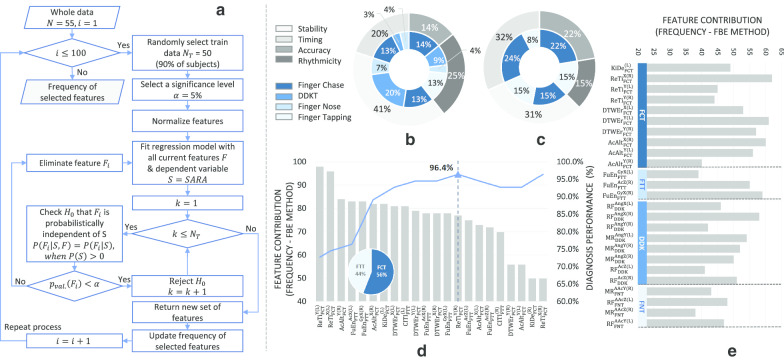
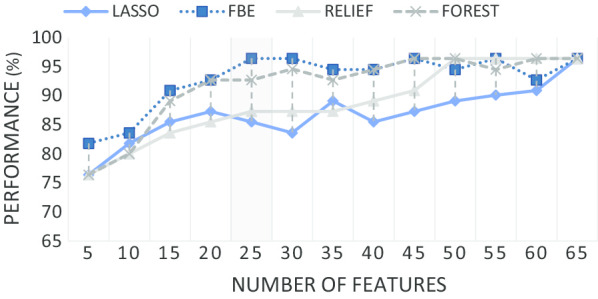
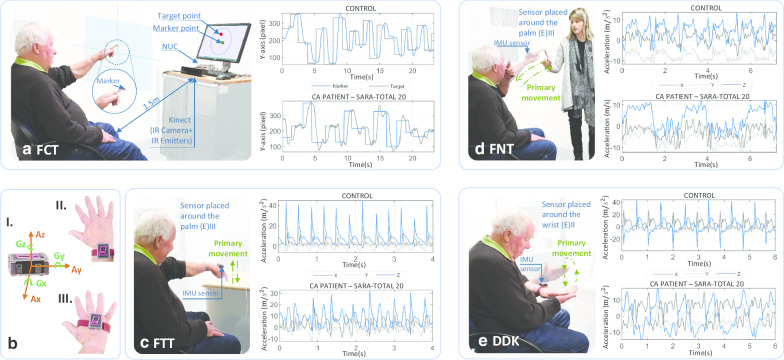
Inertial measurement units and a Kinect© system were used to record motion data while control and ataxic subjects performed four instrumented version of upper extremities tests, i.e. finger chase test (FCT), finger tapping test (FTT), finger to nose test (FNT) and dysdiadochokinesia test (DDKT). Kinematic features were extracted from this data and correlated with clinical ratings of severity of ataxia using the Scale for the Assessment and Rating of Ataxia (SARA). These features were refined using Feed Backward feature Elimination (the best performing method of four). Using several different learning models, including Linear Discrimination, Quadratic Discrimination Analysis, Support Vector Machine and K-Nearest Neighbour these extracted features were used to accurately discriminate between ataxics and control subjects. Leave-One-Out cross validation estimated the generalised performance of the diagnostic model as well as the severity predicting regression model.

RESULTS

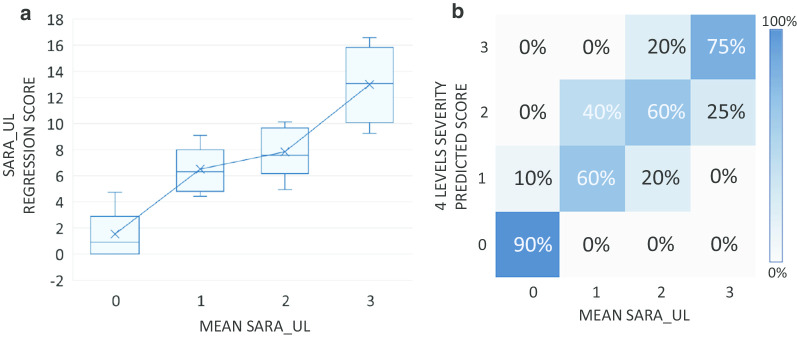
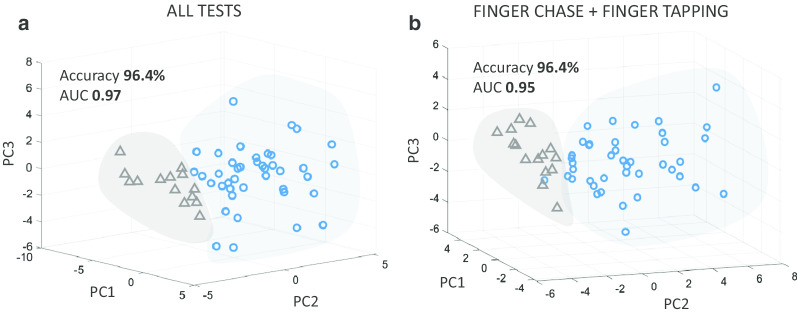
The selected model accurately ([Formula: see text]) predicted the clinical scores for ataxia and correlated well with clinical scores of the severity of ataxia ([Formula: see text], [Formula: see text]). The severity estimation was also considered in a 4-level scale to provide a rating that is familiar to the current clinically-used rating of upper limb impairments. The combination of FCT and FTT performed as well as all four test combined in predicting the presence and severity of ataxia.

CONCLUSION

Individual bedside tests can be emulated using features derived from sensors worn while bedside tests of cerebellar ataxia were being performed. Each test emphasises different aspects of stability, timing, accuracy and rhythmicity of movements. Using the current models it is possible to model the clinician in identifying ataxia and assessing severity but also to identify those test which provide the optimum set of data. Trial registration Human Research and Ethics Committee, Royal Victorian Eye and Ear Hospital, East Melbourne, Australia (HREC Reference Number: 11/994H/16).
https://cdn.ncbi.nlm.nih.gov/pmc/blobs/b143/7718681/bf98d0779626/12984_2020_790_Fig5_HTML.jpg
https://cdn.ncbi.nlm.nih.gov/pmc/blobs/b143/7718681/02fecbd93317/12984_2020_790_Fig1_HTML.jpg
https://cdn.ncbi.nlm.nih.gov/pmc/blobs/b143/7718681/7515d342014d/12984_2020_790_Fig2_HTML.jpg
https://cdn.ncbi.nlm.nih.gov/pmc/blobs/b143/7718681/f80ea612a3df/12984_2020_790_Fig3_HTML.jpg
https://cdn.ncbi.nlm.nih.gov/pmc/blobs/b143/7718681/bcd6f6c6d949/12984_2020_790_Fig4_HTML.jpg
https://cdn.ncbi.nlm.nih.gov/pmc/blobs/b143/7718681/bf98d0779626/12984_2020_790_Fig5_HTML.jpg
https://cdn.ncbi.nlm.nih.gov/pmc/blobs/b143/7718681/02fecbd93317/12984_2020_790_Fig1_HTML.jpg
https://cdn.ncbi.nlm.nih.gov/pmc/blobs/b143/7718681/7515d342014d/12984_2020_790_Fig2_HTML.jpg
https://cdn.ncbi.nlm.nih.gov/pmc/blobs/b143/7718681/f80ea612a3df/12984_2020_790_Fig3_HTML.jpg
https://cdn.ncbi.nlm.nih.gov/pmc/blobs/b143/7718681/bcd6f6c6d949/12984_2020_790_Fig4_HTML.jpg
https://cdn.ncbi.nlm.nih.gov/pmc/blobs/b143/7718681/bf98d0779626/12984_2020_790_Fig5_HTML.jpg
摘要

背景

小脑性共济失调是指由于小脑功能障碍导致的运动障碍。其表现为动作不准确,起始延迟且过度,尤其是在重复或有节奏的运动时。识别共济失调是诊断和评估严重程度的重要组成部分,对于监测进展和改善也很重要。临床医生通过观察患者进行标准运动任务来识别和评估共济失调,这些任务强调共济失调运动。我们的目的是使用运动传感器记录的运动数据来进行客观的评估,以准确地模拟临床评估。

方法

惯性测量单元和 Kinect©系统用于记录运动数据,同时控制和共济失调患者进行四个上肢仪器测试的变体,即手指追逐测试(FCT)、手指敲击测试(FTT)、手指触鼻测试(FNT)和动觉震颤测试(DDKT)。从这些数据中提取运动学特征,并使用共济失调评估和评分量表(SARA)将其与临床评估的共济失调严重程度评分相关联。使用反馈特征消除(四种最佳性能方法之一)对这些特征进行了优化。使用几种不同的学习模型,包括线性判别分析、二次判别分析、支持向量机和 K-最近邻,使用这些提取的特征准确地区分了共济失调患者和对照组。留一法交叉验证估计了诊断模型的泛化性能和严重程度预测回归模型。

结果

所选模型准确地([公式:见文本])预测了共济失调的临床评分,并与共济失调严重程度的临床评分高度相关([公式:见文本],[公式:见文本])。严重程度估计也在四级量表中进行,以提供熟悉的上肢损伤当前临床使用评分的评级。FCT 和 FTT 的组合在预测共济失调的存在和严重程度方面与所有四个测试的组合一样有效。

结论

使用佩戴在执行小脑共济失调床边测试时获得的传感器得出的特征,可以模拟单个床边测试。每个测试都强调运动的稳定性、时间、准确性和节律性的不同方面。使用当前模型,可以模拟临床医生识别共济失调和评估严重程度的能力,还可以识别提供最佳数据集的测试。

试验注册

澳大利亚皇家维多利亚眼耳医院人类研究和伦理委员会(墨尔本东部,HREC 参考号:11/994H/16)。

相似文献

1
A comprehensive scheme for the objective upper body assessments of subjects with cerebellar ataxia.用于小脑性共济失调患者客观上身部评估的综合方案。
J Neuroeng Rehabil. 2020 Dec 4;17(1):162. doi: 10.1186/s12984-020-00790-3.
2
Quantitative assessment of cerebellar ataxia, through automated limb functional tests.通过自动化肢体功能测试对小脑性共济失调进行定量评估。
J Neuroeng Rehabil. 2019 Feb 27;16(1):31. doi: 10.1186/s12984-019-0490-3.
3
Instrumented Objective Clinical Examination of Cerebellar Ataxia: the Upper and Lower Limb-a Review.小脑性共济失调的仪器化客观临床检查:上肢和下肢综述
Cerebellum. 2022 Feb;21(1):145-158. doi: 10.1007/s12311-021-01253-8. Epub 2021 Apr 14.
4
Quantitative Evaluation of Cerebellar Ataxia Through Automated Assessment of Upper Limb Movements.通过自动评估上肢运动对小脑性共济失调进行定量评估。
IEEE Trans Neural Syst Rehabil Eng. 2019 May;27(5):1081-1091. doi: 10.1109/TNSRE.2019.2911657. Epub 2019 Apr 16.
5
Objective Assessment of Upper-Extremity Motor Functions in Spinocerebellar Ataxia Using Wearable Sensors.使用可穿戴传感器对小脑脊髓病的上肢运动功能进行客观评估。
Sensors (Basel). 2022 Oct 20;22(20):7993. doi: 10.3390/s22207993.
6
Multimodal Data Acquisition for the Assessment of Cerebellar Ataxia via Ballistic Tracking.通过弹道跟踪评估小脑共济失调的多模态数据采集
Annu Int Conf IEEE Eng Med Biol Soc. 2020 Jul;2020:859-862. doi: 10.1109/EMBC44109.2020.9176379.
7
Automated Evaluation of Upper Limb Motor Impairment of Patient with Cerebellar Ataxia.小脑共济失调患者上肢运动障碍的自动化评估
Annu Int Conf IEEE Eng Med Biol Soc. 2019 Jul;2019:6846-6849. doi: 10.1109/EMBC.2019.8856330.
8
15-White Dots APP-Coo-Test: a reliable touch-screen application for assessing upper limb movement impairment in patients with cerebellar ataxias.15-White Dots APP-Coo-Test:一种可靠的触屏应用,用于评估小脑性共济失调患者上肢运动障碍。
J Neurol. 2019 Jul;266(7):1611-1622. doi: 10.1007/s00415-019-09299-9. Epub 2019 Apr 6.
9
Characteristics of Handwriting of People With Cerebellar Ataxia: Three-Dimensional Movement Analysis of the Pen Tip, Finger, and Wrist.小脑共济失调患者笔迹的特征:笔尖、手指和手腕的三维运动分析
Phys Ther. 2015 Nov;95(11):1547-58. doi: 10.2522/ptj.20140118. Epub 2015 May 7.
10
Automated Finger Chase (ballistic tracking) in the Assessment of Cerebellar Ataxia.小脑共济失调评估中的自动手指追踪(弹道追踪)
Annu Int Conf IEEE Eng Med Biol Soc. 2018 Jul;2018:3521-3524. doi: 10.1109/EMBC.2018.8513036.

引用本文的文献

1
Contrastive Learning Model for Wearable-based Ataxia Assessment.基于可穿戴设备的共济失调评估的对比学习模型
medRxiv. 2025 Mar 4:2025.02.28.25323114. doi: 10.1101/2025.02.28.25323114.
2
Remote assessment of cognition in Parkinson's disease and Cerebellar Ataxia: the MoCA test in English and Hebrew.帕金森病和小脑共济失调认知功能的远程评估:英文和希伯来文版的蒙特利尔认知评估量表测试
Front Hum Neurosci. 2024 Jan 8;17:1325215. doi: 10.3389/fnhum.2023.1325215. eCollection 2023.
3
Real-life ankle submovements and computer mouse use reflect patient-reported function in adult ataxias.

本文引用的文献

1
The Cerebro-Cerebellum as a Locus of Forward Model: A Review.作为前向模型位点的大脑小脑:综述
Front Syst Neurosci. 2020 Apr 9;14:19. doi: 10.3389/fnsys.2020.00019. eCollection 2020.
2
Development of SaraHome: A novel, well-accepted, technology-based assessment tool for patients with ataxia.萨拉家园的开发:一种新颖的、广受欢迎的基于技术的共济失调患者评估工具。
Comput Methods Programs Biomed. 2020 May;188:105257. doi: 10.1016/j.cmpb.2019.105257. Epub 2019 Dec 2.
3
Quantitative Evaluation of Cerebellar Ataxia Through Automated Assessment of Upper Limb Movements.
现实生活中的踝关节子运动和电脑鼠标使用情况反映了成人共济失调患者自我报告的功能。
Brain Commun. 2023 Mar 13;5(2):fcad064. doi: 10.1093/braincomms/fcad064. eCollection 2023.
4
Assessment of movement disorders using wearable sensors during upper limb tasks: A scoping review.上肢任务期间使用可穿戴传感器评估运动障碍:一项范围综述。
Front Robot AI. 2023 Jan 9;9:1068413. doi: 10.3389/frobt.2022.1068413. eCollection 2022.
5
Objective Assessment of Upper-Extremity Motor Functions in Spinocerebellar Ataxia Using Wearable Sensors.使用可穿戴传感器对小脑脊髓病的上肢运动功能进行客观评估。
Sensors (Basel). 2022 Oct 20;22(20):7993. doi: 10.3390/s22207993.
6
Cognitive, perceptual, and motor profiles of school-aged children with developmental coordination disorder.患有发育性协调障碍的学龄儿童的认知、感知和运动特征。
Front Psychol. 2022 Aug 3;13:860766. doi: 10.3389/fpsyg.2022.860766. eCollection 2022.
7
Automatic Classification and Severity Estimation of Ataxia From Finger Tapping Videos.基于手指敲击视频的共济失调自动分类与严重程度评估
Front Neurol. 2022 Feb 28;12:795258. doi: 10.3389/fneur.2021.795258. eCollection 2021.
8
International Classification of Functioning, Disability, and Health augmented by telemedicine and artificial intelligence for assessment of functional disability.通过远程医疗和人工智能增强的《国际功能、残疾和健康分类》用于评估功能残疾。
J Family Med Prim Care. 2021 Oct;10(10):3535-3539. doi: 10.4103/jfmpc.jfmpc_692_21. Epub 2021 Nov 5.
9
Kinematic Evaluation via Inertial Measurement Unit Associated with Upper Extremity Motor Function in Subacute Stroke: A Cross-Sectional Study.惯性测量单元与亚急性脑卒中上肢运动功能的运动学评估:一项横断面研究。
J Healthc Eng. 2021 Aug 19;2021:4071645. doi: 10.1155/2021/4071645. eCollection 2021.
通过自动评估上肢运动对小脑性共济失调进行定量评估。
IEEE Trans Neural Syst Rehabil Eng. 2019 May;27(5):1081-1091. doi: 10.1109/TNSRE.2019.2911657. Epub 2019 Apr 16.
4
Quantitative assessment of cerebellar ataxia, through automated limb functional tests.通过自动化肢体功能测试对小脑性共济失调进行定量评估。
J Neuroeng Rehabil. 2019 Feb 27;16(1):31. doi: 10.1186/s12984-019-0490-3.
5
Instrumented finger-to-nose test classification in children with ataxia or developmental coordination disorder and controls.共济失调或发育性协调障碍儿童及对照组的仪器化指鼻试验分类
Clin Biomech (Bristol). 2018 Dec;60:51-59. doi: 10.1016/j.clinbiomech.2018.10.007. Epub 2018 Oct 6.
6
Quantification of Axial Abnormality Due to Cerebellar Ataxia with Inertial Measurements.基于惯性测量的小脑性共济失调轴向异常量化。
Sensors (Basel). 2018 Aug 24;18(9):2791. doi: 10.3390/s18092791.
7
Benchmarking relief-based feature selection methods for bioinformatics data mining.基于基准的特征选择方法在生物信息学数据挖掘中的应用。
J Biomed Inform. 2018 Sep;85:168-188. doi: 10.1016/j.jbi.2018.07.015. Epub 2018 Jul 17.
8
BioKin: an ambulatory platform for gait kinematic and feature assessment.BioKin:一个用于步态运动学和特征评估的动态平台。
Healthc Technol Lett. 2015 Feb 25;2(1):40-5. doi: 10.1049/htl.2014.0094. eCollection 2015 Feb.
9
A statistical characterization of the finger tapping test: modeling, estimation, and applications.手指敲击测试的统计学特征描述:建模、估计与应用。
IEEE J Biomed Health Inform. 2015 Mar;19(2):501-7. doi: 10.1109/JBHI.2014.2384911. Epub 2014 Dec 22.
10
Quantitative evaluation of functional limitation of upper limb movements in subjects affected by ataxia.共济失调患者上肢运动功能受限的定量评估
Eur J Neurol. 2009 Feb;16(2):232-9. doi: 10.1111/j.1468-1331.2008.02396.x.