Clinic for Horses, University of Veterinary Medicine Hannover, Foundation, Hanover, Germany.
Institute of Animal Science, Faculty of Agricultural Sciences, University of Hohenheim, Stuttgart, Germany.
J Vet Intern Med. 2021 Jan;35(1):597-605. doi: 10.1111/jvim.15992. Epub 2020 Dec 5.
Little is known about the implications of hyperinsulinemia on energy metabolism, and such knowledge might help understand the pathophysiology of insulin dysregulation.
Describe differences in the metabolic response to an oral glucose test, depending on the magnitude of the insulin response.
Twelve Icelandic horses in various metabolic states.
Horses were subjected to 3 oral glucose tests (OGT; 0.5 g/kg body weight glucose). Basal, 120 and 180 minutes samples were analyzed using a combined liquid chromatography tandem mass spectrometry and flow injection analysis tandem mass spectrometry metabolomic assay. Insulin concentrations were measured using an ELISA. Analysis was performed using linear models and partial least-squares regression.
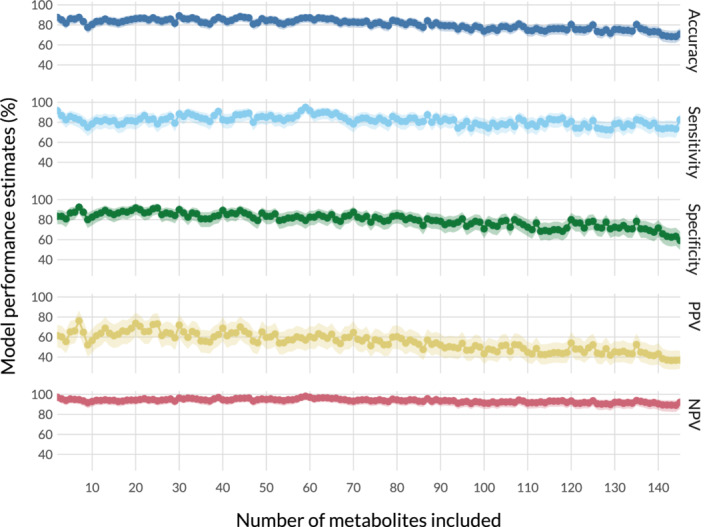
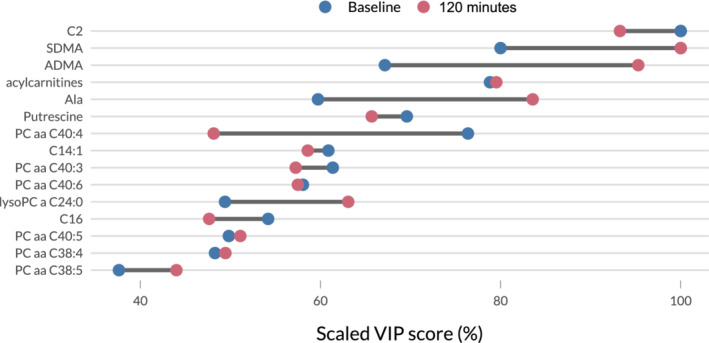
The kynurenine : tryptophan ratio increased over time during the OGT (adjusted P-value = .001). A high insulin response was associated with lower arginine (adjusted P-value = .02) and carnitine (adjusted P-value = .03) concentrations. A predictive model using only baseline samples performed well with as few as 7 distinct metabolites (sensitivity, 86%; 95% confidence interval [CI], 81%-90%; specificity, 88%; 95% CI, 84%-92%).
Our results suggest induction of low-grade inflammation during the OGT. Plasma arginine and carnitine concentrations were lower in horses with high insulin response and could constitute potential therapeutic targets. Development of screening tools to identify insulin-dysregulated horses using only baseline blood sample appears promising.
关于高胰岛素血症对能量代谢的影响知之甚少,而这些知识可能有助于理解胰岛素失调的病理生理学。
描述口服葡萄糖耐量试验(OGT)中代谢反应的差异,取决于胰岛素反应的程度。
处于不同代谢状态的 12 匹冰岛马。
对 12 匹冰岛马进行了 3 次口服葡萄糖耐量试验(OGT;0.5 g/kg 体重葡萄糖)。使用液相色谱串联质谱和流动注射分析串联质谱代谢组学分析方法分析基础、120 和 180 分钟的样本。使用 ELISA 测量胰岛素浓度。使用线性模型和偏最小二乘回归进行分析。
在 OGT 过程中,犬尿氨酸:色氨酸比值随时间增加(调整后的 P 值=0.001)。高胰岛素反应与较低的精氨酸(调整后的 P 值=0.02)和肉碱(调整后的 P 值=0.03)浓度相关。仅使用基线样本的预测模型表现良好,只需 7 种不同的代谢物(敏感性,86%;95%置信区间[CI],81%-90%;特异性,88%;95%CI,84%-92%)。
我们的结果表明,在 OGT 期间诱导低度炎症。高胰岛素反应马的血浆精氨酸和肉碱浓度较低,可能构成潜在的治疗靶点。使用仅基线血样开发识别胰岛素失调马的筛选工具似乎很有前景。