School of Veterinary Science, The University of Queensland, Gatton, Queensland, Australia.
Pferdeklinik SaarLorLux GmbH, Altforweiler, Germany.
J Vet Intern Med. 2023 Mar;37(2):703-712. doi: 10.1111/jvim.16650. Epub 2023 Feb 25.
Sirolimus, a mechanistic target of rapamycin inhibitor, suppresses insulin production in other species and has therapeutic potential for hyperinsulinemia in horses.
HYPOTHESIS/OBJECTIVE: Determine the pharmacokinetics (PKs) of sirolimus and evaluate its effect on insulin dynamics in healthy and insulin dysregulation (ID) horses.
Eight Standardbred geldings.
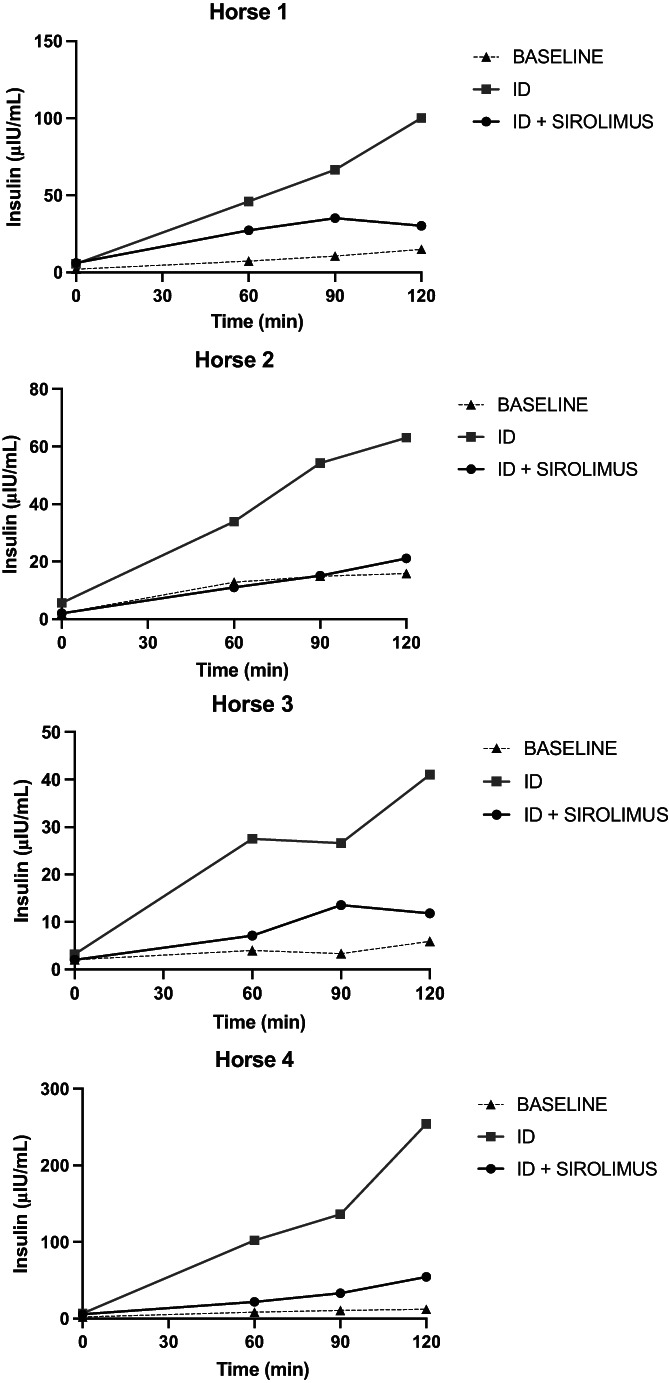
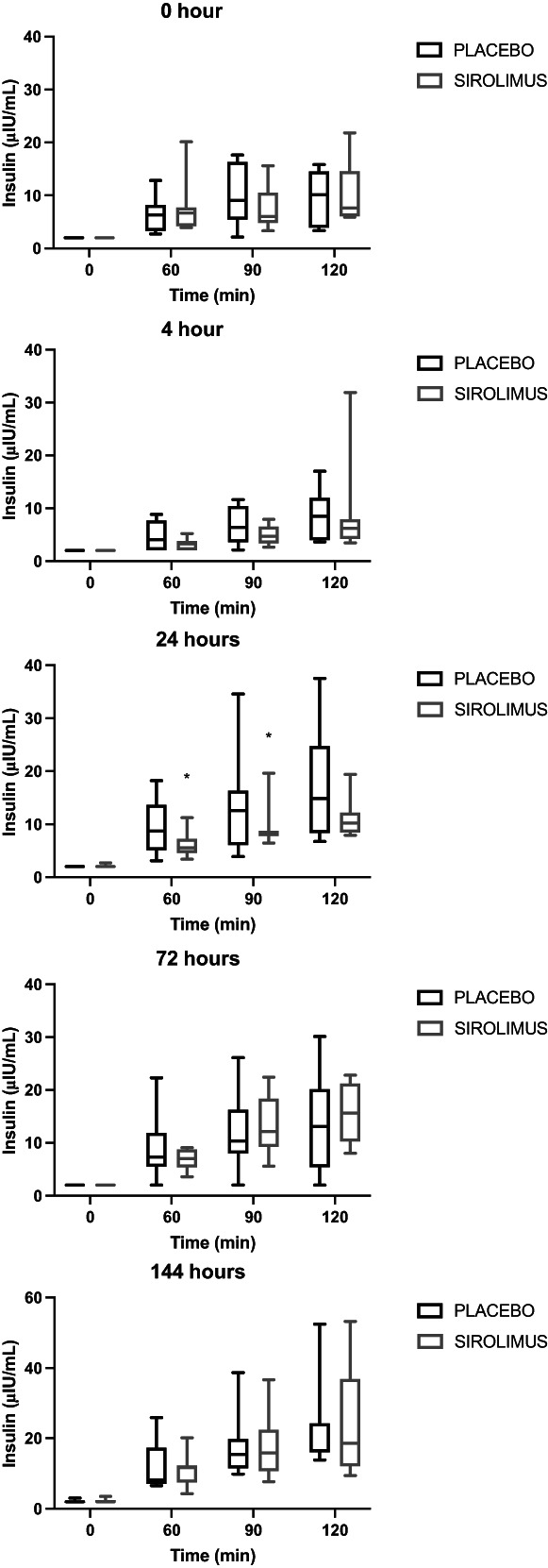
A PK study was performed followed by a placebo-controlled, randomized, crossover study. Blood sirolimus concentrations were measured by liquid chromatography-mass-spectrometry. PK indices were estimated by fitting a 2-compartment model using nonlinear least squares regression. An oral glucose test (OGT) was conducted before and 4, 24, 72, and 144 hours after administration of sirolimus or placebo. Effects of time, treatment and animal on blood glucose and insulin concentrations were analyzed using mixed-effects linear regression. Sirolimus was then administered to 4 horses with dexamethasone-induced ID and an OGT was performed at baseline, after ID induction and after 7 days of treatment.
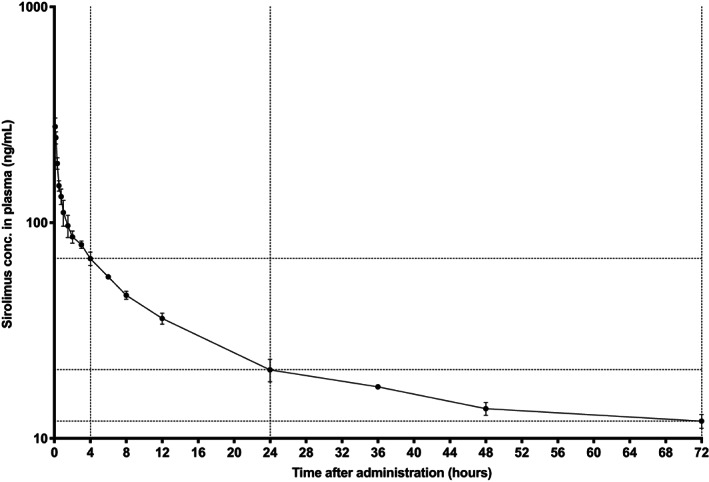
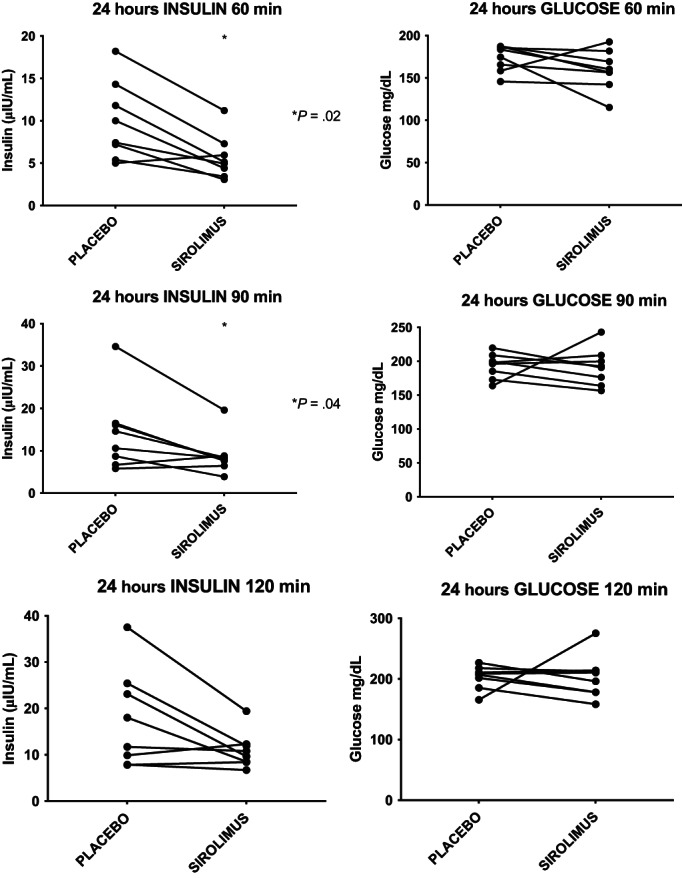
Median (range) maximum sirolimus concentration was 277.0 (247.5-316.06) ng/mL at 5 (5-10) min and half-life was 3552 (3248-4767) min. Mean (range) oral bioavailability was 9.5 (6.8-12.4)%. Sirolimus had a significant effect on insulin concentration 24 hours after a single dose: median (interquartile range) insulin at 60 min (5.0 [3.7-7.0] μIU/mL) was 37 (-5 to 54)% less than placebo (8.7 [5.8-13.7] μIU/mL, P = .03); and at 120 min (10.2 [8.4-12.2] μIU/mL) was 28 (-15 to 53)% less than placebo (14.9 [8.4-24.8] μIU/mL, P = .02). There was minimal effect on glucose concentration. Insulin responses decreased toward baseline in ID horses after 7 days of treatment.
Sirolimus decreased the insulinemic response to glucose and warrants further investigation.
西罗莫司是一种雷帕霉素作用机制靶点抑制剂,可抑制其他物种的胰岛素分泌,并有治疗马高胰岛素血症的潜力。
假设/目的:确定西罗莫司的药代动力学(PK)并评估其对健康和胰岛素失调(ID)马胰岛素动态的影响。
8 匹标准种公马。
进行 PK 研究后,进行安慰剂对照、随机、交叉研究。通过液相色谱-质谱联用测定血西罗莫司浓度。通过非线性最小二乘法回归拟合 2 室模型估算 PK 指数。在给予西罗莫司或安慰剂前、后 4、24、72 和 144 小时进行口服葡萄糖试验(OGT)。采用混合效应线性回归分析时间、处理和动物对血糖和胰岛素浓度的影响。然后,将西罗莫司给予 4 匹用地塞米松诱导 ID 的马,并在基线、ID 诱导后和 7 天治疗后进行 OGT。
单次给药后 5(5-10)分钟时西罗莫司最大浓度中位数(范围)为 277.0(247.5-316.06)ng/mL,半衰期为 3552(3248-4767)min。平均(范围)口服生物利用度为 9.5(6.8-12.4)%。西罗莫司单次给药后 24 小时对胰岛素浓度有显著影响:60 分钟时(5.0 [3.7-7.0] μIU/mL)胰岛素中位数(四分位距)比安慰剂(8.7 [5.8-13.7] μIU/mL,P=0.03)低 37(-5 至 54)%;120 分钟时(10.2 [8.4-12.2] μIU/mL)胰岛素比安慰剂低 28(-15 至 53)%(P=0.02)。对葡萄糖浓度影响较小。ID 马治疗 7 天后,胰岛素反应向基线下降。
西罗莫司降低了对葡萄糖的胰岛素反应,值得进一步研究。