School of Clinical Sciences, Monash University, Melbourne, VIC, Australia.
Department of Rheumatology, Amsterdam Rheumatology and Immunology Center, VU University Medical Center, Amsterdam, the Netherlands.
Rheumatology (Oxford). 2020 Dec 5;59(Suppl5):v19-v28. doi: 10.1093/rheumatology/keaa420.
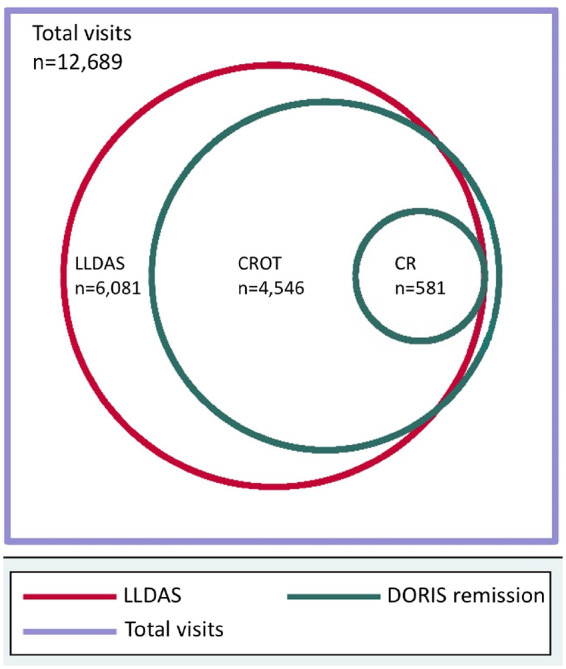
Treat-to-target strategies have changed the approach to management of many chronic conditions, with improvements in patient outcomes. The key to success of treat to target is the availability of validated treatment endpoints, which have been difficult to derive for SLE, a condition notorious for its heterogeneity. This review will focus on the development and validation of the definitions of remission in SLE framework and the lupus low disease activity state. Lupus low disease activity state is more attainable than remission, with a stepwise concentric relationship between the target states indicating increasing stringency. Both lupus low disease activity state and definitions of remission in SLE remission have been proven to be associated with reduction in disease flares, reduced risk of accrual of irreversible end organ damage, and improvement in patient reported outcomes. These endpoints have therefore provided the key for the development of a treat-to-target approach in clinical practice in SLE and for the design of future clinical trials.
达标治疗策略改变了许多慢性疾病的管理方法,改善了患者的预后。达标治疗成功的关键是有经过验证的治疗终点,而 SLE 的治疗终点很难确定,因为它的异质性是出了名的。本文将重点介绍 SLE 缓解定义和狼疮低疾病活动状态的制定和验证。狼疮低疾病活动状态比缓解更容易达到,目标状态之间呈逐步同心关系,表明严格程度逐渐增加。狼疮低疾病活动状态和 SLE 缓解定义均已被证明与减少疾病发作、降低不可逆转的终末器官损害的风险以及改善患者报告的结局相关。因此,这些终点为 SLE 临床实践中的达标治疗方法的发展以及未来临床试验的设计提供了关键。