Department of Anatomy and Neuroscience, University of Melbourne, Melbourne, Victoria, Australia.
Mol Pain. 2020 Jan-Dec;16:1744806920975950. doi: 10.1177/1744806920975950.
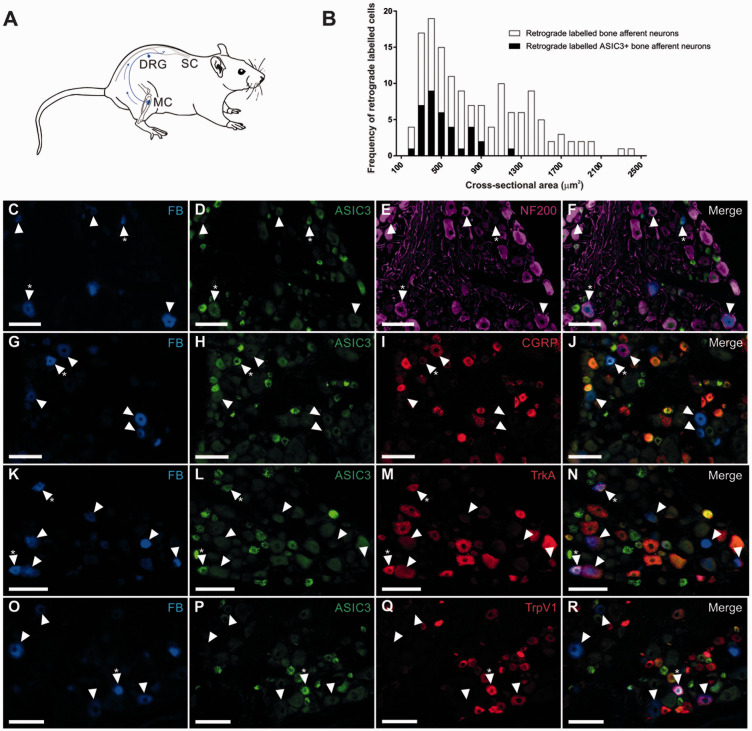
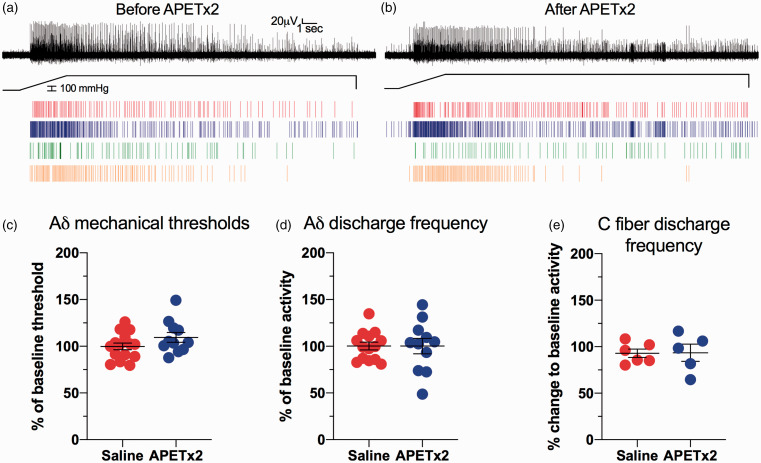
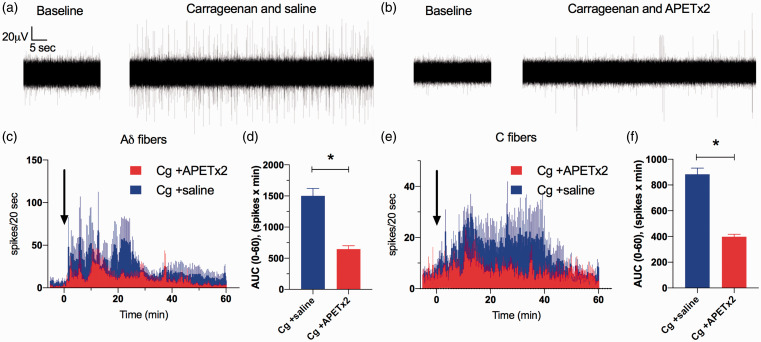
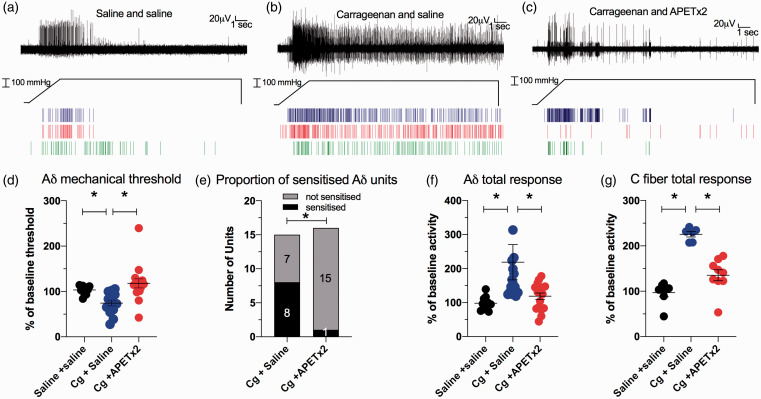
The Acid Sensing Ion Channel 3 (ASIC3) is a non-selective cation channel that is activated by acidification, and is known to have a role in regulating inflammatory pain. It has pro-algesic roles in a range of conditions that present with bone pain, but the mechanism for this has not yet been demonstrated. We aimed to determine if ASIC3 is expressed in Aδ and/or C fiber bone afferent neurons, and to explore its role in the activation and sensitization of bone afferent neurons after acute inflammation. A combination of retrograde tracing and immunohistochemistry was used to determine expression of ASIC3 in the soma of bone afferent neurons. A novel, electrophysiological bone-nerve preparation was used to make recordings of the activity and sensitivity of bone afferent neurons in the presence of carrageenan-induced inflammation, with and without the selective ASIC3 inhibitor APET×2. A substantial proportion of bone afferent neurons express ASIC3, including unmyelinated (neurofilament poor) and small diameter myelinated (neurofilament rich) neurons that are likely to be C and Aδ nerve fibers respectively. Electrophysiological recordings revealed that application of APET×2 to the marrow cavity inhibited carrageenan-induced spontaneous activity of C and Aδ fiber bone afferent neurons. APET×2 also inhibited carrageenan-induced sensitization of Aδ and C fiber bone afferent neurons to mechanical stimulation, but had no effect on the sensitivity of bone afferent neurons in the absence of inflammation. This evidence supports a role for ASIC3 in the pathogenesis of pain associated with inflammation of the bone.
酸感应离子通道 3(ASIC3)是一种非选择性阳离子通道,可被酸化激活,已知其在调节炎症性疼痛中起作用。它在多种伴有骨痛的疾病中具有致痛作用,但该机制尚未得到证实。我们旨在确定 ASIC3 是否在 Aδ 和/或 C 纤维骨传入神经元中表达,并探讨其在急性炎症后骨传入神经元的激活和敏化中的作用。逆行追踪和免疫组织化学相结合用于确定骨传入神经元体中 ASIC3 的表达。一种新的电生理学骨神经制备用于记录在卡拉胶诱导的炎症存在和不存在选择性 ASIC3 抑制剂 APET×2 的情况下骨传入神经元的活性和敏感性。相当一部分骨传入神经元表达 ASIC3,包括无髓(神经丝贫乏)和小直径有髓(神经丝丰富)神经元,分别可能是 C 和 Aδ 神经纤维。电生理记录显示,APET×2 应用于骨髓腔抑制了 C 和 Aδ 纤维骨传入神经元的自发性活动。APET×2 还抑制了 Aδ 和 C 纤维骨传入神经元对机械刺激的敏化,但对无炎症时骨传入神经元的敏感性没有影响。这一证据支持 ASIC3 在与骨炎症相关的疼痛发病机制中的作用。