Breast Disease Center, The First Affiliated Hospital, Sun Yat-sen University, Guangzhou, Guangdong, China.
Department of Anesthesiology, The First Affiliated Hospital, Sun Yat-sen University, Guangzhou, Guangdong, China.
Technol Cancer Res Treat. 2020 Jan-Dec;19:1533033820979672. doi: 10.1177/1533033820979672.
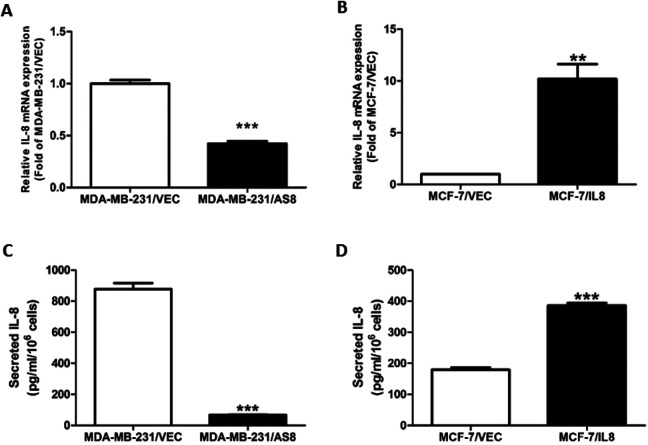
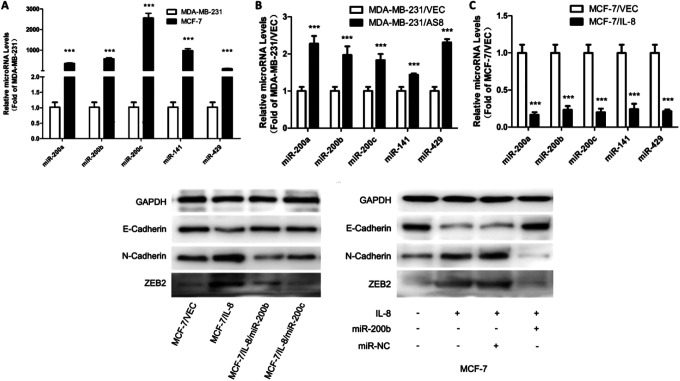
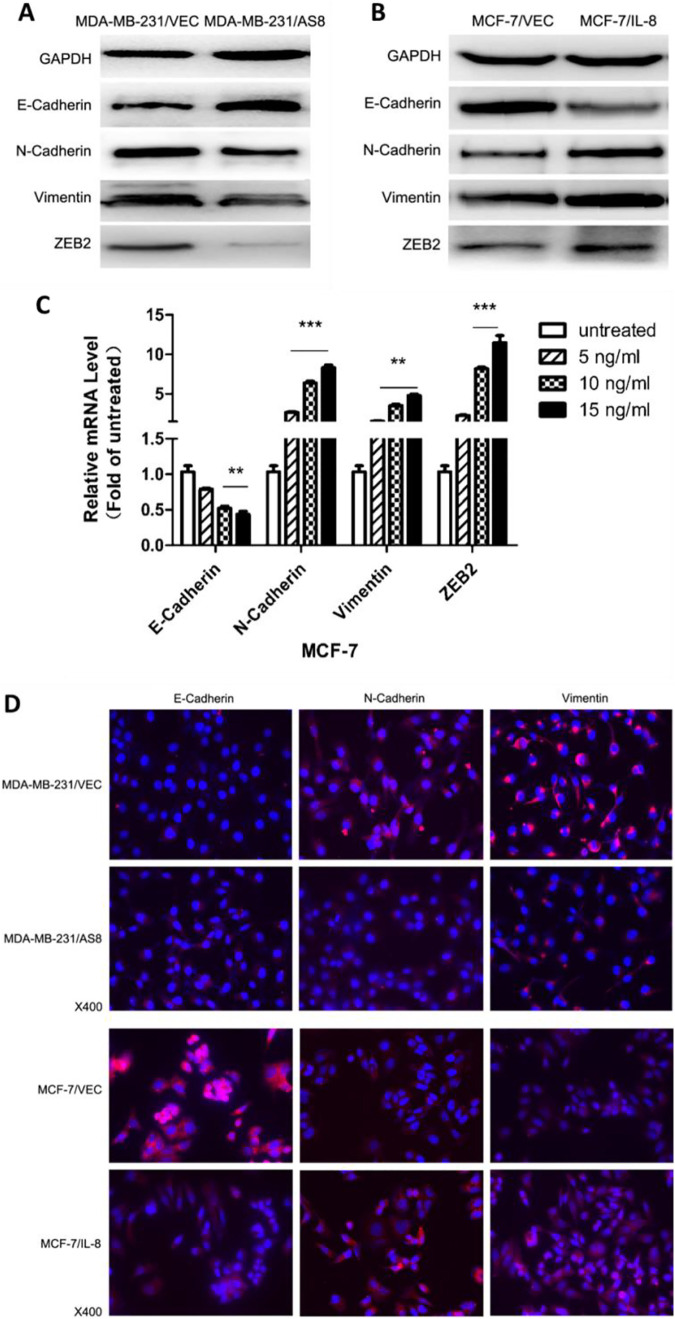
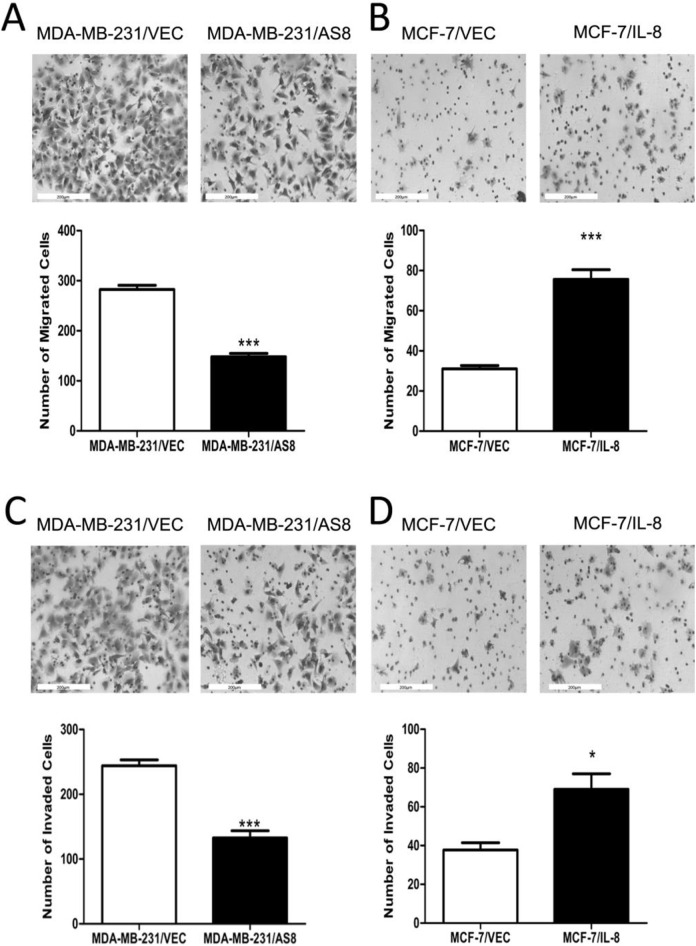
The microRNA-200 (miR-200) family has been reported to be vital for the inhibition of epithelial-to-mesenchymal transition (EMT) in tumor cells. The miR-200 family represents a complex multi-factorial regulatory network which has not been well described in breast cancer. This study aimed to clarify the underlying regulatory association between IL-8 and miR-200 family in the process of EMT in breast cancer cell. In estrogen-receptor (ER) positive breast cancer cell line MCF-7, IL-8 overexpression cells were performed by lentivirus transfection as endogenous regulation with additional exogenous IL-8 stimulation. Transient overexpressions of miR-200 family were performed after endogenous or exogenous IL-8 overexpression in MCF-7 cells. IL-8 knockdown cells were constructed via siRNA and shRNA transfection in triple negative breast cancer cell line MDA-MB-231. N-cadherin, vimentin and ZEB2 were down-regulated and E-cadherin was up-regulated in IL-8 knockdown group compared with control group. On the other hand, N-cadherin, vimentin and ZEB2 were up-regulated and E-cadherin was down-regulated in IL-8 overexpression group compared with control group. This indicated IL-8 promotes EMT in breast cancer cells. Transwell assay showed that IL-8 increased the migration and invasiveness of tumor cells. Furthermore, we performed transient overexpression of miR-200 family after endogenous or exogenous IL-8 overexpression in MCF-7 cells, which showed that the miR-200 family could inhibit EMT induced by IL-8. IL-8 promoted EMT via downregulation of miR-200 family expression in breast cancer cells and increases tumor cell migration and invasion.
miR-200 家族在肿瘤细胞上皮间质转化(EMT)的抑制中起着至关重要的作用。miR-200 家族代表了一个复杂的多因素调控网络,在乳腺癌中尚未得到很好的描述。本研究旨在阐明 IL-8 与乳腺癌细胞 EMT 过程中 miR-200 家族之间的潜在调控关系。在雌激素受体(ER)阳性乳腺癌细胞系 MCF-7 中,通过慢病毒转染过表达 IL-8 作为内源性调节,并进行额外的外源性 IL-8 刺激。在 MCF-7 细胞中过表达内源性或外源性 IL-8 后,进行 miR-200 家族的瞬时过表达。在三阴性乳腺癌细胞系 MDA-MB-231 中,通过 siRNA 和 shRNA 转染构建 IL-8 敲低细胞。与对照组相比,IL-8 敲低组中 N-钙粘蛋白、波形蛋白和 ZEB2 下调,E-钙粘蛋白上调。另一方面,与对照组相比,IL-8 过表达组中 N-钙粘蛋白、波形蛋白和 ZEB2 上调,E-钙粘蛋白下调。这表明 IL-8 促进乳腺癌细胞 EMT。Transwell 实验表明,IL-8 增加了肿瘤细胞的迁移和侵袭能力。此外,我们在 MCF-7 细胞中过表达内源性或外源性 IL-8 后进行 miR-200 家族的瞬时过表达,结果表明 miR-200 家族可以抑制 IL-8 诱导的 EMT。IL-8 通过下调 miR-200 家族的表达促进乳腺癌细胞 EMT,并增加肿瘤细胞的迁移和侵袭。