Birhanu Simon, Demena Melake, Baye Yohannes, Desalew Assefa, Dawud Bedru, Egata Gudina
School of Nursing and Midwifery, Haramaya University, Harar, Ethiopia.
School of Public Health, Haramaya University, Harar, Ethiopia.
SAGE Open Med. 2020 Nov 20;8:2050312120973480. doi: 10.1177/2050312120973480. eCollection 2020.
Antenatal care coverage is very low in low-and middle-income countries, including Ethiopia. Self-reported pregnant women's satisfaction may be important in identifying the demographic, provider-, and facility-related factors that can be improved to increase antenatal care satisfaction. However, there is a paucity of data on pregnant women's satisfaction in Ethiopia, particularly in the study setting. Therefore, this study aimed to assess antenatal care service satisfaction and associated factors among pregnant women at public health facilities in the Harari region of eastern Ethiopia.
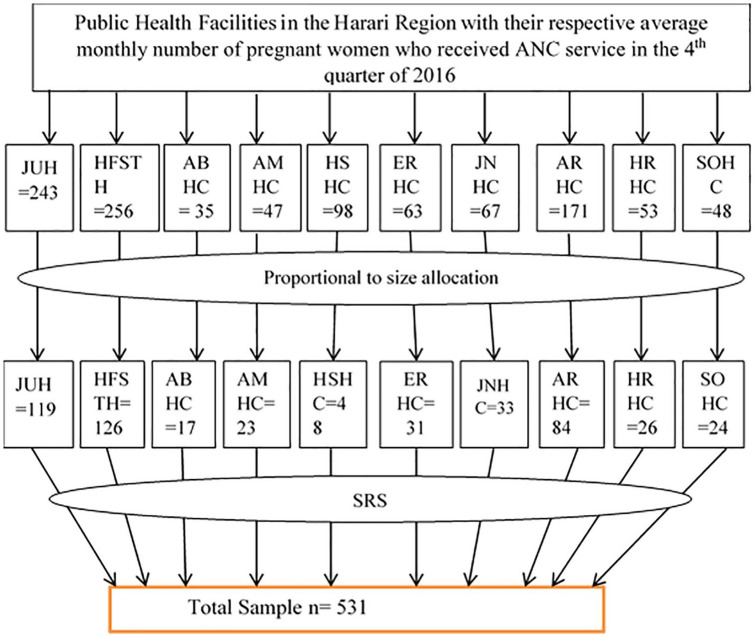
A health institution-based cross-sectional study was conducted among women who were attending antenatal care clinics in February 2017. All 531 pregnant women were selected using a systematic random sampling method. Data were collected using an interviewer-administered questionnaire, entered into EpiData version 3.1, and analyzed using SPSS version 22.0 software. A logistic regression model was applied to control for confounders. The level of significance was determined at a p-value of less than 0.05.
The magnitude of pregnant women's satisfaction with antenatal care services was 70.3% (95% confidence interval (CI) = 66.4%-74.3%). Receiving antenatal care services from the hospital (adjusted odds ratio (AOR) = 2.44, 95% CI = 1.50-3.98), did not attend formal education (AOR = 2.53, 95% CI = 1.52-4.20) and attended primary education (AOR = 2.17, 95% CI = 1.17-4.04), having a repeated visit to antenatal care (AOR = 4.62, 95% CI = 2.98-7.17), initiating antenatal care services within the first trimester (AOR = 1.74, 95% CI = 1.12-2.71), having no history of stillbirth (AOR = 2.52, 95% CI = 1.37-4.65), and waiting for no more than 30 min in the health facility to get service (AOR = 2.31, 95% CI = 1.28-4.16) were factors associated with pregnant women's satisfaction with antenatal care services.
More than two-thirds of pregnant women were satisfied with the antenatal care service. The type of health facility, education status, number and initiation time of antenatal visit, history of stillbirth, and waiting time to get service were factors associated with pregnant women's satisfaction with antenatal care services.
在包括埃塞俄比亚在内的低收入和中等收入国家,产前保健覆盖率非常低。自我报告的孕妇满意度对于确定可加以改善以提高产前保健满意度的人口统计学、提供者和设施相关因素可能很重要。然而,埃塞俄比亚关于孕妇满意度的数据匮乏,尤其是在本研究环境中。因此,本研究旨在评估埃塞俄比亚东部哈勒尔地区公共卫生设施中孕妇对产前保健服务的满意度及相关因素。
2017年2月,在参加产前保健诊所的妇女中进行了一项基于卫生机构的横断面研究。采用系统随机抽样方法选取了所有531名孕妇。使用访谈员管理的问卷收集数据,录入EpiData 3.1版本,并使用SPSS 22.0软件进行分析。应用逻辑回归模型控制混杂因素。显著性水平确定为p值小于0.05。
孕妇对产前保健服务的满意度为70.3%(95%置信区间(CI)=66.4%-74.3%)。在医院接受产前保健服务(调整比值比(AOR)=2.44,95%CI=1.50-3.98)、未接受正规教育(AOR=2.53,95%CI=1.52-4.20)和接受小学教育(AOR=2.17,95%CI=1.17-4.04)、多次进行产前检查(AOR=4.62,95%CI=2.98-7.17)、在孕早期开始接受产前保健服务(AOR=1.74,95%CI=1.12-2.71)、无死产史(AOR=2.52,95%CI=1.37-4.65)以及在卫生机构等待服务不超过30分钟(AOR=2.31,95%CI=1.28-4.16)是与孕妇对产前保健服务满意度相关的因素。
超过三分之二的孕妇对产前保健服务感到满意。卫生设施类型、教育状况、产前检查次数和开始时间、死产史以及等待服务时间是与孕妇对产前保健服务满意度相关的因素。