Sun Jing, Lin Qian, Zhao Pengyu, Zhang Qiongyao, Xu Kai, Chen Huiying, Hu Cecile Jia, Stuntz Mark, Li Hong, Liu Yuanli
School of Public Health, Chinese Academy of Medical Sciences & Peking Union Medical College, No.5 Dongdansantiao, 100730, Beijing, People's Republic of China.
Fujian Provincial Hospital, 134 East Street, 350001, Fuzhou, Fujian Province, People's Republic of China.
BMC Public Health. 2017 Aug 22;17(1):668. doi: 10.1186/s12889-017-4667-z.
It is globally agreed that a well-designed health system deliver timely and convenient access to health services for all patients. Many interventions aiming to reduce waiting times have been implemented in Chinese public tertiary hospitals to improve patients' satisfaction. However, few were well-documented, and the effects were rarely measured with robust methods.
We conducted a longitudinal study of the length of waiting times in a public tertiary hospital in Southern China which developed comprehensive data collection systems. Around an average of 60,000 outpatients and 70,000 prescribed outpatients per month were targeted for the study during Oct 2014-February 2017. We analyzed longitudinal time series data using a segmented linear regression model to assess changes in levels and trends of waiting times before and after the introduction of waiting time reduction interventions. Pearson correlation analysis was conducted to indicate the strength of association between waiting times and patient satisfactions. The statistical significance level was set at 0.05.
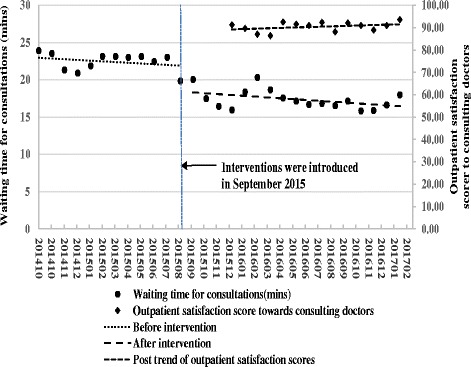
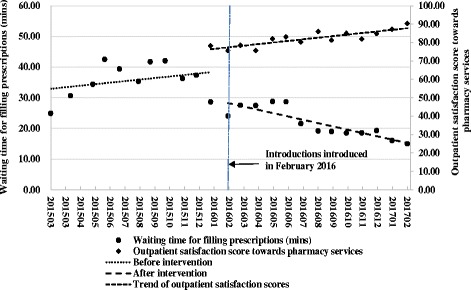
The monthly average length of waiting time decreased 3.49 min (P = 0.003) for consultations and 8.70 min (P = 0.02) for filling prescriptions in the corresponding month when respective interventions were introduced. The trend shifted from baseline slight increasing to afterwards significant decreasing for filling prescriptions (P =0.003). There was a significant negative correlation between waiting time of filling prescriptions and outpatient satisfaction towards pharmacy services (r = -0.71, P = 0.004).
The interventions aimed at reducing waiting time and raising patient satisfaction in Fujian Provincial Hospital are effective. A long-lasting reduction effect on waiting time for filling prescriptions was observed because of carefully designed continuous efforts, rather than a one-time campaign, and with appropriate incentives implemented by a taskforce authorized by the hospital managers. This case provides a model of carrying out continuous quality improvement and optimizing management process with the support of relevant evidence.
全球普遍认为,设计良好的卫生系统应能为所有患者提供及时、便捷的医疗服务。中国公立三级医院实施了许多旨在减少等待时间的干预措施,以提高患者满意度。然而,很少有干预措施有充分记录,其效果也很少用可靠的方法来衡量。
我们对中国南方一家建立了综合数据收集系统的公立三级医院的等待时间长度进行了纵向研究。在2014年10月至2017年2月期间,该研究每月平均针对约60000名门诊患者和70000名处方门诊患者。我们使用分段线性回归模型分析纵向时间序列数据,以评估引入减少等待时间干预措施前后等待时间水平和趋势的变化。进行Pearson相关分析以表明等待时间与患者满意度之间的关联强度。统计显著性水平设定为0.05。
在引入相应干预措施的当月,会诊的月平均等待时间减少了3.49分钟(P = 0.003), 取药的月平均等待时间减少了8.70分钟(P = 0.02)。取药的趋势从基线时的轻微增加转变为干预后的显著下降(P = 0.003)。取药等待时间与门诊患者对药房服务的满意度之间存在显著负相关(r = -0.71,P = 0.004)。
福建省立医院旨在减少等待时间和提高患者满意度的干预措施是有效的。由于精心设计的持续努力,而非一次性活动,并由医院管理人员授权的特别工作组实施了适当激励措施,观察到取药等待时间有持久的减少效果。本案例提供了一个在相关证据支持下开展持续质量改进和优化管理流程的模式。