Cleveland Manchanda Emily C, Macias-Konstantopoulos Wendy L
Emergency Medicine, Harvard Affiliated Emergency Medicine Residency, Boston, USA.
Department of Emergency Medicine, Massachusetts General Hospital, Boston, USA.
Cureus. 2020 Nov 4;12(11):e11325. doi: 10.7759/cureus.11325.
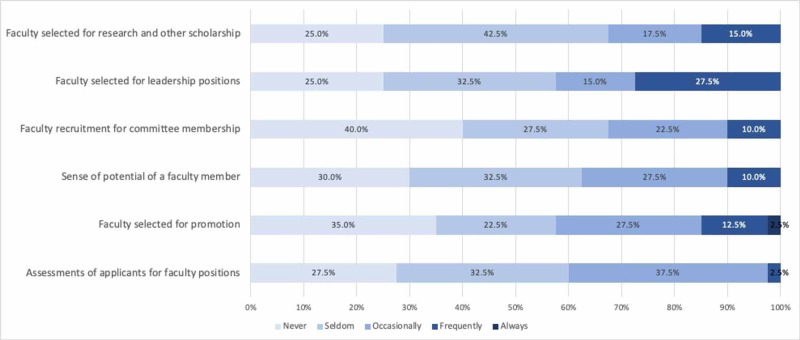
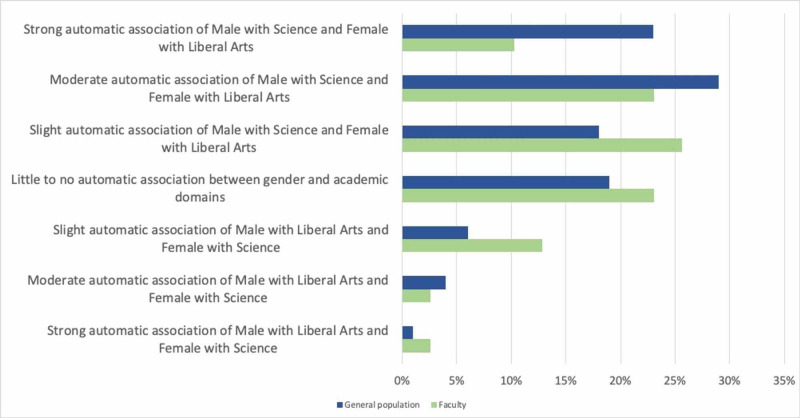
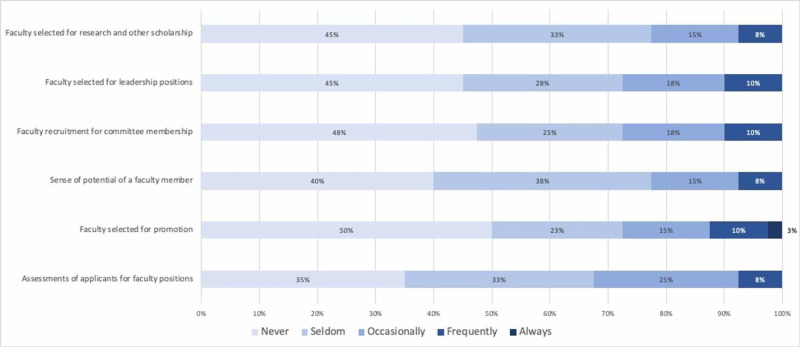
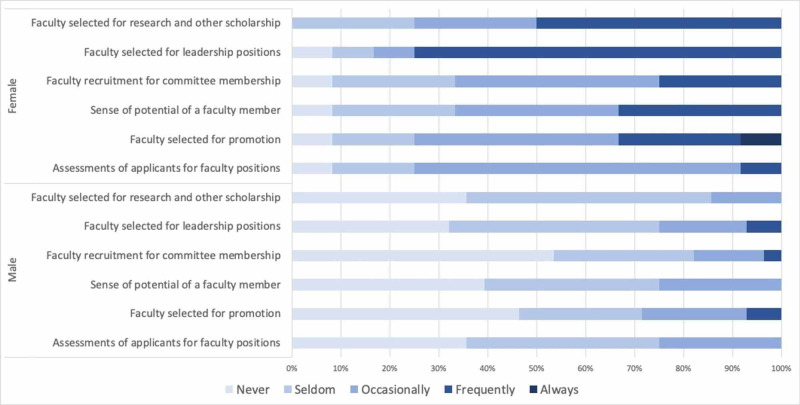
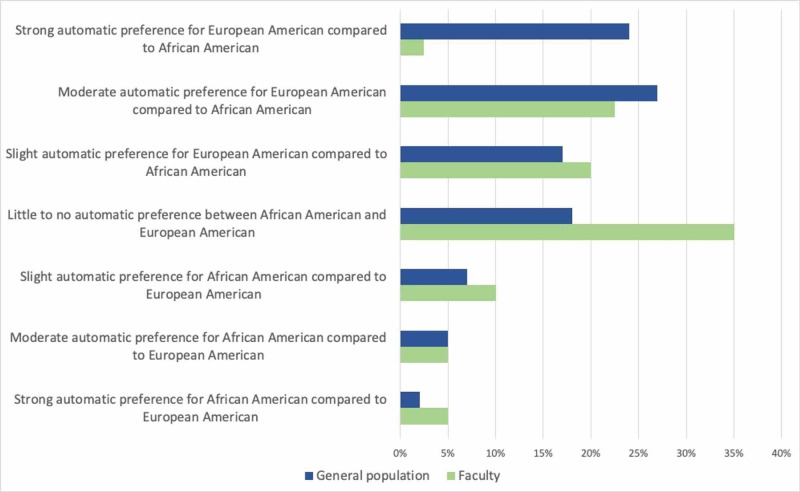
Background Gender and racial disparities in academic medicine have recently garnered much attention. Implicit Association Tests (IATs) offer a validated means of evaluating unconscious associations and preferences. This study examines the perceived role of implicit bias in faculty development in academic emergency medicine (EM). Methods EM faculty at a large urban academic medical center were invited to independently participate in a self-reflection assessment in preparation for a faculty retreat session discussing diversity, equity, and inclusion. Participants completed two IATs designed to examine gender associations (gender IAT) and race preferences (race IAT) followed by a short anonymous survey where IAT scores were recorded. The survey also captured demographic information and perceptions about the impact of gender and racial biases in faculty development. Results Forty faculty members (66%) completed the survey; 70% were male and 80% white. The majority (59%) reported gender IAT results indicating automatic male-sciences and female-liberal arts associations. Nearly half (45%) reported race IAT results indicating an automatic preference for white people. More than 70% of males reported that faculty recruitment, development, and promotion decisions were 'never' or 'seldom' affected by gender bias, while more than 80% reported racial bias 'never' or 'seldom' affects these decisions. Female faculty more frequently perceived adverse effects of unconscious gender and race biases. Conclusion Our group of academic physicians reported IAT results showing different levels of implicit bias compared to the general population. Female faculty may be both more aware of and more susceptible to the adverse effects of unconscious biases. Further study is needed to determine both the extent to which unconscious biases affect the academic workplace, as well as ways in which such unintentional forms of discrimination can be eliminated. Unconscious biases are not unique to EM. Intentional efforts to increase self-awareness of these 'blind spots' may help mitigate their impact and foster a more diverse and inclusive healthcare environment.
背景 学术医学中的性别和种族差异最近备受关注。内隐联想测验(IAT)提供了一种评估无意识联想和偏好的有效方法。本研究探讨了内隐偏见在学术急诊医学(EM)教师发展中所扮演的角色。方法 一家大型城市学术医疗中心的急诊医学教师被邀请独立参与一项自我反思评估,为一场讨论多样性、公平性和包容性的教师务虚会做准备。参与者完成了两项旨在检测性别联想(性别IAT)和种族偏好(种族IAT)的IAT,随后进行了一项简短的匿名调查,记录了IAT分数。该调查还收集了人口统计学信息以及对性别和种族偏见在教师发展中的影响的看法。结果 40名教师(66%)完成了调查;70%为男性,80%为白人。大多数(59%)报告的性别IAT结果表明存在自动的男性-科学和女性-文科联想。近一半(45%)报告的种族IAT结果表明对白种人有自动偏好。超过70%的男性报告称,教师招聘、发展和晋升决策“从未”或“很少”受到性别偏见的影响,而超过80%的人报告称种族偏见“从未”或“很少”影响这些决策。女性教师更频繁地察觉到无意识性别和种族偏见的负面影响。结论 我们这群学术医生报告的IAT结果显示,与普通人群相比,存在不同程度的内隐偏见。女性教师可能既更了解无意识偏见的负面影响,也更容易受到其影响。需要进一步研究以确定无意识偏见对学术工作场所的影响程度,以及消除这种无意形式歧视的方法。无意识偏见并非急诊医学所特有。有意提高对这些“盲点”的自我意识的努力可能有助于减轻其影响,并营造一个更加多样化和包容的医疗环境。