Ortseifen Vera, Viefhues Martina, Wobbe Lutz, Grünberger Alexander
Proteome and Metabolome Research, Faculty of Biology, Center for Biotechnology/CeBiTec, Bielefeld University, Bielefeld, Germany.
Experimental Biophysics and Applied Nanosciences, Faculty of Physics, Bielefeld University, Bielefeld, Germany.
Front Bioeng Biotechnol. 2020 Nov 13;8:589074. doi: 10.3389/fbioe.2020.589074. eCollection 2020.
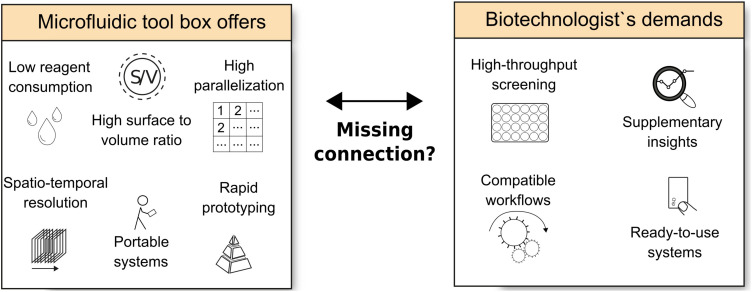
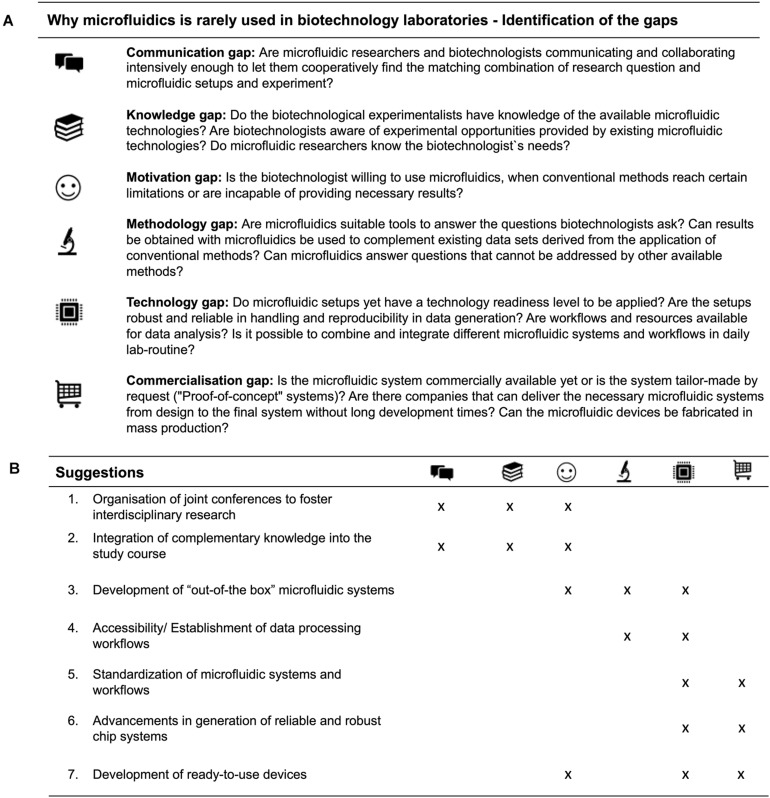
Microfluidics and novel lab-on-a-chip applications have the potential to boost biotechnological research in ways that are not possible using traditional methods. Although microfluidic tools were increasingly used for different applications within biotechnology in recent years, a systematic and routine use in academic and industrial labs is still not established. For many years, absent innovative, ground-breaking and "out-of-the-box" applications have been made responsible for the missing drive to integrate microfluidic technologies into fundamental and applied biotechnological research. In this review, we highlight microfluidics' offers and compare them to the most important demands of the biotechnologists. Furthermore, a detailed analysis in the state-of-the-art use of microfluidics within biotechnology was conducted exemplarily for four emerging biotechnological fields that can substantially benefit from the application of microfluidic systems, namely the phenotypic screening of cells, the analysis of microbial population heterogeneity, organ-on-a-chip approaches and the characterisation of synthetic co-cultures. The analysis resulted in a discussion of potential "gaps" that can be responsible for the rare integration of microfluidics into biotechnological studies. Our analysis revealed six major gaps, concerning the lack of interdisciplinary communication, mutual knowledge and motivation, methodological compatibility, technological readiness and missing commercialisation, which need to be bridged in the future. We conclude that connecting microfluidics and biotechnology is not an impossible challenge and made seven suggestions to bridge the gaps between those disciplines. This lays the foundation for routine integration of microfluidic systems into biotechnology research procedures.
微流控技术和新型芯片实验室应用有潜力以传统方法无法实现的方式推动生物技术研究。尽管近年来微流控工具在生物技术领域的不同应用中使用得越来越多,但在学术和工业实验室中仍未建立起系统的常规使用方法。多年来,缺乏创新、突破性和“跳出框框”的应用一直被认为是将微流控技术整合到基础和应用生物技术研究中缺乏动力的原因。在本综述中,我们强调了微流控技术的优势,并将其与生物技术专家的最重要需求进行了比较。此外,我们还针对四个新兴的生物技术领域,即细胞表型筛选、微生物群体异质性分析、芯片器官方法和合成共培养物的表征,对微流控技术在生物技术领域的最新应用进行了详细分析。分析结果引发了对可能导致微流控技术很少融入生物技术研究的潜在“差距”的讨论。我们的分析揭示了六个主要差距,涉及跨学科交流、相互知识和动力、方法兼容性、技术成熟度以及商业化缺失等方面,这些差距未来需要弥合。我们得出结论,将微流控技术与生物技术联系起来并非不可能的挑战,并提出了七条弥合这些学科之间差距的建议。这为将微流控系统常规整合到生物技术研究程序奠定了基础。