Amiri Mandana, Dowran Behnaz, Salimi Hossein, Zarghami Mohammad Hossein
Behavioral Sciences Research Center, Life Style Institute, Baqiyatallah University of Medical Sciences, Tehran, Iran.
Exercise Physiology Research Center, Life Style Institute, Baqiyatallah University of Medical Sciences, Tehran, Iran.
J Educ Health Promot. 2020 Oct 30;9:290. doi: 10.4103/jehp.jehp_268_20. eCollection 2020.
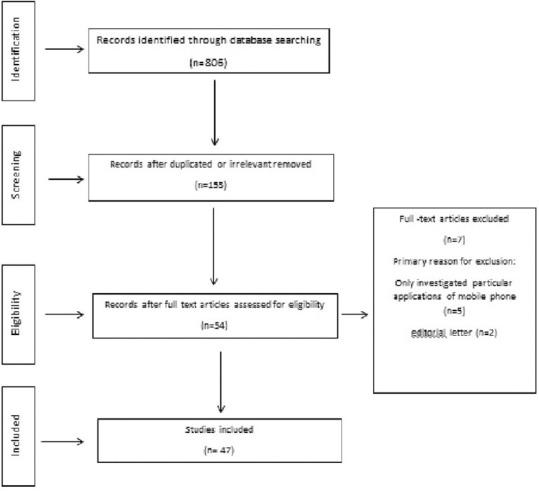
There is growing evidence that the problematic use of mobile phone is an evolving problem. Although some studies have noted a greater prevalence in the Middle East, intercultural differences have not been sufficiently studied to date. The present study, therefore, aims at reviewing Iranian published studies on the problematic use of mobile phone in Iran. This study was conducted as a review study. For this purpose, we searched all published studies in this field that were conducted in Iran and reviewed all of the articles by studying the prevalence of the problematic use of cell phone in Iran, the adopted measuring instruments, the employed terms, predictors of the problematic use of cell phone, and the consequences of the problematic use of cell phone. After applying the inclusion and exclusion criteria, 47 articles were selected for evaluation. Among the problematic consequences, sleep disturbance was the most studied factor. Additionally, gender, feeling of loneliness, attachment stiles and age were mostly referred to as predictors. In addition, the reported prevalence varied from 0.9% to 64.5%, depending on the studied population and the measuring instruments. The diversity of reported prevalence rate of problematic use of mobile phone in Iran can be related to the ambiguity of the concept of "problematic use" and the diversity of the employed measuring tools. Thus, care should be taken in generalizing and interpreting the results.
越来越多的证据表明,手机使用问题是一个不断演变的问题。尽管一些研究指出中东地区的患病率更高,但迄今为止,跨文化差异尚未得到充分研究。因此,本研究旨在回顾伊朗发表的关于伊朗手机使用问题的研究。本研究作为一项综述研究开展。为此,我们搜索了在伊朗进行的该领域所有已发表的研究,并通过研究伊朗手机使用问题的患病率、采用的测量工具、使用的术语、手机使用问题的预测因素以及手机使用问题的后果,对所有文章进行了综述。应用纳入和排除标准后,选择了47篇文章进行评估。在有问题的后果中,睡眠障碍是研究最多的因素。此外,性别、孤独感、依恋风格和年龄大多被提及为预测因素。此外,根据研究人群和测量工具的不同,报告的患病率从0.9%到64.5%不等。伊朗手机使用问题报告患病率的多样性可能与“问题使用”概念的模糊性以及所使用测量工具的多样性有关。因此,在概括和解释结果时应谨慎。