Department of Anesthesia, Critical Care and Pain Medicine, Massachusetts General Hospital, Shriners Hospitals for Children, Harvard Medical School, Charlestown, Massachusetts.
Am J Physiol Endocrinol Metab. 2021 Jan 1;320(1):E150-E159. doi: 10.1152/ajpendo.00161.2020. Epub 2020 Dec 7.
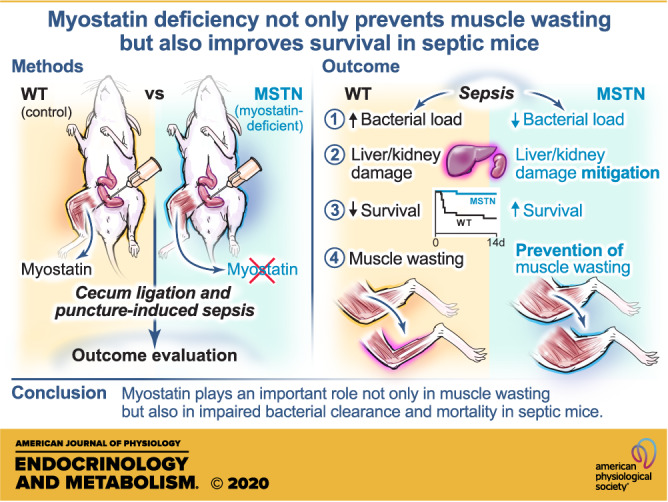
Sepsis remains a leading cause of mortality in critically ill patients. Muscle wasting is a major complication of sepsis and negatively affects clinical outcomes. Despite intense investigation for many years, the molecular mechanisms underlying sepsis-related muscle wasting are not fully understood. In addition, a potential role of muscle wasting in disease development of sepsis has not been studied. Myostatin is a myokine that downregulates skeletal muscle mass. We studied the effects of myostatin deficiency on muscle wasting and other clinically relevant outcomes, including mortality and bacterial clearance, in mice. Myostatin deficiency prevented muscle atrophy along with inhibition of increases in muscle-specific RING finger protein 1 (MuRF-1) and atrogin-1 expression and phosphorylation of signal transducer and activator of transcription protein 3 (STAT3; major players of muscle wasting) in septic mice. Moreover, myostatin deficiency improved survival and bacterial clearance of septic mice. Sepsis-induced liver dysfunction, acute kidney injury, and neutrophil infiltration into the liver and kidney were consistently mitigated by myostatin deficiency, as indicated by plasma concentrations of aspartate aminotransferase (AST), alanine aminotransferase (ALT), and neutrophil gelatinase-associated lipocalin (NGAL) and myeloperoxidase activity in the organs. Myostatin deficiency also inhibited sepsis-induced increases in plasma high-mobility group protein B1 (HMGB1) and macrophage inhibitory cytokine (MIC)-1/growth differentiation factor (GDF)-15 concentrations. These results indicate that myostatin plays an important role not only in muscle wasting but also in other clinically relevant outcomes in septic mice. Furthermore, our data raise the possibility that muscle wasting may not be simply a complication, but myostatin-mediated muscle cachexia and related changes in muscle may actually drive the development of sepsis as well. Muscle wasting is a major complication of sepsis, but its role in the disease development is not known. Myostatin deficiency improved bacterial clearance and survival and mitigated damage in the liver and kidney in septic mice, which paralleled prevention of muscle wasting. These results raise the possibility that muscle wasting may not simply be a complication of sepsis, but myostatin-mediated cachexic changes may have a role in impaired bacterial clearance and mortality in septic mice.
脓毒症仍然是危重病患者死亡的主要原因。肌肉减少症是脓毒症的主要并发症,对临床结局产生负面影响。尽管多年来进行了大量研究,但脓毒症相关肌肉减少症的分子机制仍未完全阐明。此外,肌肉减少症在脓毒症发病机制中的潜在作用尚未得到研究。肌肉生长抑制素是一种肌因子,可下调骨骼肌质量。我们研究了肌肉生长抑制素缺乏对肌肉减少症和其他临床相关结局的影响,包括死亡率和细菌清除率,在脓毒症小鼠中。肌肉生长抑制素缺乏可防止肌肉萎缩,同时抑制肌肉特异性环指蛋白 1(MuRF-1)和自噬基因 1(atrogin-1)表达以及信号转导和转录激活因子 3(STAT3;肌肉减少症的主要参与者)的磷酸化增加在脓毒症小鼠中。此外,肌肉生长抑制素缺乏可改善脓毒症小鼠的存活率和细菌清除率。脓毒症诱导的肝损伤、急性肾损伤以及中性粒细胞浸润到肝脏和肾脏,均被肌肉生长抑制素缺乏所减轻,这表现为血浆天门冬氨酸氨基转移酶(AST)、丙氨酸氨基转移酶(ALT)浓度和中性粒细胞明胶酶相关脂质运载蛋白(NGAL)以及器官中髓过氧化物酶活性的降低。肌肉生长抑制素缺乏还抑制了脓毒症诱导的血浆高迁移率族蛋白 B1(HMGB1)和巨噬细胞抑制因子(MIC)-1/生长分化因子(GDF)-15 浓度的增加。这些结果表明,肌肉生长抑制素不仅在肌肉减少症中发挥重要作用,而且在脓毒症小鼠的其他临床相关结局中也发挥重要作用。此外,我们的数据提示肌肉减少症可能不仅仅是一种并发症,肌肉生长抑制素介导的肌肉恶病质和相关的肌肉变化实际上可能也推动了脓毒症的发展。肌肉减少症是脓毒症的主要并发症,但它在疾病发展中的作用尚不清楚。肌肉生长抑制素缺乏可改善脓毒症小鼠的细菌清除率和存活率,并减轻脓毒症小鼠的肝和肾损伤,这与肌肉减少症的预防相平行。这些结果提示肌肉减少症可能不仅仅是脓毒症的一种并发症,而是肌肉生长抑制素介导的恶病质变化可能在脓毒症小鼠的细菌清除率和死亡率降低中发挥作用。