
阿司匹林与利伐沙班用于全髋关节或全膝关节置换术后静脉血栓栓塞预防的疗效与安全性:一项荟萃分析方案
Efficacy and safety of aspirin and rivaroxaban for venous thromboembolism prophylaxis after total hip or knee arthroplasty: A protocol for meta-analysis.
作者信息
Le Guoping, Yang Chengzhi, Zhang Ming, Xi Licheng, Luo Hanwen, Tang Jingli, Zhao Jinmin
机构信息
Division of Traumatic Surgery, First Affiliated Hospital of Guangxi Medical University, Nanning.
Department of Orthopedics, Fourth Affiliated Hospital of Guangxi Medical University, Liuzhou, Guangxi, China.
出版信息
Medicine (Baltimore). 2020 Dec 4;99(49):e23055. doi: 10.1097/MD.0000000000023055.
BACKGROUND
The purpose of this meta-analysis is to compare the efficacy and safety of aspirin and rivaroxaban in the prevention of venous thromboembolism (VTE) following either total knee arthroplasty or total hip arthroplasty.
METHODS
A comprehensive literature search of several electronic databases (PubMed, Embase, and Web of Science) was conducted to identify relevant studies. Outcomes of interest included VTE rate, deep vein thrombosis (DVT) rate, pulmonary embolism rate, major bleeding events, mortality rate, blood transfusion, and wound complication. Risk ratio (RR) with 95% confidence intervals (95%CIs) were calculated using a fixed-effects model or random-effects model.
RESULTS
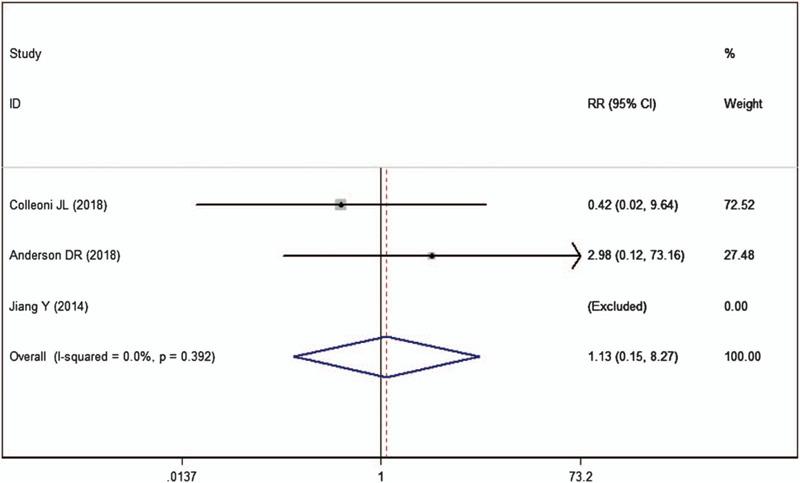
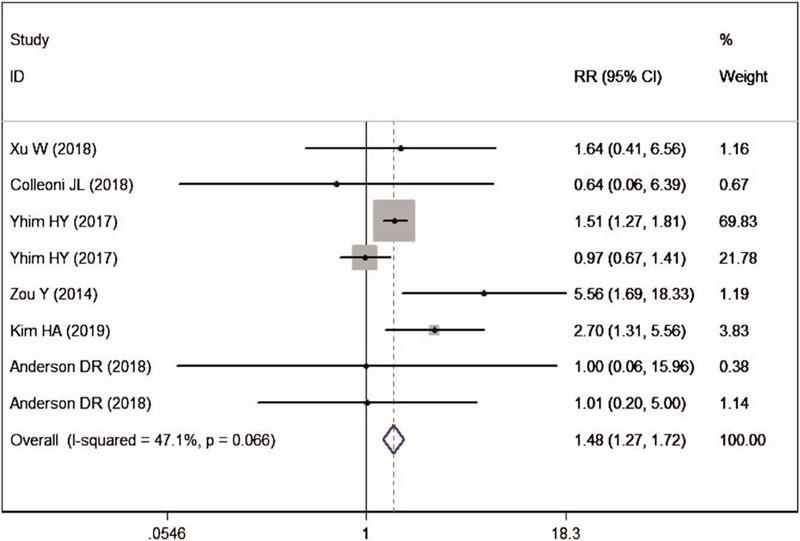
A total of 8 studies with 97,677 patients met the inclusion criteria and were included in this meta-analysis. Compared with rivaroxaban, aspirin had a significantly higher incidence of DVT (RR = 1.48, 95%CI: 1.27, 1.72; P < .001), and decreased risk of blood transfusion (RR = 0.94, 95%CI: 0.93, 0.94; P < .001). However, there were no significant differences between the 2 drugs in terms of total VTE rate (RR = 1.39%, 95%CI: 0.94, 2.05; P = .101), pulmonary embolism rate (RR = 1.64, 95%CI: 0.92, 2.92; P = .094), mortality rate (RR = 1.13, 95%CI: 0.15, 8.27; P = .907), major bleeding (RR = 1.00, 95%CI: 0.44, 2.27; P = .995), and wound complication rate (RR = 0.37, 95%CI: 0.07, 1.87; P = .229).
CONCLUSION
Our results suggested that aspirin and rivaroxaban offered similar effect in the prevention of VTE after total knee arthroplasty or total hip arthroplasty. However, rivaroxaban seemed to have better effect than aspirin in reducing the risk of DVT, and aspirin was safer than rivaroxaban in decreasing the blood transfusion rate.
背景
本荟萃分析的目的是比较阿司匹林和利伐沙班在预防全膝关节置换术或全髋关节置换术后静脉血栓栓塞(VTE)方面的疗效和安全性。
方法
对多个电子数据库(PubMed、Embase和Web of Science)进行全面的文献检索,以确定相关研究。感兴趣的结局包括VTE发生率、深静脉血栓形成(DVT)发生率、肺栓塞发生率、大出血事件、死亡率、输血情况及伤口并发症。采用固定效应模型或随机效应模型计算风险比(RR)及95%置信区间(95%CI)。
结果
共有8项研究、97677例患者符合纳入标准并纳入本荟萃分析。与利伐沙班相比,阿司匹林的DVT发生率显著更高(RR = 1.48,95%CI:1.27,1.72;P <.001),输血风险降低(RR = 0.94,95%CI:0.93,0.94;P <.001)。然而,两种药物在总VTE发生率(RR = 1.39%,95%CI:0.94,2.05;P = 0.101)、肺栓塞发生率(RR = 1.64,95%CI:0.92,2.92;P = 0.094)、死亡率(RR = 1.13,95%CI:0.15,8.27;P = 0.907)、大出血(RR = 1.00,95%CI:0.44,2.27;P = 0.995)及伤口并发症发生率(RR = 0.37,95%CI:0.07,1.87;P = 0.229)方面无显著差异。
结论
我们的结果表明,阿司匹林和利伐沙班在预防全膝关节置换术或全髋关节置换术后VTE方面效果相似。然而,利伐沙班在降低DVT风险方面似乎比阿司匹林效果更好,而阿司匹林在降低输血率方面比利伐沙班更安全。



 Zotero 插件