Zhang Tao, Wang Hong, Chen Jichi, He Enqiu
Department of Mechanical Engineering and Automation, Northeastern University, Shenyang 110819, China.
College of Applied Technology, Shenyang University, Shenyang 110044, China.
Entropy (Basel). 2020 Nov 3;22(11):1248. doi: 10.3390/e22111248.
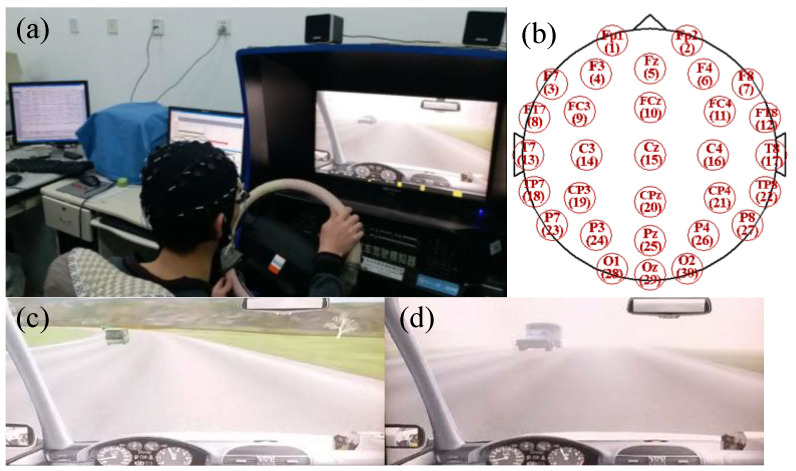
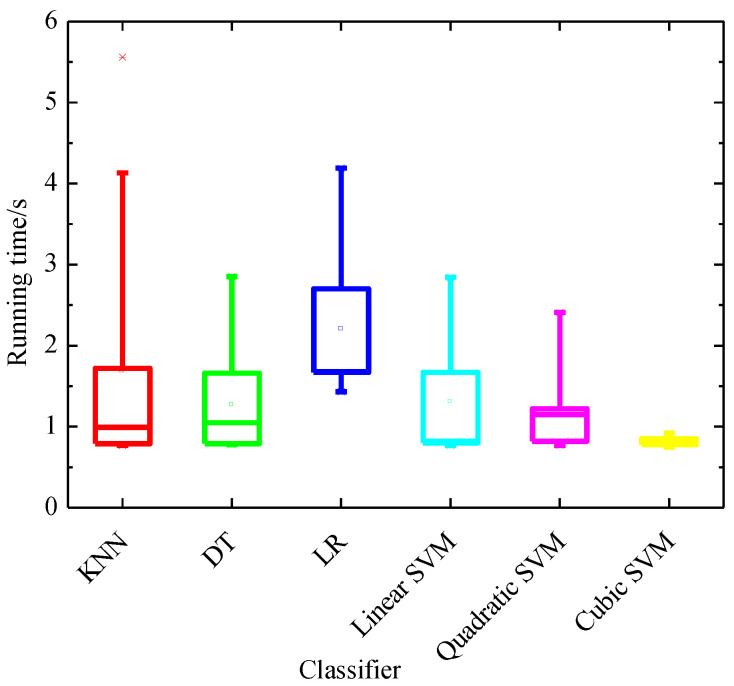
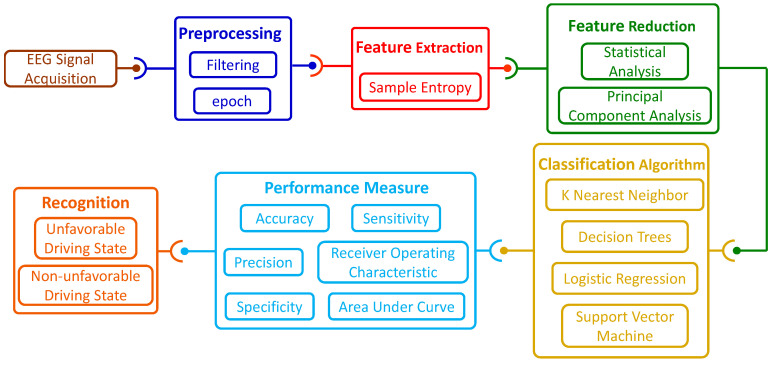
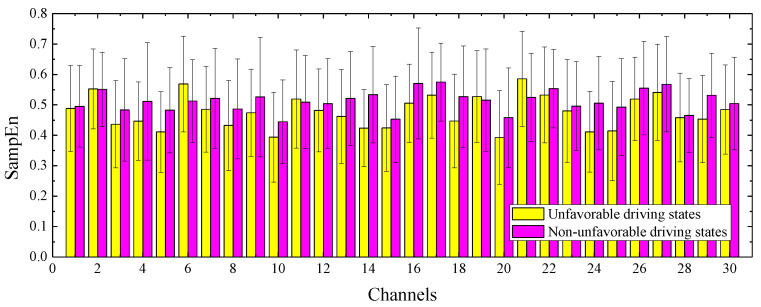
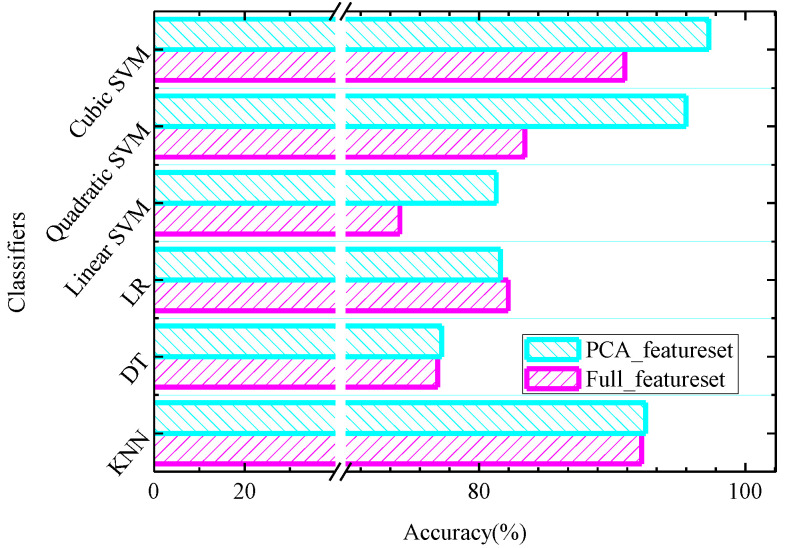
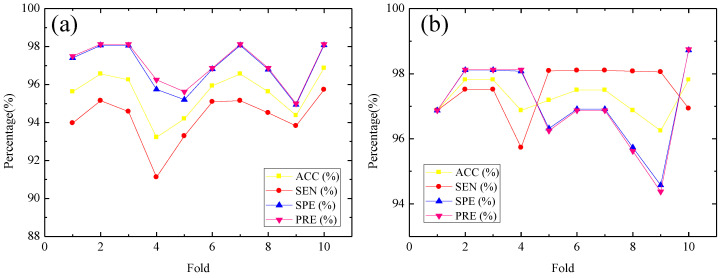
Unfavorable driving states can cause a large number of vehicle crashes and are significant factors in leading to traffic accidents. Hence, the aim of this research is to design a robust system to detect unfavorable driving states based on sample entropy feature analysis and multiple classification algorithms. Multi-channel Electroencephalography (EEG) signals are recorded from 16 participants while performing two types of driving tasks. For the purpose of selecting optimal feature sets for classification, principal component analysis (PCA) is adopted for reducing dimensionality of feature sets. Multiple classification algorithms, namely, K nearest neighbor (KNN), decision tree (DT), support vector machine (SVM) and logistic regression (LR) are employed to improve the accuracy of unfavorable driving state detection. We use 10-fold cross-validation to assess the performance of the proposed systems. It is found that the proposed detection system, based on PCA features and the cubic SVM classification algorithm, shows robustness as it obtains the highest accuracy of 97.81%, sensitivity of 96.93%, specificity of 98.73% and precision of 98.75%. Experimental results show that the system we designed can effectively monitor unfavorable driving states.
不良驾驶状态会导致大量车辆碰撞事故,是引发交通事故的重要因素。因此,本研究的目的是基于样本熵特征分析和多种分类算法设计一个强大的系统来检测不良驾驶状态。在16名参与者执行两种驾驶任务时记录多通道脑电图(EEG)信号。为了选择用于分类的最优特征集,采用主成分分析(PCA)来降低特征集的维度。使用多种分类算法,即K近邻(KNN)、决策树(DT)、支持向量机(SVM)和逻辑回归(LR)来提高不良驾驶状态检测的准确性。我们使用10折交叉验证来评估所提出系统的性能。结果发现,基于PCA特征和立方SVM分类算法的所提出的检测系统表现出稳健性,因为它获得了最高准确率97.81%、灵敏度96.93%、特异性98.73%和精确率98.75%。实验结果表明,我们设计的系统能够有效地监测不良驾驶状态。