Department of Radiology and Research Institute of Radiology, University of Ulsan College of Medicine, Asan Medical Center, Seoul, Korea.
Department of Radiology, Chung-Ang University Hospital, Chung-Ang University College of Medicine, Seoul, Korea.
Korean J Radiol. 2021 May;22(5):751-758. doi: 10.3348/kjr.2020.0576. Epub 2020 Nov 30.
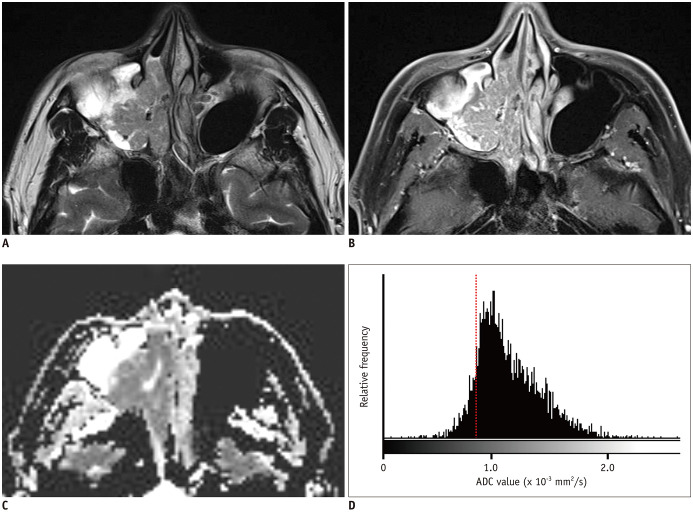
Preoperative differentiation between inverted papilloma (IP) and its malignant transformation to squamous cell carcinoma (IP-SCC) is critical for patient management. We aimed to determine the diagnostic accuracy of conventional imaging features and histogram parameters obtained from whole tumor apparent diffusion coefficient (ADC) values to predict IP-SCC in patients with IP, using decision tree analysis.
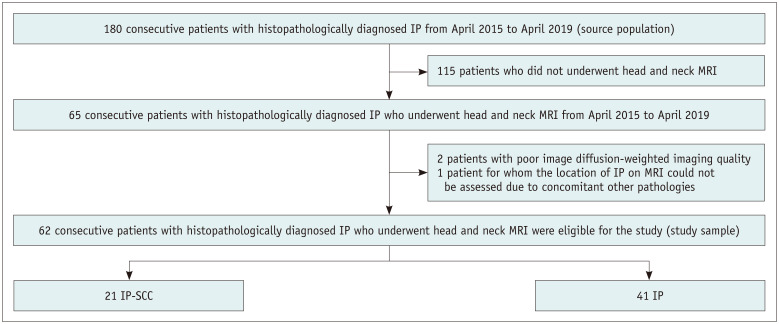
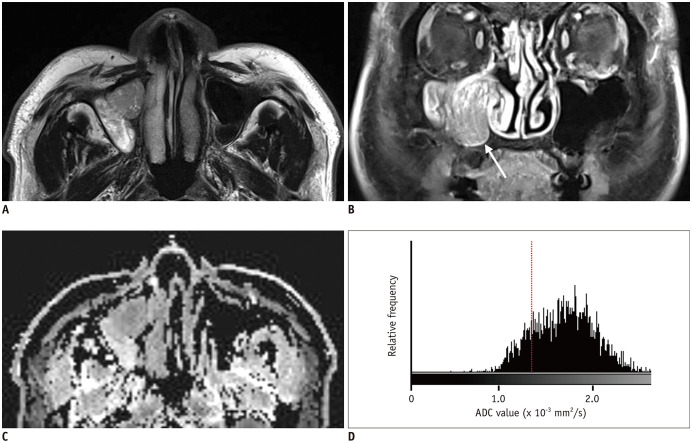
In this retrospective study, we analyzed data generated from the records of 180 consecutive patients with histopathologically diagnosed IP or IP-SCC who underwent head and neck magnetic resonance imaging, including diffusion-weighted imaging and 62 patients were included in the study. To obtain whole tumor ADC values, the region of interest was placed to cover the entire volume of the tumor. Classification and regression tree analyses were performed to determine the most significant predictors of IP-SCC among multiple covariates. The final tree was selected by cross-validation pruning based on minimal error.
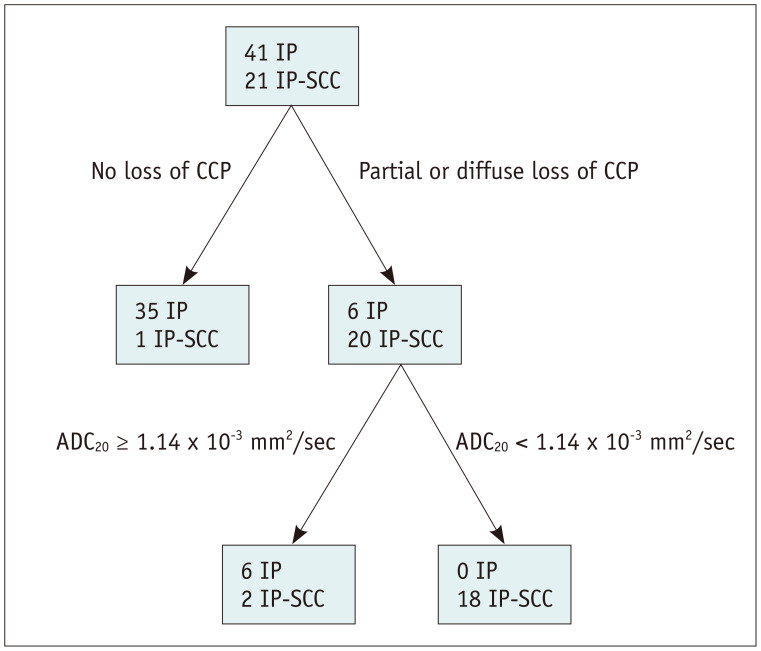
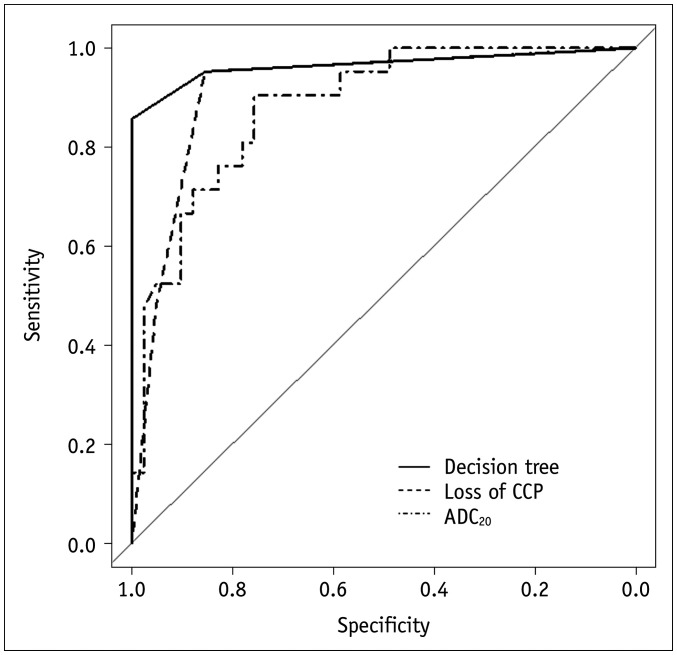
Of 62 patients with IP, 21 (34%) had IP-SCC. The decision tree analysis revealed that the loss of convoluted cerebriform pattern and the 20th percentile cutoff of ADC were the most significant predictors of IP-SCC. With these decision trees, the sensitivity, specificity, accuracy, and C-statistics were 86% (18 out of 21; 95% confidence interval [CI], 65-95%), 100% (41 out of 41; 95% CI, 91-100%), 95% (59 out of 61; 95% CI, 87-98%), and 0.966 (95% CI, 0.912-1.000), respectively.
Decision tree analysis using conventional imaging features and histogram analysis of whole volume ADC could predict IP-SCC in patients with IP with high diagnostic accuracy.
术前鉴别内翻性乳头状瘤(IP)及其恶性转化为鳞状细胞癌(IP-SCC)对于患者管理至关重要。我们旨在通过决策树分析确定常规成像特征和直方图参数与全肿瘤表观扩散系数(ADC)值之间的诊断准确性,以预测 IP 患者中的 IP-SCC。
在这项回顾性研究中,我们分析了 180 例经组织病理学诊断为 IP 或 IP-SCC 的连续患者的头颈部磁共振成像(包括扩散加权成像)记录数据,其中 62 例患者纳入研究。为了获得全肿瘤 ADC 值,感兴趣区域被放置以覆盖肿瘤的整个体积。分类和回归树分析用于确定多个协变量中 IP-SCC 的最显著预测因子。最终树是通过基于最小误差的交叉验证修剪选择的。
在 62 例 IP 患者中,21 例(34%)患有 IP-SCC。决策树分析显示,脑回状模式的丧失和 ADC 的第 20 百分位截断是 IP-SCC 的最显著预测因子。使用这些决策树,敏感性、特异性、准确性和 C 统计量分别为 86%(21 例中的 18 例;95%置信区间 [CI],65-95%)、100%(41 例中的 41 例;95% CI,91-100%)、95%(61 例中的 59 例;95% CI,87-98%)和 0.966(95% CI,0.912-1.000)。
使用常规成像特征和全容积 ADC 直方图分析的决策树分析可以预测 IP 患者中的 IP-SCC,具有较高的诊断准确性。