Lachat Camille, Bruyère Diane, Etcheverry Amandine, Aubry Marc, Mosser Jean, Warda Walid, Herfs Michaël, Hendrick Elodie, Ferrand Christophe, Borg Christophe, Delage-Mourroux Régis, Feugeas Jean-Paul, Guittaut Michaël, Hervouet Eric, Peixoto Paul
UMR1098, RIGHT, Université Bourgogne Franche-Comté, INSERM, EFS BFC, F-25000 Besançon, France.
Laboratory of Experimental Pathology, GIGA-Cancer, University of Liege, 4000 Liege, Belgium.
Cancers (Basel). 2020 Dec 5;12(12):3649. doi: 10.3390/cancers12123649.
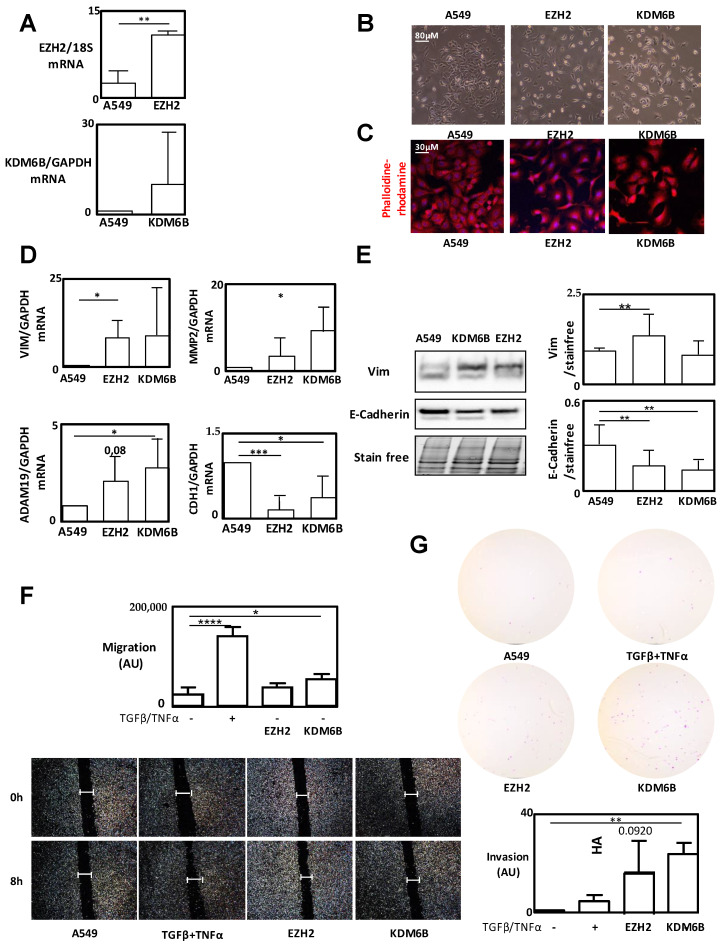
The role of Epigenetics in Epithelial Mesenchymal Transition (EMT) has recently emerged. Two epigenetic enzymes with paradoxical roles have previously been associated to EMT, EZH2 (Enhancer of Zeste 2 Polycomb Repressive Complex 2 (PRC2) Subunit), a lysine methyltranserase able to add the H3K27me3 mark, and the histone demethylase KDM6B (Lysine Demethylase 6B), which can remove the H3K27me3 mark. Nevertheless, it still remains unclear how these enzymes, with apparent opposite activities, could both promote EMT. In this study, we evaluated the function of these two enzymes using an EMT-inducible model, the lung cancer A549 cell line. ChIP-seq coupled with transcriptomic analysis showed that EZH2 and KDM6B were able to target and modulate the expression of different genes during EMT. Based on this analysis, we described INHBB, WTN5B, and ADAMTS6 as new EMT markers regulated by epigenetic modifications and directly implicated in EMT induction.
表观遗传学在上皮-间质转化(EMT)中的作用最近才被发现。此前,两种具有矛盾作用的表观遗传酶与EMT相关,即EZH2(zeste增强子2多梳抑制复合体2(PRC2)亚基),一种能够添加H3K27me3标记的赖氨酸甲基转移酶,以及组蛋白去甲基化酶KDM6B(赖氨酸去甲基化酶6B),它可以去除H3K27me3标记。然而,目前仍不清楚这两种具有明显相反活性的酶如何都能促进EMT。在本研究中,我们使用一种EMT诱导模型——肺癌A549细胞系,评估了这两种酶的功能。ChIP-seq结合转录组分析表明,EZH2和KDM6B在EMT过程中能够靶向并调节不同基因的表达。基于此分析,我们将抑制素βB(INHBB)、WNT5B和ADAMTS6描述为受表观遗传修饰调控且直接参与EMT诱导的新EMT标志物。