Hajdu Dorottya, Sedova Aleksandra, Datlinger Felix, Hafner Julia, Steiner Irene, Kriechbaum Katharina, Scholda Christoph, Sacu Stefan, Schmidt-Erfurth Ursula, Pollreisz Andreas
Department of Ophthalmology and Optometry, Vienna Clinical Trial Centre (VTC), Medical University of Vienna, Waehringer Guertel 18-20, E8i, 1090, Vienna, Austria.
Center for Medical Statistics, Informatics, and Intelligent Systems (CeMSIIS), Section for Medical Statistics, Medical University of Vienna, Vienna, Austria.
Int J Retina Vitreous. 2020 Nov 4;6(1):50. doi: 10.1186/s40942-020-00253-w.
The aim of our study was to investigate a possible association between macular perfusion status and retinal ischemia and leakage up to far peripheral retinal areas in eyes with early to advanced stages of diabetic retinopathy (DR).
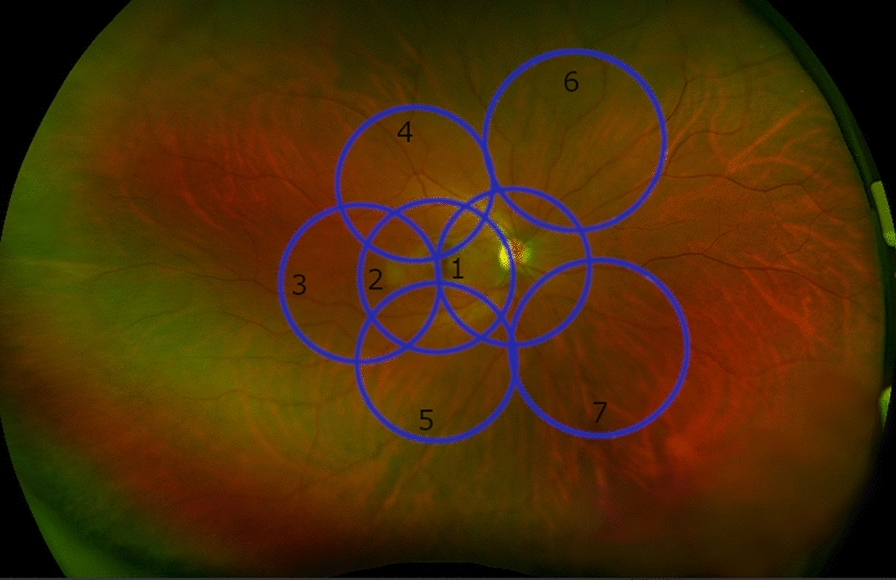
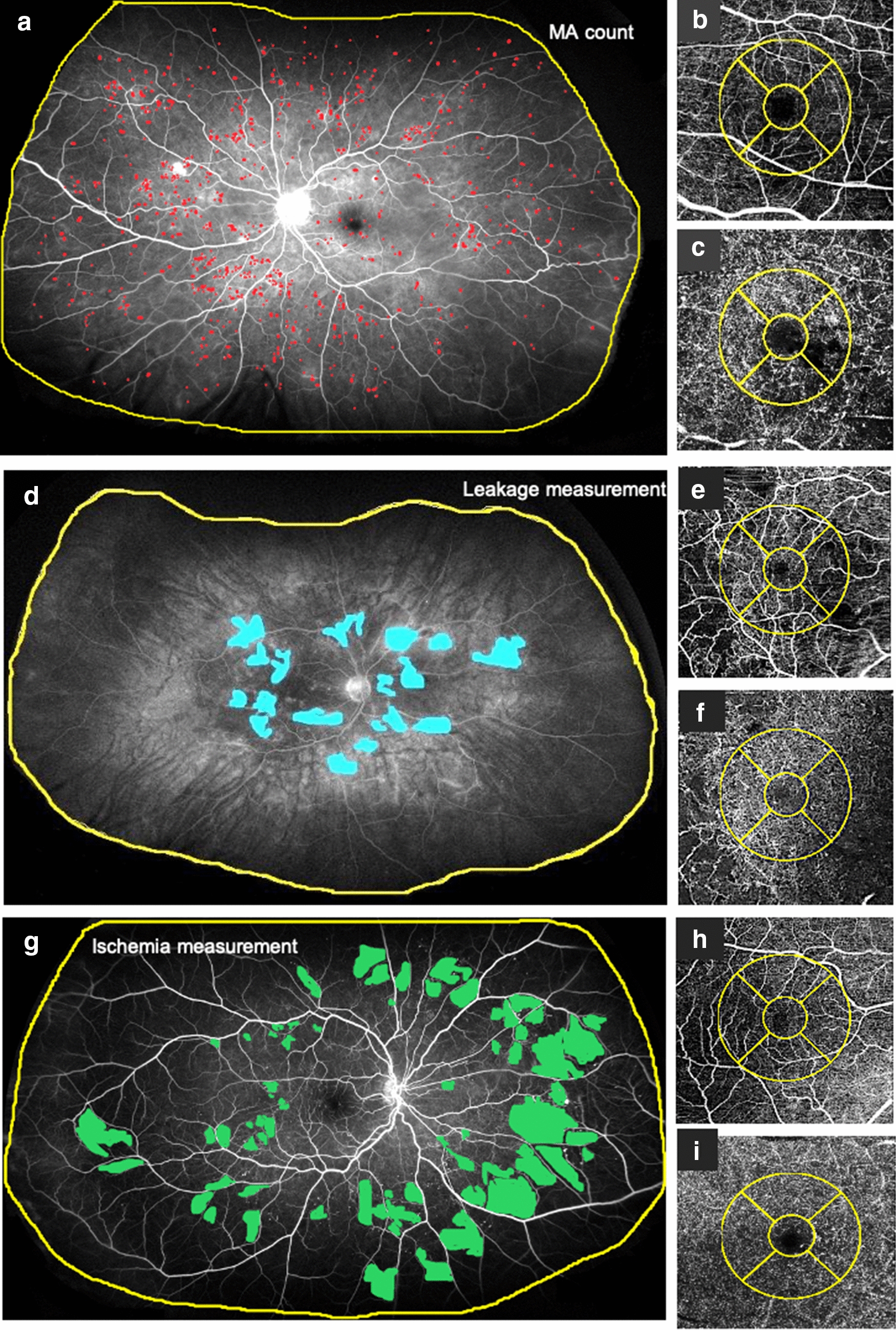
In a retrospective, cross sectional analysis ultrawide field (UWF) color fundus photos (Optos, Optomap California) were graded for DR severity. Foveal avascular zone (FAZ) and vessel density from the superficial (SCP) and deep capillary plexus (DCP) were assessed on optical coherence tomography angiography (OCTA) scans (Topcon, DRI-OCT Triton). UWF angiography images were used to quantify leakage/ischemic index and number of microaneurysms (MA). Age, gender, disease duration, type of diabetes, HbA1C, hypertension, complications of diabetes and ocular history were recorded. Univariate mixed models and Spearman correlation analysis were used for statistical testing.
24 eyes of 17 laser-naive diabetic patients with different stages of DR were analyzed. The mean age was 59.56 ± 8.46 years and the mean disease duration 19.65 ± 12.25 years. No statistically significant associations between FAZ size, macular vessel density of SCP/DCP and peripheral retinal ischemia, leakage and MA number were demonstrated. Higher stages of DR were associated with ischemic index (estimate [95% CI]: 13.04 [1.5; 24.5], p = 0.033) and MA count (estimate [95% CI]: 43.7 [15.6; 71.8], p = 0.01), but no association with leakage index was observed. Only weak correlations between DR severity and anamnestic data were found.
Retinal ischemic index and the amount of MAs assessed on UWFA up to peripheral areas are indicators of DR severity but not related to microvascular perfusion status in the macular region. Significance and timely sequence of macular vessel density in DR progression may need to be re-evaluated in future studies.
我们研究的目的是调查糖尿病视网膜病变(DR)早期至晚期患者黄斑灌注状态与视网膜缺血及远周边视网膜区域渗漏之间可能存在的关联。
在一项回顾性横断面分析中,对超广角(UWF)彩色眼底照片(Optos,Optomap California)进行DR严重程度分级。在光学相干断层扫描血管造影(OCTA)扫描(Topcon,DRI - OCT Triton)上评估中央凹无血管区(FAZ)以及浅层(SCP)和深层毛细血管丛(DCP)的血管密度。使用UWF血管造影图像量化渗漏/缺血指数和微动脉瘤(MA)数量。记录年龄、性别、病程、糖尿病类型、糖化血红蛋白、高血压、糖尿病并发症和眼部病史。采用单变量混合模型和Spearman相关性分析进行统计学检验。
分析了17例未接受激光治疗的不同阶段DR糖尿病患者的24只眼。平均年龄为59.56±8.46岁,平均病程为19.65±12.25年。未发现FAZ大小、SCP/DCP黄斑血管密度与周边视网膜缺血、渗漏及MA数量之间存在统计学显著关联。DR更高阶段与缺血指数(估计值[95%置信区间]:13.04[1.5;24.5],p = 0.033)和MA计数(估计值[95%置信区间]:43.7[15.6;71.8],p = 0.01)相关,但未观察到与渗漏指数相关。仅发现DR严重程度与既往病史数据之间存在弱相关性。
在外周区域通过超广角荧光血管造影(UWFA)评估的视网膜缺血指数和MA数量是DR严重程度的指标,但与黄斑区域的微血管灌注状态无关。黄斑血管密度在DR进展中的意义和时间顺序可能需要在未来研究中重新评估。