Experimental Immunology Branch, National Cancer Institute, Bethesda, MD, 20892, USA.
Nat Commun. 2020 Dec 8;11(1):6264. doi: 10.1038/s41467-020-20070-x.
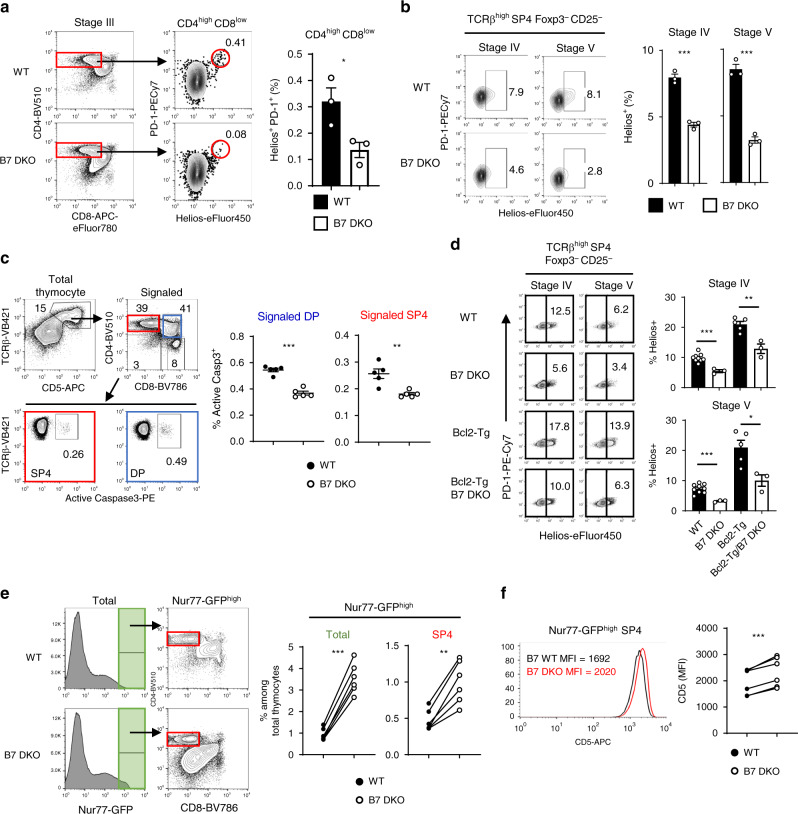
The molecular and cellular mechanisms mediating thymic central tolerance and prevention of autoimmunity are not fully understood. Here we show that B7-CD28 co-stimulation and B7 expression by specific antigen-presenting cell (APC) types are required for clonal deletion and for regulatory T (Treg) cell generation from endogenous tissue-restricted antigen (TRA)-specific thymocytes. While B7-CD28 interaction is required for both clonal deletion and Treg induction, these two processes differ in their CD28 signaling requirements and in their dependence on B7-expressing dendritic cells, B cells, and thymic epithelial cells. Meanwhile, defective thymic clonal deletion due to altered B7-CD28 signaling results in the accumulation of mature, peripheral TRA-specific T cells capable of mediating destructive autoimmunity. Our findings thus reveal a function of B7-CD28 co-stimulation in shaping the T cell repertoire and limiting autoimmunity through both thymic clonal deletion and Treg cell generation.
胸腺中枢耐受和预防自身免疫的分子和细胞机制尚未完全阐明。本文作者表明,B7-CD28 共刺激和特定抗原呈递细胞(APC)类型表达的 B7 对于克隆性删除和内源性组织限制性抗原(TRA)特异性胸腺细胞中调节性 T(Treg)细胞的产生是必需的。虽然 B7-CD28 相互作用对于克隆性删除和 Treg 诱导都是必需的,但这两个过程在 CD28 信号要求以及对表达 B7 的树突状细胞、B 细胞和胸腺上皮细胞的依赖性方面存在差异。同时,由于 B7-CD28 信号转导改变导致的胸腺克隆性删除缺陷会导致成熟的外周 TRA 特异性 T 细胞积累,这些细胞能够介导破坏性自身免疫。因此,这些发现揭示了 B7-CD28 共刺激在通过胸腺克隆性删除和 Treg 细胞产生来塑造 T 细胞库和限制自身免疫中的作用。