HM CINAC, Hospital Universitario HM Puerta del Sur, HM Hospitales, Universidad CEU-San Pablo, Madrid, Spain.
CIBERNED, Instituto de Salud Carlos III, Madrid, Spain.
Sci Rep. 2020 Dec 8;10(1):21422. doi: 10.1038/s41598-020-77383-6.
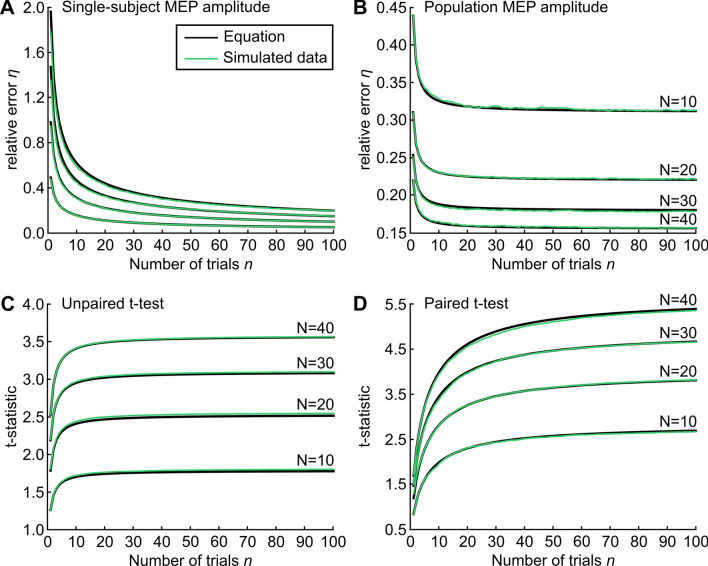
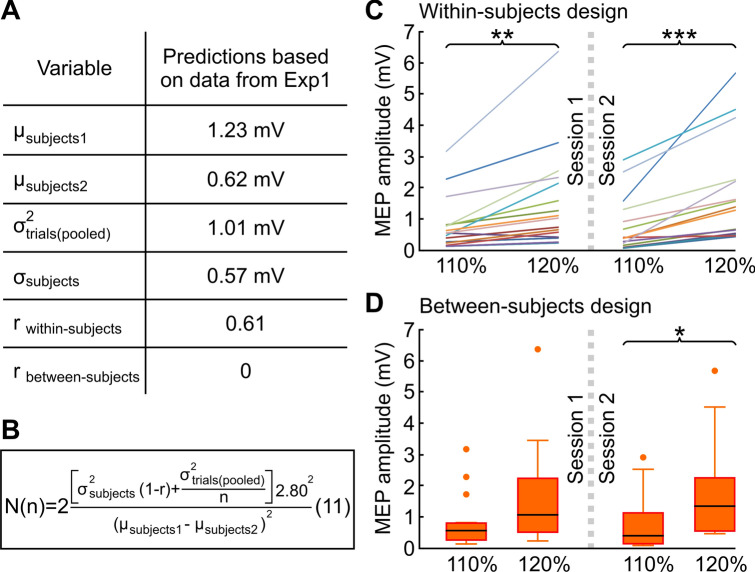
The amplitude of motor evoked potentials (MEPs) elicited by transcranial magnetic stimulation (TMS) is a common yet highly variable measure of corticospinal excitability. The tradeoff between maximizing the number of trials and minimizing experimental time remains a hurdle. It is therefore important to establish how many trials should be used. The aim of this study is not to provide rule-of-thumb answers that may be valid only in specific experimental conditions, but to offer a more general framework to inform the decision about how many trials to use under different experimental conditions. Specifically, we present a set of equations that show how the number of trials affects single-subject MEP amplitude, population MEP amplitude, hypothesis testing and test-retest reliability, depending on the variability within and between subjects. The equations are derived analytically, validated with Monte Carlo simulations, and representatively applied to experimental data. Our findings show that the minimum number of trials for estimating single-subject MEP amplitude largely depends on the experimental conditions and on the error considered acceptable by the experimenter. Conversely, estimating population MEP amplitude and hypothesis testing are markedly more dependent on the number of subjects than on the number of trials. These tools and results help to clarify the impact of the number of trials in the design and reproducibility of past and future experiments.
经颅磁刺激(TMS)诱发的运动诱发电位(MEPs)幅度是皮质脊髓兴奋性的常用且高度可变的测量指标。在最大限度地增加试验次数和最小化实验时间之间取得平衡仍然是一个障碍。因此,确定应该使用多少个试验是很重要的。本研究的目的不是提供可能仅在特定实验条件下有效的经验法则答案,而是提供一个更通用的框架,以便在不同实验条件下决定使用多少个试验。具体来说,我们提出了一组方程,展示了试验次数如何根据个体内和个体间的变异性影响单个体 MEP 幅度、群体 MEP 幅度、假设检验和测试-再测试可靠性。这些方程是通过解析推导得出的,并用蒙特卡罗模拟进行了验证,并代表性地应用于实验数据。我们的研究结果表明,估计单个体 MEP 幅度所需的最小试验次数在很大程度上取决于实验条件和实验者可接受的误差。相反,估计群体 MEP 幅度和假设检验则明显更依赖于受试者的数量,而不是试验次数。这些工具和结果有助于澄清试验次数在过去和未来实验的设计和可重复性方面的影响。