Institute of Theoretical Physics, Faculty of Physics and Astronomy, University of Wrocław, pl. M. Borna 9, 50-204, Wrocław, Poland.
Sci Rep. 2020 Dec 8;10(1):21488. doi: 10.1038/s41598-020-78415-x.
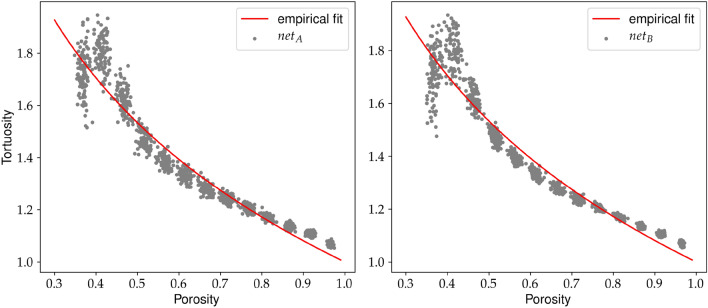
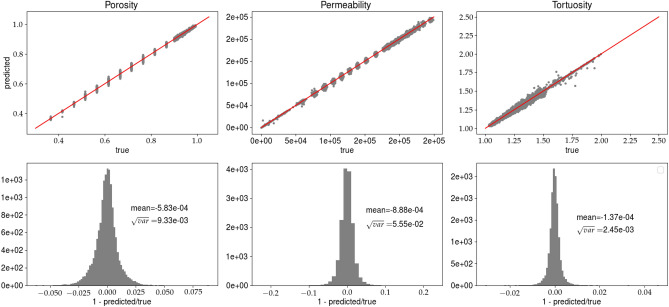
Convolutional neural networks (CNN) are utilized to encode the relation between initial configurations of obstacles and three fundamental quantities in porous media: porosity ([Formula: see text]), permeability (k), and tortuosity (T). The two-dimensional systems with obstacles are considered. The fluid flow through a porous medium is simulated with the lattice Boltzmann method. The analysis has been performed for the systems with [Formula: see text] which covers five orders of magnitude a span for permeability [Formula: see text] and tortuosity [Formula: see text]. It is shown that the CNNs can be used to predict the porosity, permeability, and tortuosity with good accuracy. With the usage of the CNN models, the relation between T and [Formula: see text] has been obtained and compared with the empirical estimate.
卷积神经网络(CNN)用于编码障碍物初始构型与多孔介质中三个基本量之间的关系:孔隙度 ([Formula: see text])、渗透率 (k) 和迂曲度 (T)。考虑二维含障碍物系统。使用晶格玻尔兹曼方法模拟多孔介质中的流体流动。分析涵盖了渗透率 [Formula: see text] 和迂曲度 [Formula: see text] 的五个数量级跨度的 [Formula: see text] 系统。结果表明,CNN 可用于准确预测孔隙度、渗透率和迂曲度。通过使用 CNN 模型,获得了 T 与 [Formula: see text] 之间的关系,并与经验估计进行了比较。