Kuvås Karen Rosmo, Saltvedt Ingvild, Aam Stina, Thingstad Pernille, Ellekjær Hanne, Askim Torunn
Department of Neuromedicine and Movement Science, Faculty of Medicine and Health Science, NTNU-Norwegian University of Science and Technology, Trondheim, Norway.
Department of Geriatrics, Clinic of Medicine, St. Olavs Hospital, Trondheim University Hospital, Trondheim, Norway.
Clin Epidemiol. 2020 Dec 1;12:1327-1336. doi: 10.2147/CLEP.S276631. eCollection 2020.
The Norwegian Cognitive Impairment After Stroke (Nor-COAST) study aimed to estimate the prevalence and incidence of neurocognitive disorder in an unselected stroke cohort. The aim of the present study was to investigate whether selection bias occurred by comparing baseline characteristics from participants with non-participants in Nor-COAST.
Nor-COAST is a prospective cohort multi-center study, recruiting participants from five Norwegian hospitals. Patients with the diagnosis of acute stroke were screened for inclusion. Baseline data from the participants recruited between May 2015 and March 2017 were compared to corresponding data from those not participating in Nor-COAST but registered in the Norwegian Stroke Registry. Regression analysis was used to assess whether age, stroke severity, sex and stroke subtype were independently associated with inclusion in the study.
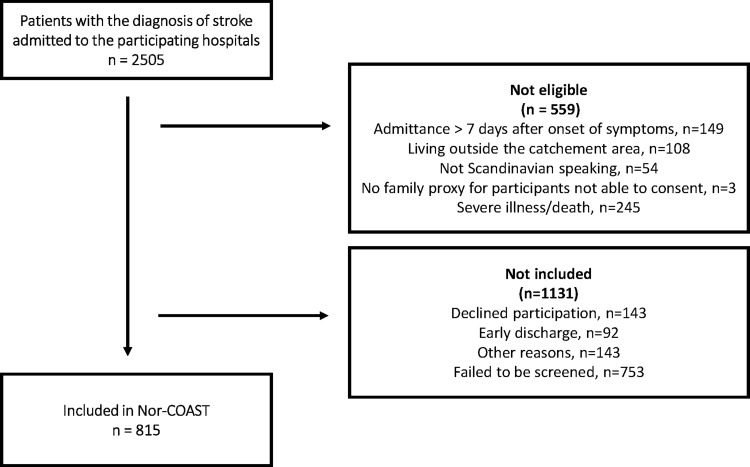
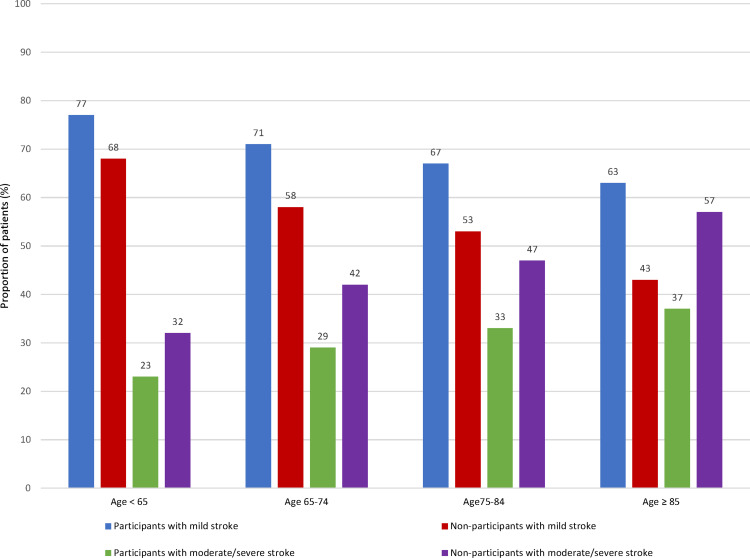
Out of 2505 available patients, 815 (32.5%) were included in Nor-COAST. There were no differences between participants and non-participants with respect to age (mean (SD) age 73.5 (11.7) versus 74.2 (14.5) years) or sex (44.8% versus 46.9% women). A significantly larger proportion of the participants were independent prior to stroke (87% versus 78%), had mild strokes (69% versus 55%) and suffered from cerebral infarction (90% versus 84%). The regression analysis showed decreased odds ratio (OR) of being included for those with higher degree of pre-stroke dependency (OR 0.895, 95% CI 0.825 to 0.971, p=0.007) and a more severe stroke (OR 0.952, 95% CI 0.939 to 0.966, p<0.001).
The participants in Nor-COAST had a better pre-stroke health condition and milder strokes compared to non-participants. However, the participants should be regarded as representative of the majority of the stroke population which suffers from mild strokes. Nevertheless, baseline information for non-participants should be available also in future clinical studies to make it easier to identify which part of the stroke population the results can be generalized to.
挪威卒中后认知障碍(Nor-COAST)研究旨在评估一个未经挑选的卒中队列中神经认知障碍的患病率和发病率。本研究的目的是通过比较Nor-COAST参与者与非参与者的基线特征,调查是否存在选择偏倚。
Nor-COAST是一项前瞻性队列多中心研究,从挪威五家医院招募参与者。对诊断为急性卒中的患者进行纳入筛查。将2015年5月至2017年3月招募的参与者的基线数据与未参与Nor-COAST但在挪威卒中登记处登记的患者的相应数据进行比较。采用回归分析评估年龄、卒中严重程度、性别和卒中亚型是否与纳入研究独立相关。
在2505名可用患者中,815名(32.5%)被纳入Nor-COAST。参与者与非参与者在年龄(平均(标准差)年龄73.5(11.7)岁对74.2(14.5)岁)或性别(女性分别为44.8%对46.9%)方面无差异。参与者中卒中前独立的比例显著更高(87%对78%),轻度卒中的比例更高(69%对55%),脑梗死的比例更高(90%对84%)。回归分析显示,卒中前依赖程度较高者被纳入的比值比(OR)降低(OR 0.895,95%可信区间0.825至0.971,p = 0.007),卒中更严重者被纳入的比值比降低(OR 0.952,95%可信区间0.939至0.966,p < 0.001)。
与非参与者相比,Nor-COAST的参与者卒中前健康状况更好,卒中更轻。然而,参与者应被视为大多数轻度卒中患者群体的代表。尽管如此,未来的临床研究也应提供非参与者的基线信息,以便更容易确定研究结果可推广到哪部分卒中患者群体。