Li Jie, Zhang Lijuan, Sun Zongqiong, Ge Yuxi, Zhou Jialiang, Xie Qigen
Department of Intervention, Affiliated Hospital of Jiangnan University (Wuxi Fourth People's Hospital), China.
Department of Radiology, Wuxi People's Hospital, Nanjing Medical University, China.
J Contemp Brachytherapy. 2020 Aug;12(4):335-342. doi: 10.5114/jcb.2020.98112. Epub 2020 Aug 21.
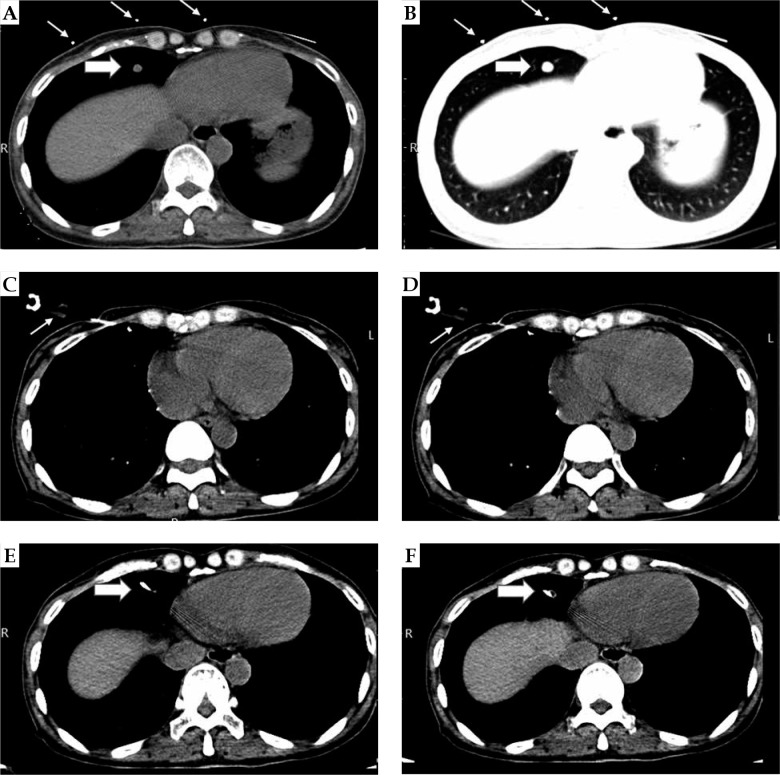
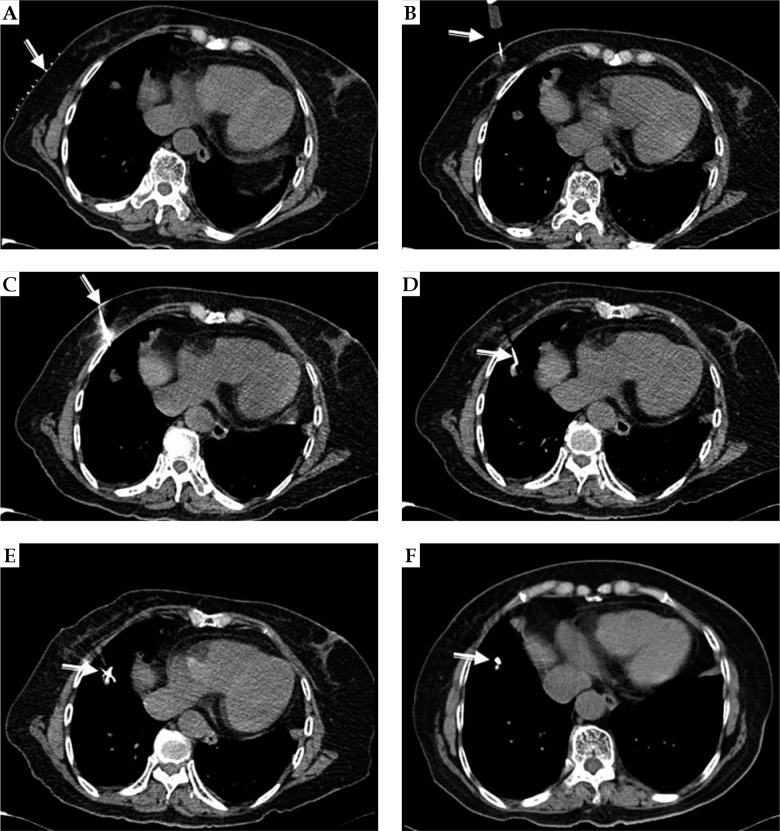
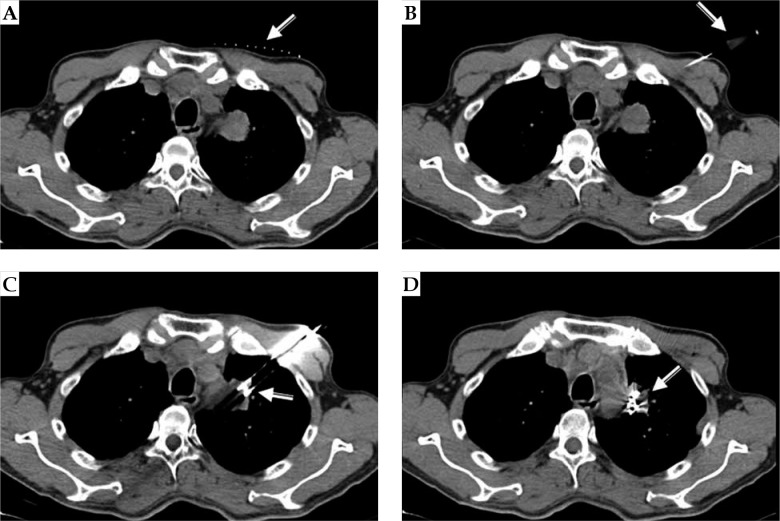
Small lung metastases change their location with respiration, making difficult to localize, therefore, increasing the number of punctures. Accurate puncture can reduce trauma to lung tissue and accelerate patient's recovery. The aim of the study was to present our experience with the technique of using local anesthesia 5-ml syringe as a guide for computerized tomography-guided iodine-125 seed implantation (CT-ISI).
This was a retrospective study, including patients with small metastatic tumors in the lung, treated with CT-ISI between December 2013 and March 2018 at the Affiliated Hospital of the University. The patients were divided according to whether a 5-ml syringe was used as a guide during CT-ISI or not. The final follow-up was on March 31, 2018. Implantation success and complications were examined.
Nineteen patients were included. A total of 840 seeds were used, with 44.2 ±33.6 (range, 10-160) seeds per patient. The mean D for CT-ISI was 134.5 ±7.5 Gy. Treatment intervention for eleven patients was performed using a 5-ml syringe as a guide during CT-ISI. There were no differences in total dose and number of implanted seeds between the two groups, but the number of punctures per lesion was lower in the syringe group than in the no-syringe group (1.9 ±0.5 vs. 2.9 ±0.6, < 0.001), suggesting a higher puncture accuracy. The total number of SMTIL was 50 (median, 2; range, 1-10), and the median size was 1.9 cm (range, 0.8-2.4 cm). All SMTIL were well-controlled at 6-months follow-up (response rate [RR] = 100%). One patient in the no-syringe group experienced grade 2 chest tightness, chest pain, intraoperative needle tract bleeding, and post-operative blood in sputum.
Puncture with a 5-ml syringe as a guide during CT-ISI seems to be a more accurate option for patients with small (< 2.5 cm) lung metastasis.
肺部小转移瘤会随呼吸改变位置,难以定位,因此穿刺次数增多。精确穿刺可减少对肺组织的创伤并加速患者康复。本研究的目的是介绍我们使用局部麻醉5毫升注射器作为计算机断层扫描引导下碘-125粒子植入术(CT-ISI)导向技术的经验。
这是一项回顾性研究,纳入了2013年12月至2018年3月在该大学附属医院接受CT-ISI治疗的肺部小转移瘤患者。根据CT-ISI期间是否使用5毫升注射器作为导向将患者分组。最后随访时间为2018年3月31日。检查植入成功率和并发症情况。
纳入19例患者。共使用840枚粒子,每位患者平均植入44.2±33.6(范围10 - 160)枚粒子。CT-ISI的平均D值为134.5±7.5 Gy。11例患者在CT-ISI期间使用5毫升注射器作为导向进行治疗干预。两组之间的总剂量和植入粒子数量无差异,但注射器组每个病灶的穿刺次数低于无注射器组(1.9±0.5对2.9±0.6,P<0.001),表明穿刺准确性更高。小转移瘤病灶总数为50个(中位数为2;范围1 - 10),中位大小为1.9厘米(范围0.8 - 2.4厘米)。所有小转移瘤病灶在6个月随访时均得到良好控制(缓解率[RR]=100%)。无注射器组有1例患者出现2级胸闷、胸痛、术中针道出血和术后痰中带血。
对于肺部小(<2.5厘米)转移瘤患者,在CT-ISI期间使用5毫升注射器作为导向进行穿刺似乎是一种更精确的选择。