Department of Cardiology, Sir Run Run Shaw Hospital, Zhejiang University School of Medicine, Hangzhou, China.
Key Laboratory of Cardiovascular Intervention and Regenerative Medicine of Zhejiang Province, Hangzhou, China.
Oxid Med Cell Longev. 2020 Nov 26;2020:8866946. doi: 10.1155/2020/8866946. eCollection 2020.
Coronary heart disease is currently the leading cause of death in humans. Its poor prognosis and high mortality are associated with myocardial ischemia, which leads to metabolic disorder-related cardiomyocyte apoptosis and reactive oxygen species (ROS) production. Previous cardiovascular metabolomics studies in humans and mice have shown that proline metabolism is severely altered after cardiomyocyte hypoxia. Proline dehydrogenase (PRODH) is located on the inner mitochondrial membrane and is an enzyme that catalyzes the first step of proline catabolism, which plays an important role in improving the cellular redox state. In vitro oxygen-glucose deprivation can mimic in vivo myocardial ischemic injury. This study is aimed at investigating whether enhancing proline metabolism by overexpressing PRODH can ameliorate hypoxia-induced injury in cardiomyocytes and to reveal the related altered metabolites and mechanistic pathway via untargeted metabolomics analysis.
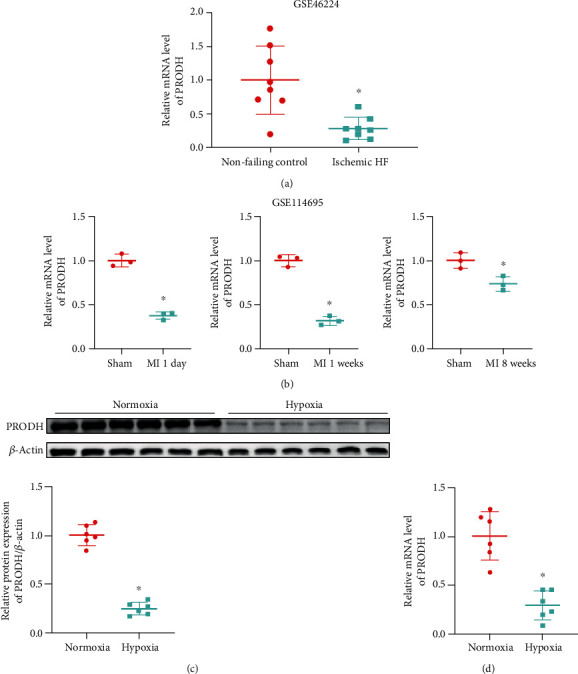
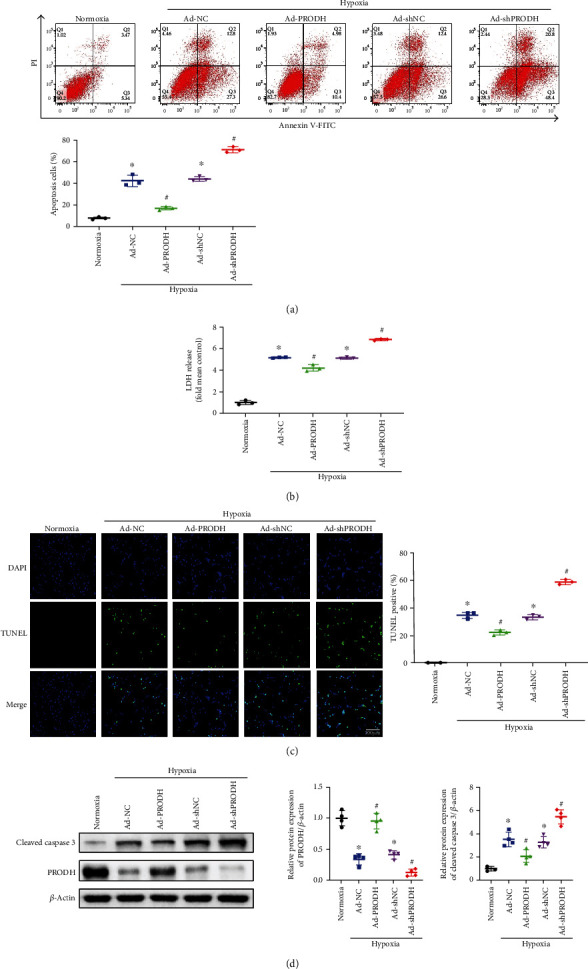
First, through public database analysis and RT-qPCR and western blot analyses in a cardiomyocyte hypoxia model, we found that the expression of the proline-degrading enzyme PRODH was downregulated after myocardial infarction and hypoxia exposure. Second, LDH assays, terminal deoxynucleotidyl transferase dUTP nick end labeling (TUNEL), DHE staining, flow cytometric apoptosis analysis with DCFH and Annexin V-FITC/PI, and western blot analysis were used to assess the injury level in cardiomyocytes. Enhanced proline metabolism induced by PRODH overexpression reduced the levels of reactive oxidative stress and apoptosis, whereas PRODH knockdown had the opposite effects. Third, untargeted metabolomics analysis revealed that the protective effect was associated with significant changes in metabolism linked to sphingolipid signaling pathways, unsaturated fatty acid biosynthesis, phosphocreatine, glutathione disulfide, aminoacyl-tRNA biosynthesis, and ABC transporters.
Our study demonstrated a protective effect of enhanced proline metabolism in cardiomyocytes under hypoxia, providing a novel strategy for exploring new treatments for coronary heart disease.
冠心病目前是人类死亡的主要原因。其预后不良和高死亡率与心肌缺血有关,这导致代谢紊乱相关的心肌细胞凋亡和活性氧(ROS)的产生。之前在人类和小鼠的心血管代谢组学研究中表明,缺氧后脯氨酸代谢严重改变。脯氨酸脱氢酶(PRODH)位于线粒体内膜,是一种催化脯氨酸分解代谢第一步的酶,在改善细胞氧化还原状态方面发挥着重要作用。体外氧葡萄糖剥夺可以模拟体内心肌缺血损伤。本研究旨在探讨通过过表达 PRODH 增强脯氨酸代谢是否可以改善心肌细胞缺氧诱导的损伤,并通过非靶向代谢组学分析揭示相关改变的代谢物和机制途径。
首先,通过公共数据库分析以及心肌细胞缺氧模型中的 RT-qPCR 和 Western blot 分析,我们发现脯氨酸降解酶 PRODH 的表达在心肌梗死后和缺氧暴露后下调。其次,通过 LDH 测定、末端脱氧核苷酸转移酶 dUTP 缺口末端标记(TUNEL)、DHE 染色、DCFH 和 Annexin V-FITC/PI 流式细胞术凋亡分析以及 Western blot 分析评估心肌细胞的损伤水平。PRODH 过表达诱导的增强脯氨酸代谢降低了活性氧化应激和细胞凋亡水平,而 PRODH 敲低则产生相反的效果。第三,非靶向代谢组学分析表明,这种保护作用与与鞘脂信号通路、不饱和脂肪酸生物合成、磷酸肌酸、二硫谷胱甘肽、氨酰-tRNA 生物合成和 ABC 转运体相关的代谢变化显著相关。
我们的研究表明,增强脯氨酸代谢对缺氧心肌细胞具有保护作用,为探索治疗冠心病的新方法提供了新策略。