Pajuste Klavs, Rucins Martins, Domracheva Ilona, Sobolev Arkadij, Pikun Nadiia, Plotniece Mara, Duburs Gunars, Pajuste Karlis, Plotniece Aiva
Latvian Institute of Organic Synthesis, Aizkraukles str. 21, LV-1006, Riga, Latvia.
Department of Pharmaceutical Chemistry, Faculty of Pharmacy, Riga Stradiņš University, Dzirciema str. 16, LV-1007, Riga, Latvia.
Data Brief. 2020 Nov 19;33:106545. doi: 10.1016/j.dib.2020.106545. eCollection 2020 Dec.
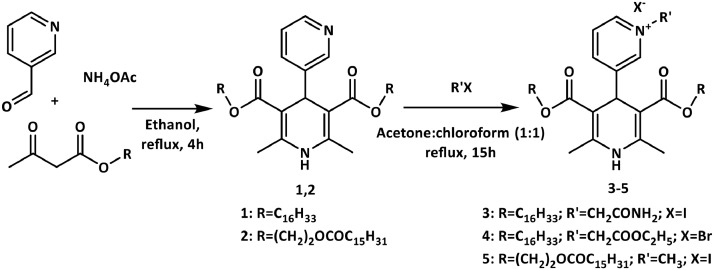
In this data file the synthetic procedures for preparation of the original 4-pyridinium-1,4-dihydropyridines (4-Py-1,4-DHP) and their parent compounds - dialkyl 2,6-dimethyl-4-(3-pyridyl)-1,4-dihydropyridine-3,5-dicarboxylates were described. In total, 5 unpublished compounds were obtained and characterised. All the structures of original compounds were confirmed by Nuclear Magnetic Resonance (NMR, including H NMR and C NMR) and low resolution mass spectra (MS) data. Additionally, the cytotoxic properties of four 4-Py-1,4-DHPs were evaluated on 3 cell lines - normal NIH3T3 (mouse embryonic fibroblast), cancerous HT-1080 (human lung fibrosarcoma) and MH-22A (mouse hepatoma) and self-assembling properties were studied and characterisation of formed nanoparticles were performed using dynamic light scattering technique. In this article provided data are directly related to the previously published research articles - "Novel cationic amphiphilic 1,4-dihydropyridine derivatives for DNA delivery" [1] where compound 5 was tested as gene delivery agent without full physico-chemical characterisation and "Synthesis and studies of calcium channel blocking and antioxidant activities of novel 4-pyridinium and/or N-propargyl substituted 1,4-dihydropyridine derivatives" [2] where synthesis and physico-chemical characterisation as well as calcium channel blocking and antioxidant activities were described for compound 6. Synthesis of other compounds - parent 1,4-DHPs 1 and 2, and 4-Py-1,4-DHPs 3-5, their characterisation, estimation of cytotoxicity and self-assembling properties for all 4-Py-1,4-DHPs 3-6 are reported herein for the first time. Information provided in this data file can be used in medicinal chemistry by other scientists to estimate structure-activity relationships for the analysis and construction of various cationic 1,4-dihydropyridine derivatives and related heterocycles.
在该数据文件中,描述了制备原始4-吡啶鎓-1,4-二氢吡啶(4-Py-1,4-DHP)及其母体化合物——2,6-二甲基-4-(3-吡啶基)-1,4-二氢吡啶-3,5-二羧酸二烷基酯的合成方法。总共获得并表征了5种未发表的化合物。所有原始化合物的结构均通过核磁共振(NMR,包括氢核磁共振和碳核磁共振)以及低分辨率质谱(MS)数据得以确认。此外,对四种4-Py-1,4-DHP在3种细胞系上的细胞毒性进行了评估,这3种细胞系分别是正常的NIH3T3(小鼠胚胎成纤维细胞)、癌性的HT-1080(人肺纤维肉瘤)和MH-22A(小鼠肝癌细胞),并研究了它们的自组装性质,同时使用动态光散射技术对形成的纳米颗粒进行了表征。在本文中提供的数据与之前发表的研究文章直接相关,这些文章包括“用于DNA递送的新型阳离子两亲性1,4-二氢吡啶衍生物”[1],其中化合物5作为基因递送剂进行了测试,但未进行全面的物理化学表征;以及“新型4-吡啶鎓和/或N-炔丙基取代的1,4-二氢吡啶衍生物的钙通道阻滞和抗氧化活性的合成与研究”[2],其中描述了化合物6的合成、物理化学表征以及钙通道阻滞和抗氧化活性。本文首次报道了其他化合物——母体1,4-DHP 1和2以及4-Py-1,4-DHP 3 - 5的合成、它们的表征、对所有4-Py-1,4-DHP 3 - 6的细胞毒性评估和自组装性质。该数据文件中提供的信息可供其他科学家在药物化学中用于估计结构-活性关系,以分析和构建各种阳离子1,4-二氢吡啶衍生物及相关杂环。