Rothschild Claire W, Richardson Barbra A, Guthrie Brandon L, Kithao Peninah, Omurwa Tom, Mukabi James, Lokken Erica M, John-Stewart Grace, Unger Jennifer A, Kinuthia John, Drake Alison L
Department of Epidemiology, University of Washington, Seattle, USA.
Departments of Biostatistics and Global Health, University of Washington, Seattle, USA; Division of Vaccine and Infectious Diseases, Fred Hutchinson Cancer Research Center, Seattle, USA.
Contracept X. 2020 Oct 29;2:100045. doi: 10.1016/j.conx.2020.100045. eCollection 2020.
We developed and validated a pragmatic risk assessment tool for identifying contraceptive discontinuation among Kenyan women who do not desire pregnancy.
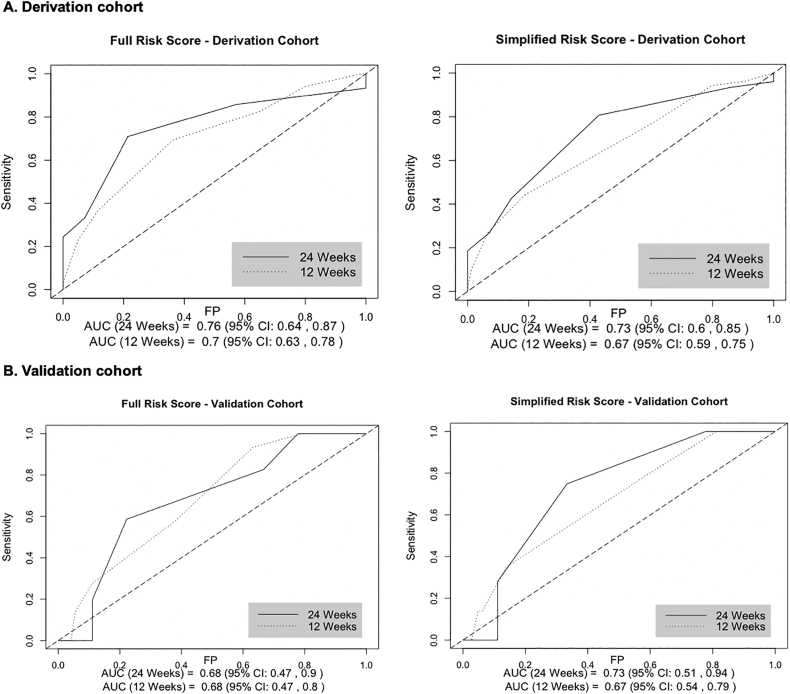
Within a prospective cohort of contraceptive users, participants were randomly allocated to derivation ( = 558) and validation ( = 186) cohorts. Risk scores were developed by selecting the Cox proportional hazards model with the minimum Akaike information criterion. Predictive performance was evaluated using time-dependent receiver operating characteristic curves and area under the curve (AUC).
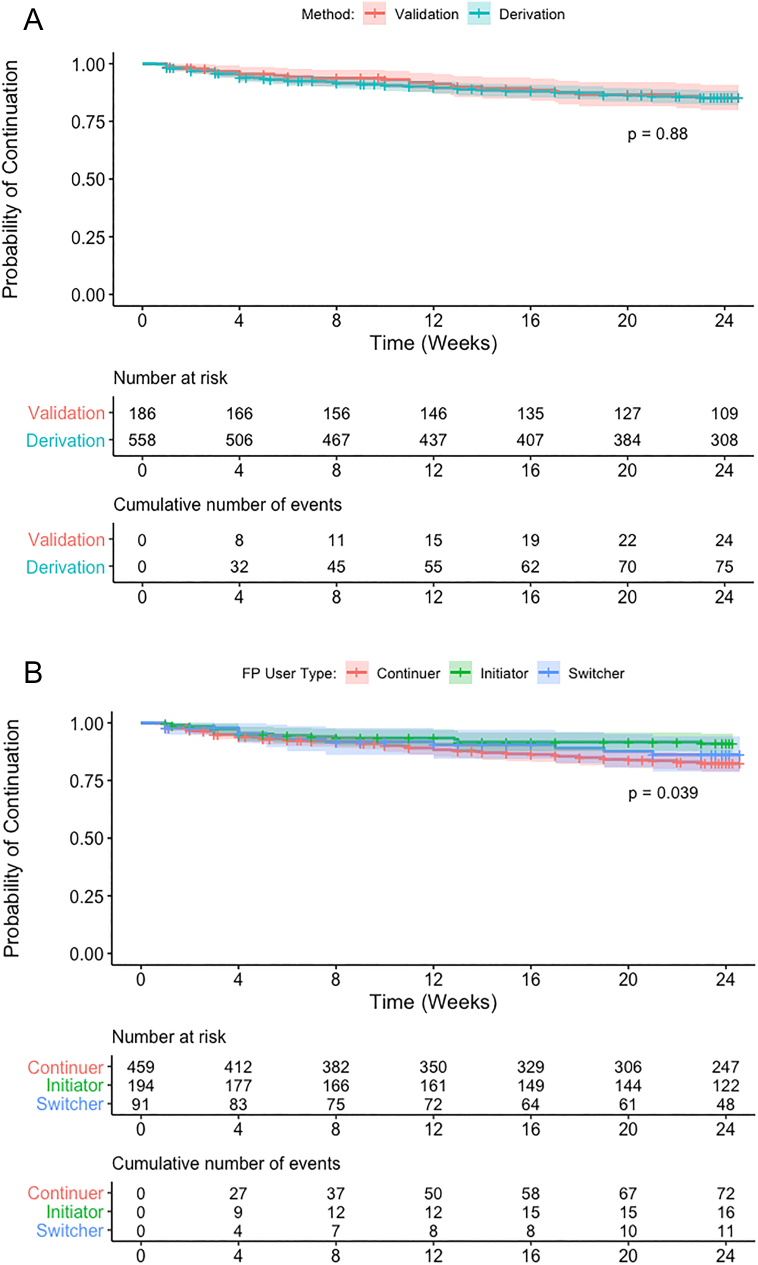
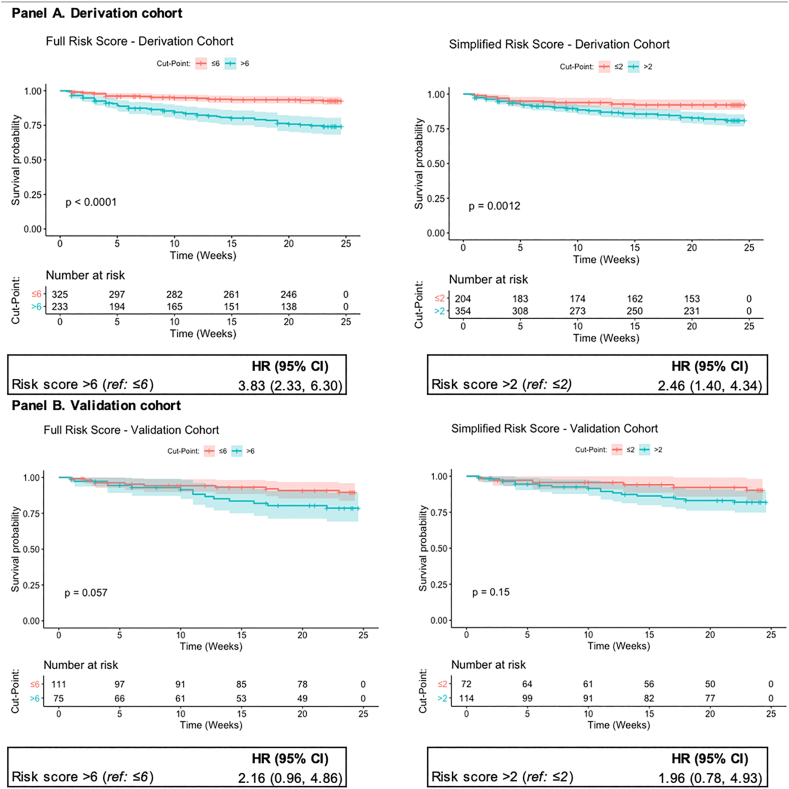
The overall contraceptive discontinuation rate was 36.9 per 100 woman-years (95% confidence interval [CI] 30.3-44.9). The predictors of discontinuation selected for the risk score included use of a short-term method or copper intrauterine device (vs. injectable or implant), method continuation or switch (vs. initiation), < 9 years of completed education, not having a child aged < 6 months, and having no spouse or a spouse supportive of family planning (vs. having a spouse who has unsupportive or uncertain attitudes towards family planning). AUC at 24 weeks was 0.76 (95% CI 0.64-0.87) with 70.0% sensitivity and 78.6% specificity at the optimal cut point in the derivation cohort. Discontinuation was 3.8-fold higher among high- vs. low-risk women (95% CI 2.33-6.30). AUC was 0.68 (95% CI 0.47-0.90) in the validation cohort. A simplified score comprising routinely collected variables demonstrated similar performance (derivation-AUC: 0.73 [95% CI 0.60-0.85]; validation-AUC: 0.73 [95% CI 0.51-0.94]). Positive predictive value in the derivation cohort was 31.4% for the full and 28.1% for the simplified score.
The risk scores demonstrated moderate predictive ability but identified large proportions of women as high risk. Future research is needed to improve sensitivity and specificity of a clinical tool to identify women at high risk for experiencing method-related challenges.
Contraceptive discontinuation is a major driver of unmet contraceptive need globally. Few tools exist for identifying women who may benefit most from additional support in order to meet their contraceptive needs and preferences. This study developed and assessed the validity of a provider-focused risk prediction tool for contraceptive discontinuation among Kenyan women using modern contraception. High rates of early discontinuation observed in this study emphasize the necessity of investing in efforts to develop new contraceptive technologies and stronger delivery systems to better align with women's needs and preferences for voluntary family planning.
我们开发并验证了一种实用的风险评估工具,用于识别不希望怀孕的肯尼亚女性中的避孕措施停用情况。
在一个避孕使用者的前瞻性队列中,参与者被随机分配到推导队列(n = 558)和验证队列(n = 186)。通过选择具有最小赤池信息准则的Cox比例风险模型来制定风险评分。使用时间依赖性受试者工作特征曲线和曲线下面积(AUC)评估预测性能。
总体避孕措施停用率为每100妇女年36.9例(95%置信区间[CI] 30.3 - 44.9)。为风险评分选择的停用预测因素包括使用短期方法或铜宫内节育器(相对于注射剂或植入剂)、方法延续或转换(相对于开始使用)、完成教育年限<9年、没有6个月以下的孩子、没有配偶或有支持计划生育的配偶(相对于有对计划生育持不支持或态度不确定的配偶)。在推导队列中,24周时的AUC为0.76(95% CI 0.64 - 0.87),在最佳切点处敏感性为70.0%,特异性为78.6%。高风险女性的停用率比低风险女性高3.8倍(95% CI 2.33 - 6.30)。验证队列中的AUC为0.68(95% CI 0.47 - 0.90)。一个包含常规收集变量的简化评分表现出相似的性能(推导-AUC:0.73 [95% CI