Department of Population Family and Reproductive Health, Johns Hopkins Bloomberg School of Public Health, Baltimore, Maryland, United States of America.
Department of Epidemiology and Biostatistics, School of Public Health, Makerere University, Kampala, Uganda.
PLoS One. 2021 Jan 12;16(1):e0238662. doi: 10.1371/journal.pone.0238662. eCollection 2021.
Understanding contraceptive use dynamics is critical to addressing unmet need for contraception. Despite evidence that male partners may influence contraceptive decision-making, few studies have prospectively examined the supportive ways that men influence women's contraceptive use and continuation.
This study sought to understand the predictive effect of partner influence, defined as partner's fertility intentions and support for contraception, and discussions about avoiding pregnancy prior to contraceptive use, on contraceptive use dynamics (continuation, discontinuation, switching, adoption) over a one-year period.
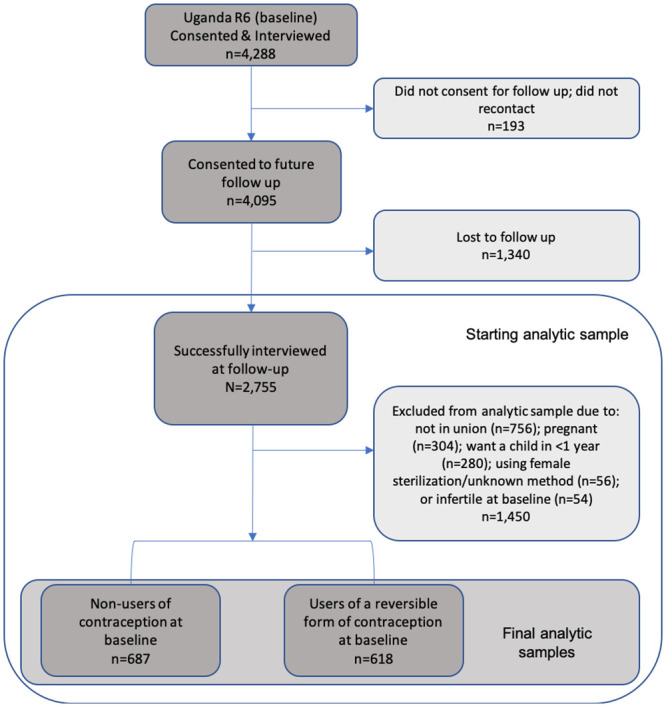
This study uses nationally representative longitudinal data of Ugandan women aged 15-49 collected in 2018-2019 (n = 4,288 women baseline; n = 2,755 women one-year follow-up). Two analytic sub-samples of women in union and in need of contraception at baseline were used (n = 618 contraceptive users at baseline for discontinuation/switching analysis; n = 687 contraceptive non-users at baseline for adoption analysis). Primary dependent variables encompassed contraceptive use dynamics (continuation, discontinuation, switching, and adoption); three independent variables assessed partner influence. For each sub-sample, bivariate associations explored differences in sociodemographic and partner influences by contraceptive dynamics. Multinomial regression models were used to examine discontinuation and switching for contraceptive users at baseline; logistic regression identified predictors of contraceptive adoption among non-users at baseline.
Among users at baseline, 26.3% of women switched methods and 31.5% discontinued contraceptive use by follow-up. Multinomial logistic regression, adjusting for women's characteristics, indicated the relative risk of contraceptive discontinuation doubled when women did not discuss pregnancy avoidance with their partner prior to contraceptive use. Partner influence was not related to method switching. Among non-users at baseline, partner support for future contraceptive use was associated with nearly three-fold increased odds of contraceptive adoption.
These results highlight the potentially supportive role of male partners in contraceptive adoption. Future research is encouraged to elucidate the complex pathways between couple-based decision-making and contraceptive dynamics through further prospective studies.
了解避孕方法的使用动态对于解决避孕需求未得到满足的问题至关重要。尽管有证据表明男性伴侣可能会影响避孕决策,但很少有研究前瞻性地考察男性支持女性使用和继续使用避孕方法的方式。
本研究旨在了解伴侣影响(定义为伴侣的生育意愿和对避孕的支持,以及在使用避孕方法之前讨论避免怀孕)对避孕方法使用动态(持续使用、停止使用、更换、采用)的预测效果,时间跨度为一年。
本研究使用了 2018-2019 年收集的乌干达 15-49 岁女性的全国代表性纵向数据(基线时 4288 名女性;一年随访时 2755 名女性)。使用了两个基线时处于婚姻状态且需要避孕的女性分析亚组(基线时 618 名避孕使用者用于停止/更换分析;基线时 687 名非避孕使用者用于采用分析)。主要因变量包括避孕方法使用动态(持续使用、停止使用、更换和采用);三个自变量评估了伴侣的影响。对于每个亚组,双变量关联分析探讨了避孕动态的社会人口学和伴侣影响的差异。使用多项逻辑回归模型检查基线时的避孕使用者的停止和更换情况;使用逻辑回归确定了基线时非使用者采用避孕方法的预测因素。
在基线时的使用者中,26.3%的女性在随访时更换了方法,31.5%停止了避孕方法的使用。在调整了女性特征后,多变量逻辑回归表明,在使用避孕方法之前没有与伴侣讨论避免怀孕的女性,其避孕方法停止的相对风险增加了一倍。伴侣的影响与方法更换无关。在基线时的非使用者中,伴侣对未来避孕的支持与采用避孕方法的几率增加近三倍有关。
这些结果强调了男性伴侣在采用避孕方法方面的潜在支持作用。鼓励未来的研究通过进一步的前瞻性研究阐明基于夫妻的决策和避孕动态之间的复杂途径。