Department of Environmental Health Sciences, Columbia University Mailman School of Public Health, New York, New York, USA.
Department of Biostatistics, Columbia University Mailman School of Public Health, New York, New York, USA.
Environ Health Perspect. 2020 Dec;128(12):127001. doi: 10.1289/EHP7313. Epub 2020 Dec 9.
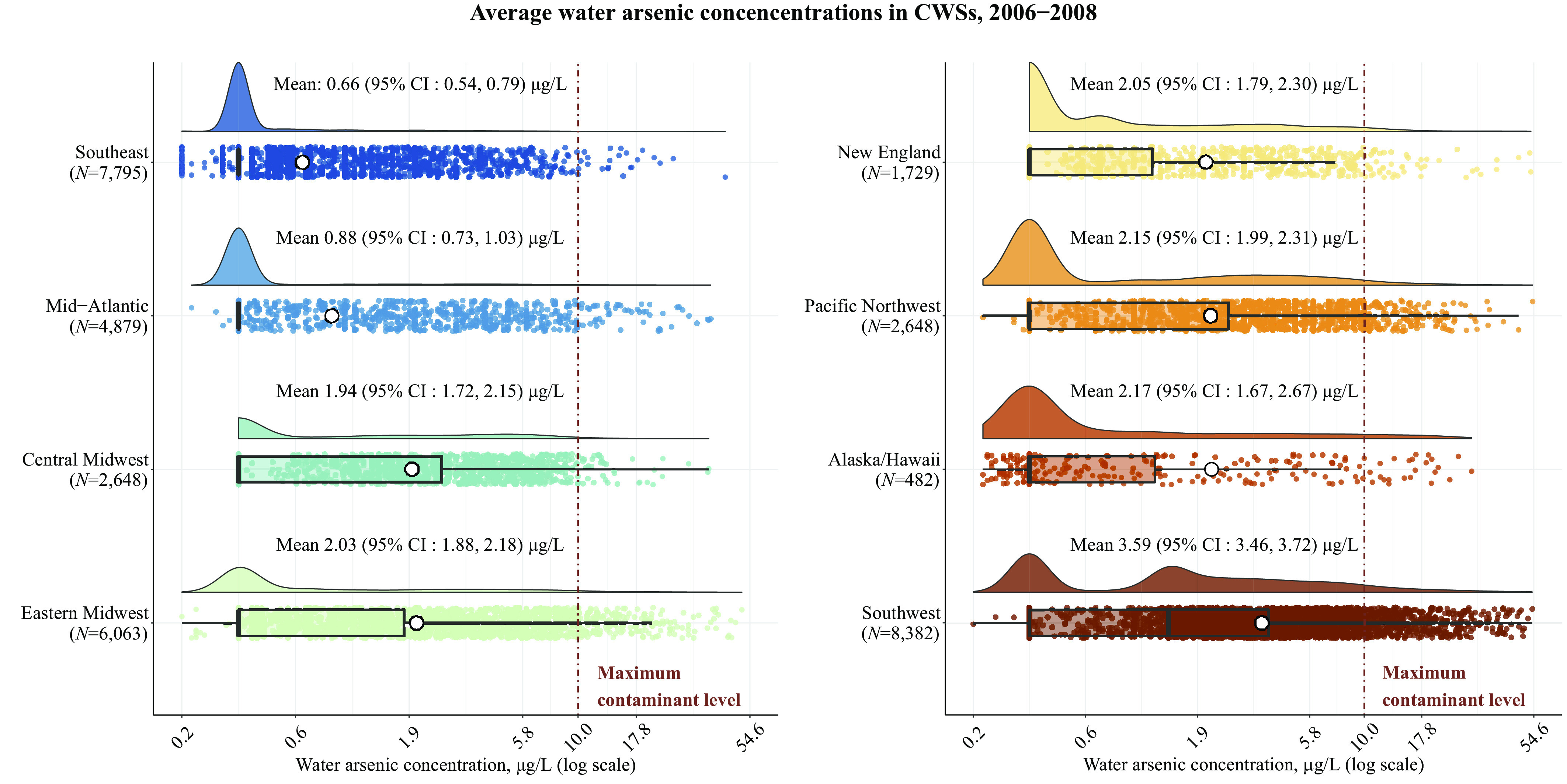
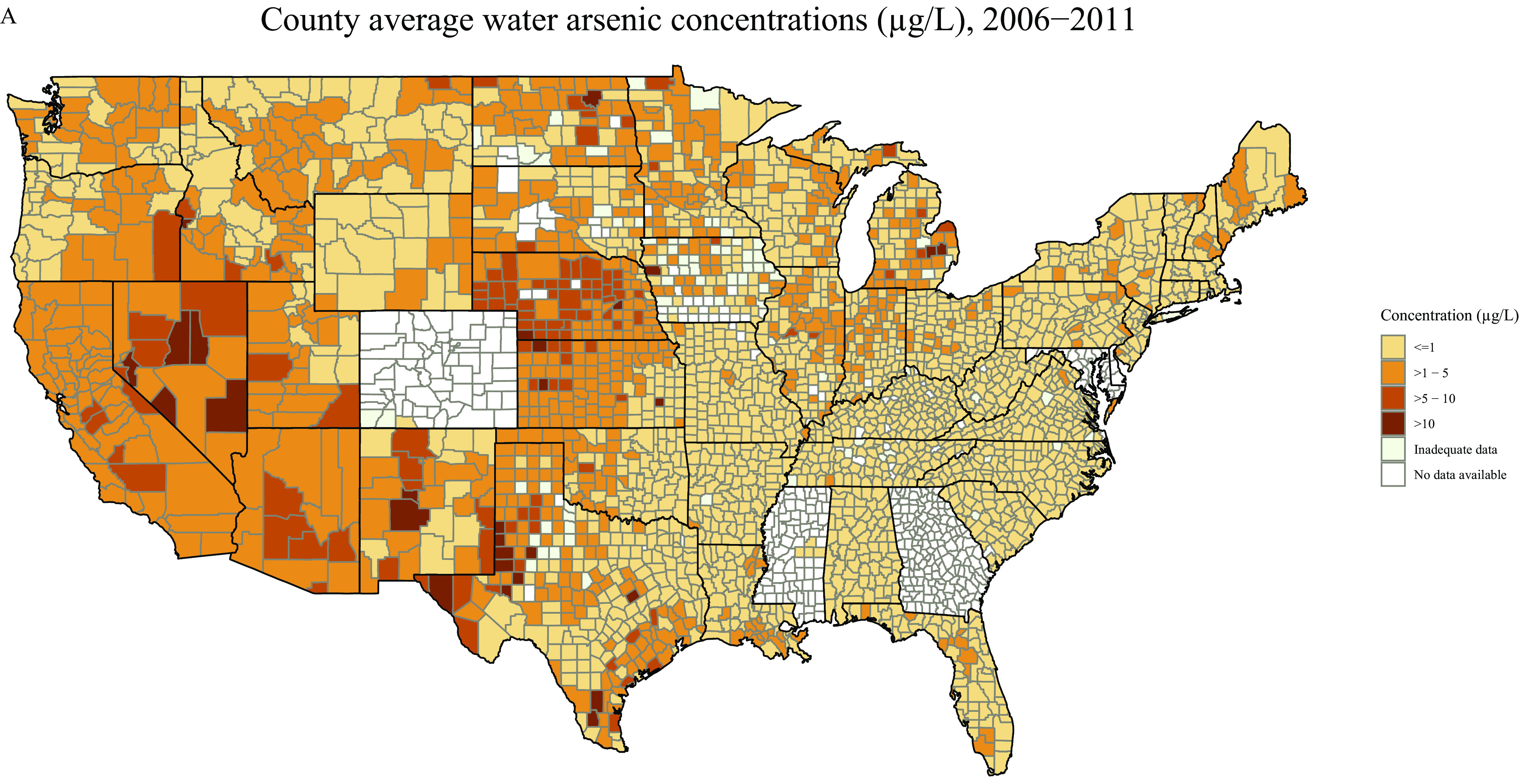
In the United States, nationwide estimates of public drinking water arsenic exposure are not readily available. We used the U.S. Environmental Protection Agency's (EPA) Six-Year Review contaminant occurrence data set to estimate public water arsenic exposure. We compared community water system (CWS) arsenic concentrations during 2006-2008 vs. after 2009-2011, the initial monitoring period for compliance with the U.S. EPA's arsenic maximum contaminant level (MCL).
Our objective was to characterize potential inequalities in CWS arsenic exposure over time and across sociodemographic subgroups.
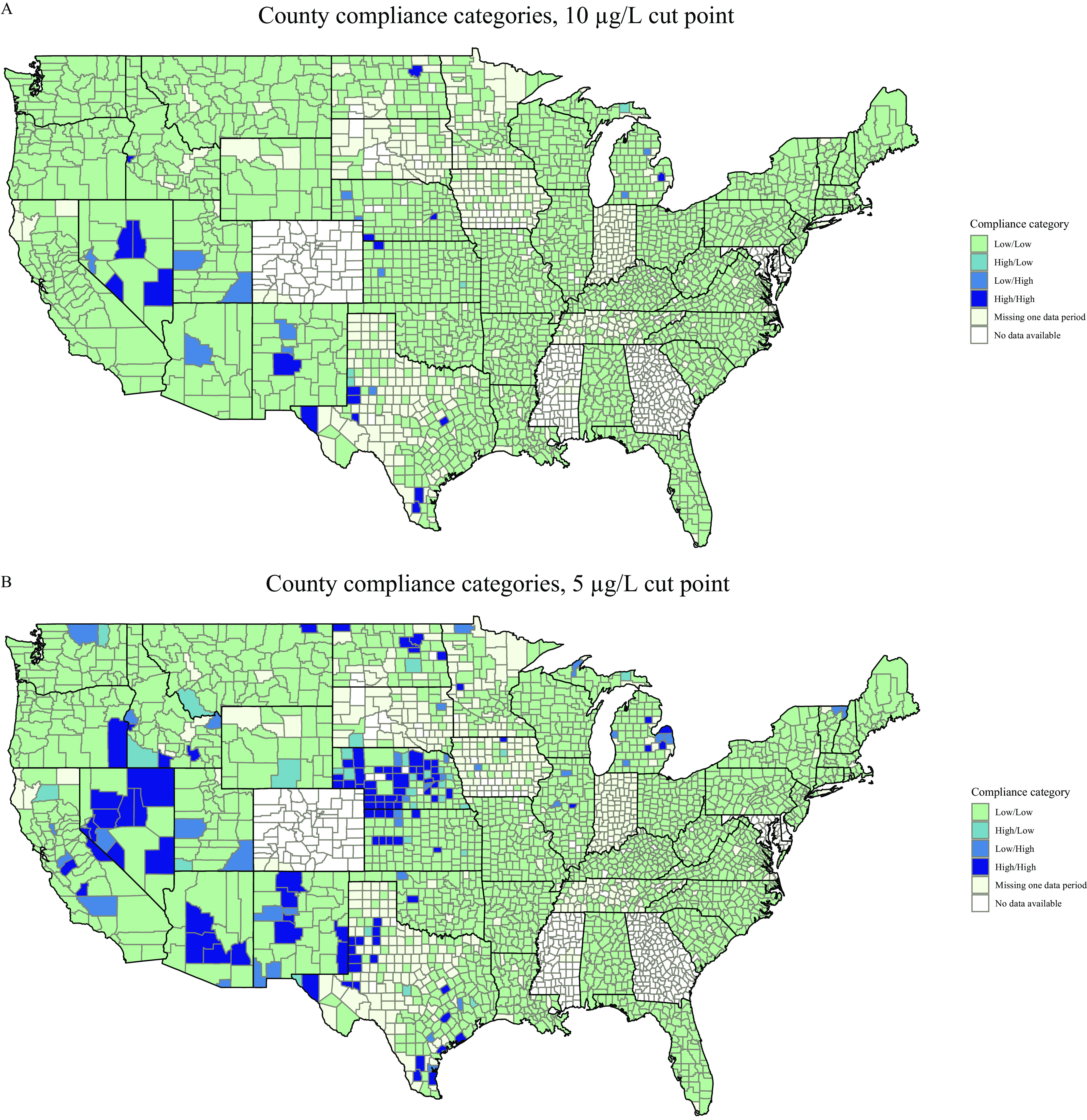
We estimated 3-y average arsenic concentrations for 36,406 CWSs (98%) and 2,740 counties (87%) and compared differences in means and quantiles of water arsenic (via quantile regression) between both 3-y periods for U.S. regions and sociodemographic subgroups. We assigned CWSs and counties MCL compliance categories (High if above the MCL; Low if below) for each 3-y period.
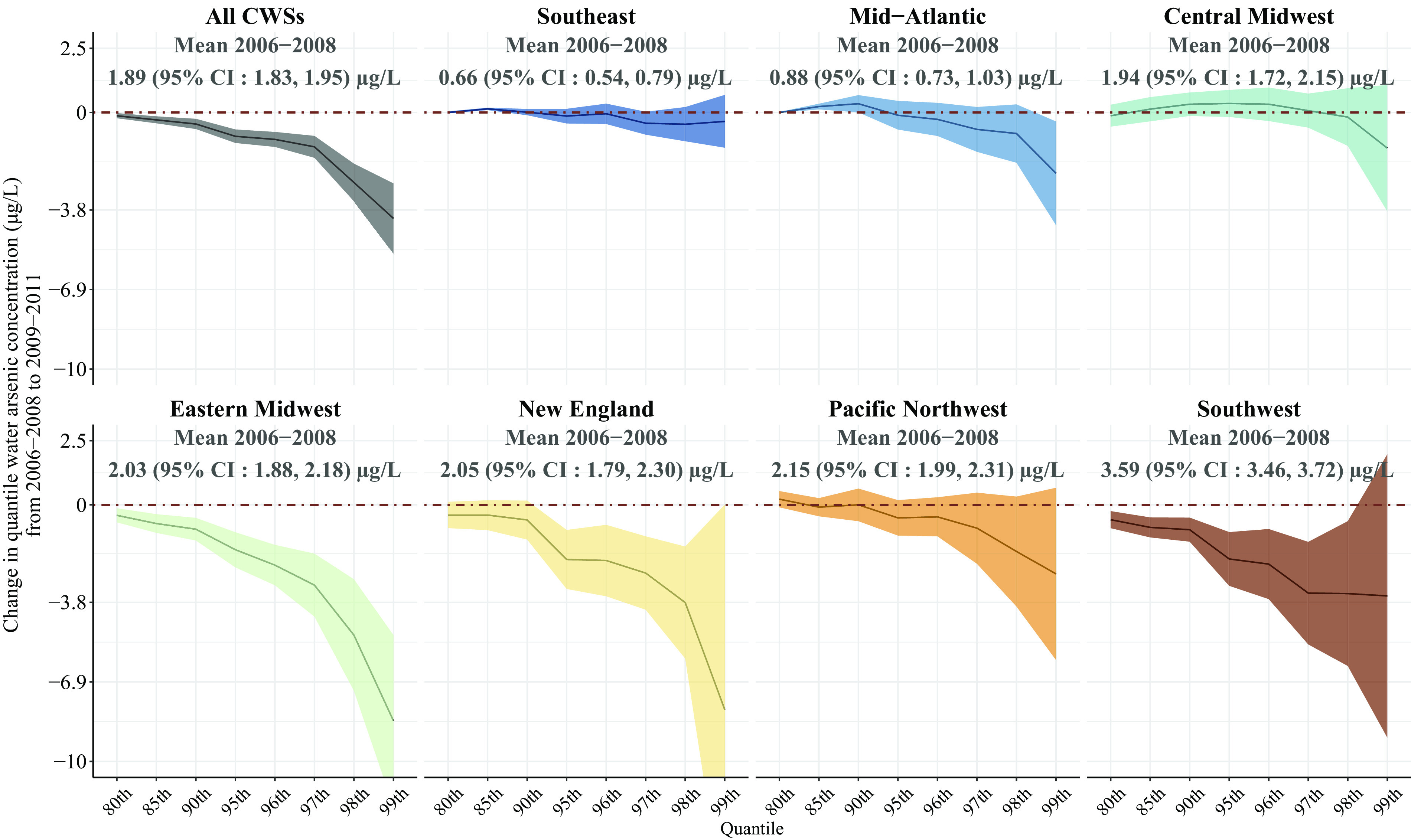
From 2006-2008 to 2009-2011, mean and 95th percentile CWS arsenic (in micrograms per liter) declined by 10.3% (95% CI: 6.5%, 14.1%) and 11.5% (8.3%, 14.8%) nationwide, by 11.4% (4.7%, 18.1%) and 16.3% (8.1%, 24.5%) for the Southwest, and by 36.8% (7.4%, 66.1%) and 26.5% (12.1%, 40.8%) for New England, respectively. CWSs in the High/High compliance category (not MCL compliant) were more likely in the Southwest (61.1%), served by groundwater (94.7%), serving smaller populations (mean 1,102 persons), and serving Hispanic communities (38.3%).
Larger absolute declines in CWS arsenic concentrations at higher water arsenic quantiles indicate declines are related to MCL implementation. CWSs reliant on groundwater, serving smaller populations, located in the Southwest, and serving Hispanic communities were more likely to continue exceeding the arsenic MCL, raising environmental justice concerns. These estimates of public drinking water arsenic exposure can enable further surveillance and epidemiologic research, including assessing whether differential declines in water arsenic exposure resulted in differential declines in arsenic-associated disease. https://doi.org/10.1289/EHP7313.
在美国,没有关于全国公共饮用水砷暴露的估计数据。我们使用美国环境保护署(EPA)的六年审查污染物数据集中的数据来估计公共水中的砷暴露。我们比较了 2006-2008 年和 2009-2011 年(首次监测遵守美国 EPA 砷最大污染物水平(MCL)的情况)期间社区供水系统(CWS)的砷浓度。
我们的目的是描述随着时间的推移和社会人口统计学亚组在 CWS 砷暴露方面的潜在不平等。
我们估计了 36406 个 CWS(98%)和 2740 个县(87%)的 3 年平均砷浓度,并通过分位数回归比较了美国各地区和社会人口统计学亚组在这两个 3 年期间水砷的均值和分位数差异。我们为每个 3 年期间的 CWS 和县城 MCL 合规类别(如果高于 MCL,则为高;如果低于 MCL,则为低)分配了类别。
从 2006-2008 年到 2009-2011 年,全国范围内 CWS 砷的均值和 95%分位数(每升微克)分别下降了 10.3%(95%CI:6.5%,14.1%)和 11.5%(8.3%,14.8%),西南部分别下降了 11.4%(4.7%,18.1%)和 16.3%(8.1%,24.5%),新英格兰分别下降了 36.8%(7.4%,66.1%)和 26.5%(12.1%,40.8%)。在西南部,高/高合规类别(不符合 MCL)的 CWS 更有可能(61.1%)依赖地下水(94.7%),服务于较小的人群(平均 1102 人),并服务于西班牙裔社区(38.3%)。
在更高的水砷分位数处,CWS 砷浓度的绝对值下降更大,这表明下降与 MCL 的实施有关。依赖地下水、服务于较小人群、位于西南部且服务于西班牙裔社区的 CWS 更有可能继续超过砷 MCL,这引发了环境正义方面的担忧。这些关于公共饮用水砷暴露的估计数据可以进一步进行监测和流行病学研究,包括评估水中砷暴露的差异是否导致与砷相关疾病的差异下降。https://doi.org/10.1289/EHP7313.