Department of Clinical and Health Psychology, Ulm University, Ulm, Germany.
Embodiment Resources Academy (ERA), Munich, Germany.
PLoS One. 2020 Dec 9;15(12):e0242578. doi: 10.1371/journal.pone.0242578. eCollection 2020.
Previous research has shown that anxiety syndromes are highly prevalent among university students. Effective treatments are needed to reduce the burden of anxiety in this population. Powerful postures have been found to impact affective states, as well as interoception (i.e. the ability to perceive inner bodily signals). However, no previous study has compared the effects of powerful- and neutral postures in regards to anxiety and interoceptive ability.
The first part of the study measured the single-session effect of adopting powerful- vs. neutral postures on students' (n = 57) interoceptive ability and state anxiety. The second part of the study measured the effect of adopting powerful or neutral postures twice daily for two weeks, on individuals' interoceptive ability and trait anxiety.
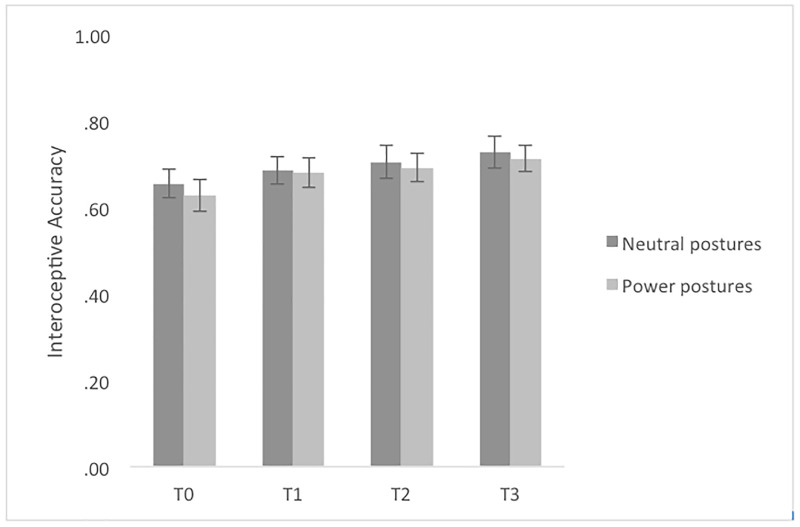
State anxiety decreased in both conditions whereas interoceptive accuracy only increased in the power posing condition after a single session. Interoceptive accuracy increased in both groups after two weeks of training.
The study included no comparison to a condition where individuals adopted their natural (i.e. usual) bodily posture.
Embodiment interventions that include elements of adopting an open or expansive bodily posture whilst maintaining a self-focus, can help to reduce state anxiety and improve interoceptive accuracy in student populations. Power posing does not seem to be superior to holding a neutral posture to improve interoceptive accuracy or anxiety. One reason therefore could be that both conditions include the manipulation of self-focus and a postural change that diverges from individuals' normal posture.
先前的研究表明,焦虑症在大学生中非常普遍。需要有效的治疗方法来减轻这一人群的焦虑负担。有力的姿势已被发现会影响情绪状态和内感受能力(即感知内在身体信号的能力)。然而,以前没有研究比较有力姿势和中性姿势对焦虑和内感受能力的影响。
研究的第一部分测量了学生(n=57)在单次体验中采用有力姿势与中性姿势对其内感受能力和状态焦虑的影响。研究的第二部分测量了个体在两周内每天两次采用有力或中性姿势对其内感受能力和特质焦虑的影响。
两种情况下的状态焦虑都有所降低,而单次体验后仅有力姿势组的内感受准确性增加。经过两周的训练,两组的内感受准确性都有所提高。
研究未将个体采用其自然(即通常)身体姿势的情况与其他情况进行比较。
包含采用开放或扩张身体姿势并保持自我关注的体现干预措施,可以帮助减少学生群体的状态焦虑并提高内感受准确性。有力姿势似乎并不比保持中性姿势更能提高内感受准确性或缓解焦虑。原因之一可能是两种情况都包括了对自我关注和与个体正常姿势不同的姿势变化的控制。