Department of Clinical and Health Psychology, Ulm University, Ulm, Germany.
Embodiment Resources Academy (ERA), Munich, Germany.
PLoS One. 2019 Feb 7;14(2):e0211453. doi: 10.1371/journal.pone.0211453. eCollection 2019.
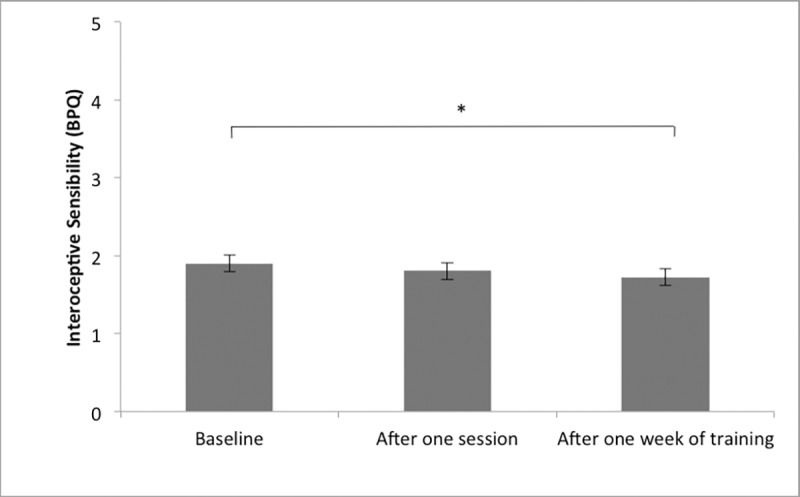
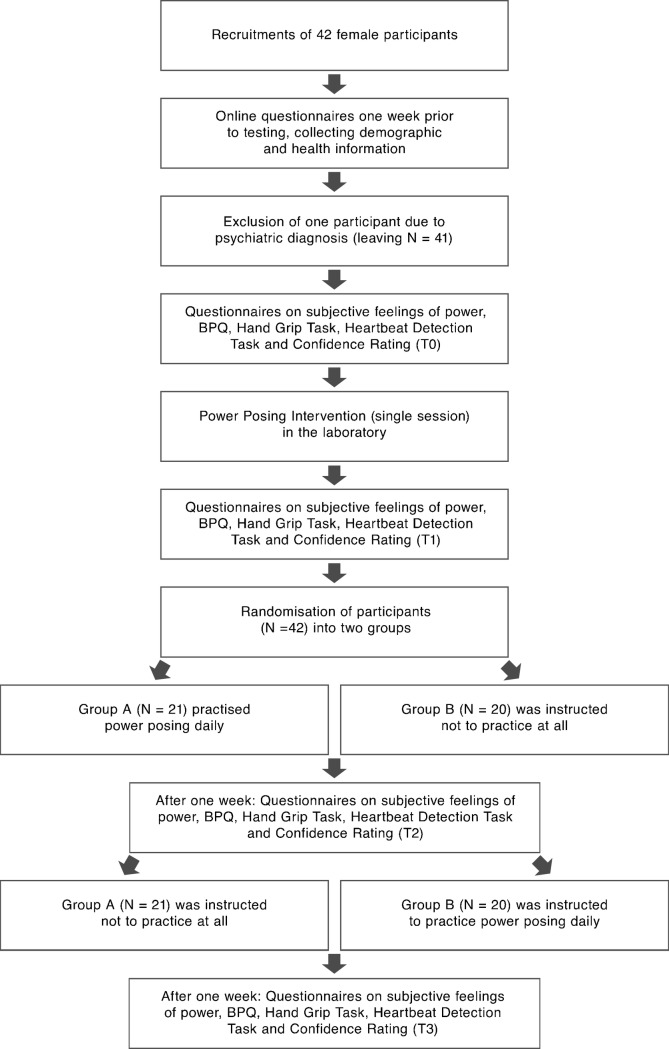
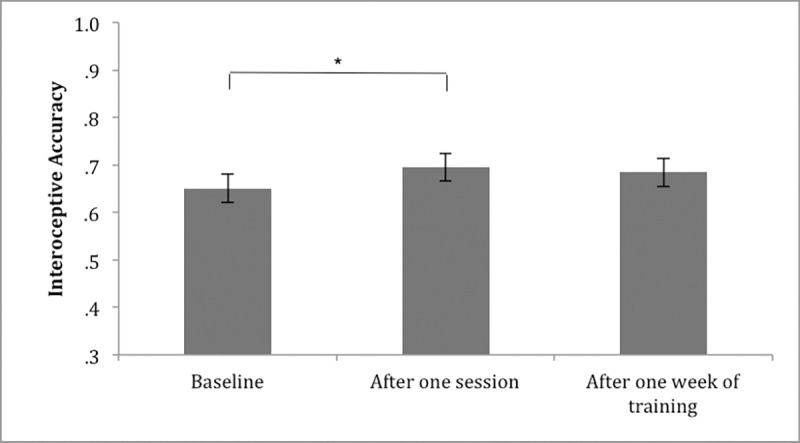
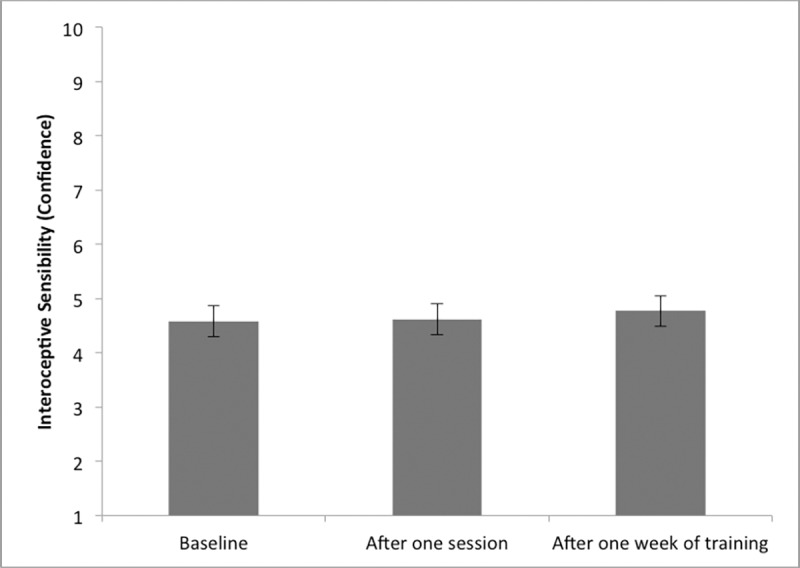
Interoception refers to the detection and perception of signals from the inner body. Deficits in this domain have been linked to psychopathologies, prompting the search for strategies to improve this ability. Preliminary studies have shown that interoception could be enhanced through the manipulation of subjective feelings of power. We tested the effects of adopting powerful postures on different facets of interoception. Firstly, we measured the impact of a single power posing session on interoceptive ability in 41 healthy females. Then, the same participants were randomly assigned to two conditions (daily power posing practice vs. no practice). After one week the conditions alternated. Interoceptive accuracy, measured by the heartbeat tracking task, interoceptive sensibility, measured by the Body Perception Questionnaire (BPQ) and confidence ratings, as well as subjective feelings of power were assessed at baseline, after a single power posing session and after one week of training. A single power posing session significantly increased individuals' interoceptive accuracy. Also, power posing reduced individuals' scores on the BPQ after one week of daily practice and increased subjective feelings of power after one session and one week of daily practice. These findings suggest that adopting powerful postures has the potential to increase interoceptive accuracy, as well as subjective feelings of power, and to reduce interoceptive sensibility, measured by questionnaire.
内感受是指对来自体内信号的检测和感知。该领域的缺陷与精神病理学有关,这促使人们寻找改善这种能力的策略。初步研究表明,通过操纵主观的力量感,可以增强内感受。我们测试了通过采取有力姿势来改善内感受不同方面的效果。首先,我们在 41 名健康女性中测量了单次力量姿势对内感受能力的影响。然后,相同的参与者被随机分配到两种条件(每日力量姿势练习与不练习)。一周后条件交替。通过心跳跟踪任务测量内感受准确性,通过身体感知问卷(BPQ)和置信度评分测量内感受敏感性,以及主观力量感,在基线、单次力量姿势后和一周训练后进行评估。单次力量姿势显著提高了个体的内感受准确性。此外,力量姿势在一周的日常练习后降低了个体在 BPQ 上的得分,并且在单次练习和一周的日常练习后增加了主观力量感。这些发现表明,采取有力的姿势有可能提高内感受准确性和主观力量感,并降低通过问卷测量的内感受敏感性。