Department of Medical Radiologic Technology, School of Medicine, College of Health Sciences, Addis Ababa University, Addis Ababa, Ethiopia.
PLoS One. 2020 Dec 9;15(12):e0243634. doi: 10.1371/journal.pone.0243634. eCollection 2020.
The cost of university presents various challenges with regards to students' daily learning activities. This is particularly evident in developing countries, where higher education students face acute financial problems that greatly affect their daily educational activities. In Ethiopia, public university students do benefit from governmental cost-sharing programs. Moreover, health sciences students have additional costs during their clinical placements that are above the common expenses for university students.
Authors aim to explore the challenges that undergraduate health sciences students in their clinical year face with limited pocket money, as well as how students perceive these limited funds affecting their learning activities and their ability to meet challenges.
This descriptive qualitative study was conducted at the Department of Medical Radiologic Technology, College of Health Sciences, at Addis Ababa University in Ethiopia. Interviews were conducted between January 28, 2019 and February 1, 2019 with twelve students; and only ten participants were included in the study. The semi-structured questions explored participants' experiences and perceptions regarding the challenges of a lack of pocket money and its impacts on their learning activities. Their reaction to financial challenges was assessed.
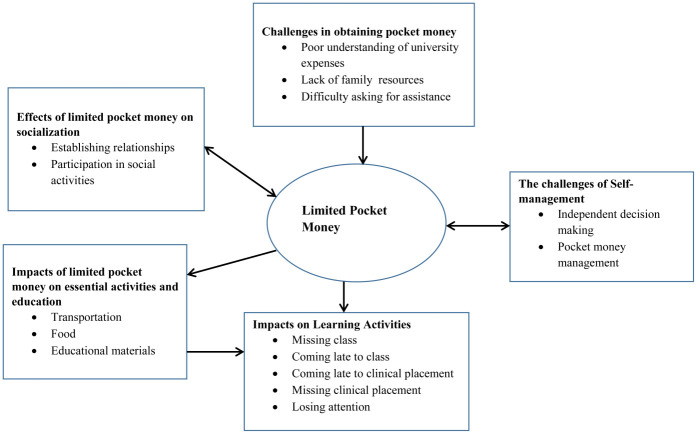
Four themes that are related to the impact of a lack of money on learning activities emerged from our interviews. First, students believed that their difficulty in obtaining pocket money from family or other funding sources contributed to their financial stress, which negatively impacted their learning. Moreover, their difficulty in affording the basic needs for a student greatly affected their learning abilities in the classroom as well as in their clinical placements. The ability to self-manage was also a significant concern for students, with the pressure to use self-control and proper money management adding to their financial stress. Lastly, students observed that the lack of pocket money affected their ability to make social connections at university, which they saw as negatively impacting their learning abilities.
Ethiopian undergraduate health sciences students faced many challenges due to the lack of pocket money and these challenges affected student learning both directly or indirectly. Based on our data, we believe that the underlying causes of student financial hardship can be addressed by increasing public awareness of university expenses, clarifying the cost-sharing system to the public, redesigning the cost-sharing policy, and improving university services. Additionally, teaching students self-management skills is also another area that could increase student success.
大学的费用给学生的日常学习活动带来了各种挑战。在发展中国家,这种情况尤为明显,那里的高等教育学生面临严重的财政问题,这极大地影响了他们的日常教育活动。在埃塞俄比亚,公立大学的学生确实受益于政府的成本分担计划。此外,医学生在临床实习期间的额外费用超出了大学生的普通费用。
作者旨在探讨临床年的本科医学生在零花钱有限的情况下所面临的挑战,以及学生如何看待这些有限的资金对他们的学习活动和应对挑战的能力的影响。
这是一项在埃塞俄比亚亚的斯亚贝巴大学健康科学学院医学放射技术系进行的描述性定性研究。访谈于 2019 年 1 月 28 日至 2 月 1 日进行,共采访了 12 名学生,但只有 10 名参与者被纳入研究。半结构式问题探讨了参与者对缺乏零花钱的挑战及其对学习活动的影响的经验和看法。评估了他们对财务挑战的反应。
从我们的访谈中出现了四个与缺乏资金对学习活动的影响有关的主题。首先,学生们认为,他们难以从家庭或其他资金来源获得零花钱,这导致了他们的经济压力,对他们的学习产生了负面影响。此外,他们难以负担学生的基本需求,这极大地影响了他们在课堂和临床实习中的学习能力。自我管理的能力也是学生们关注的一个重要问题,自我控制和妥善的财务管理的压力增加了他们的经济压力。最后,学生们观察到,缺乏零花钱影响了他们在大学结交社交的能力,他们认为这对他们的学习能力产生了负面影响。
由于缺乏零花钱,埃塞俄比亚本科医学生面临许多挑战,这些挑战直接或间接地影响了学生的学习。根据我们的数据,我们认为,增加公众对大学费用的认识、向公众澄清成本分担制度、重新设计成本分担政策以及改善大学服务,可以解决学生经济困难的根本原因。此外,教授学生自我管理技能也是提高学生成功率的另一个领域。
