Desanlis Ines, Paul Rachel, Kmita Marie
Genetics and Development Research Unit, Institut de Recherches Cliniques de Montréal, Montreal, QC H2W 1R7, Canada.
Département de Médecine, Université de Montréal, Montreal, QC H3T 1J4, Canada.
J Dev Biol. 2020 Dec 7;8(4):31. doi: 10.3390/jdb8040031.
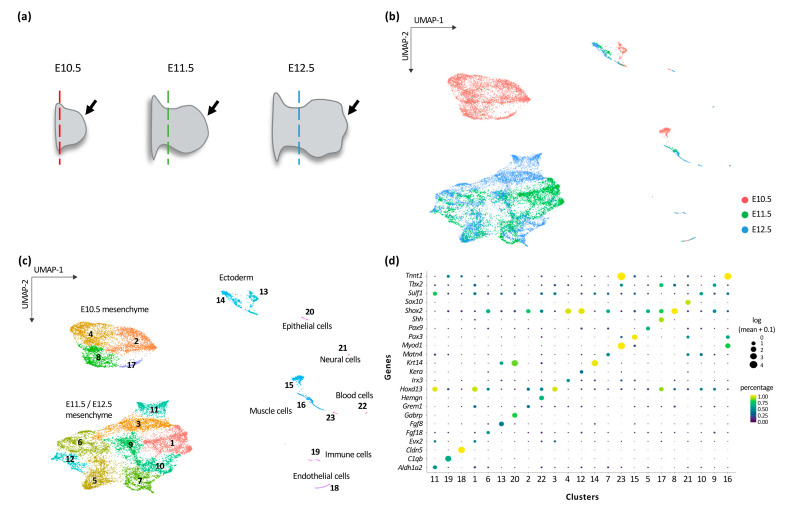
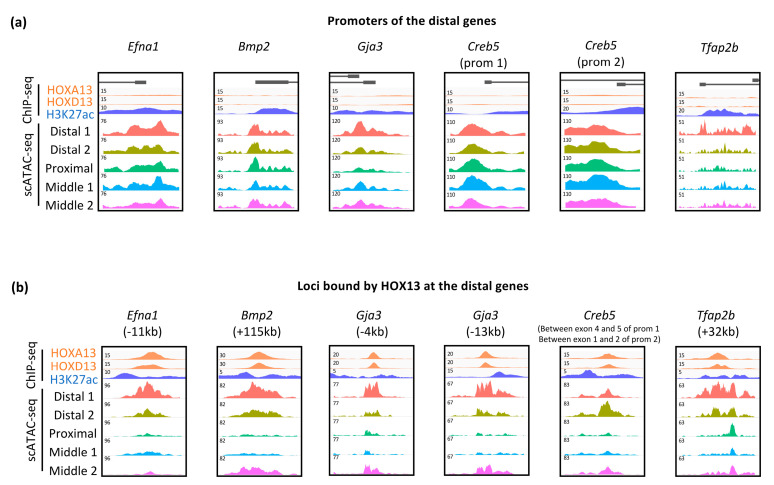
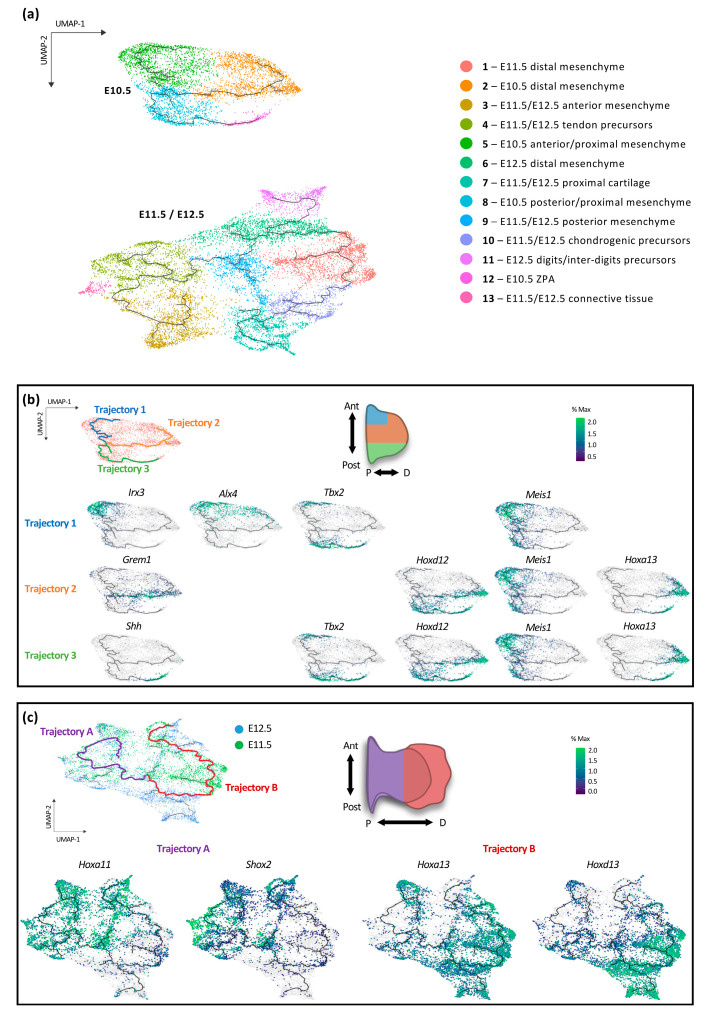
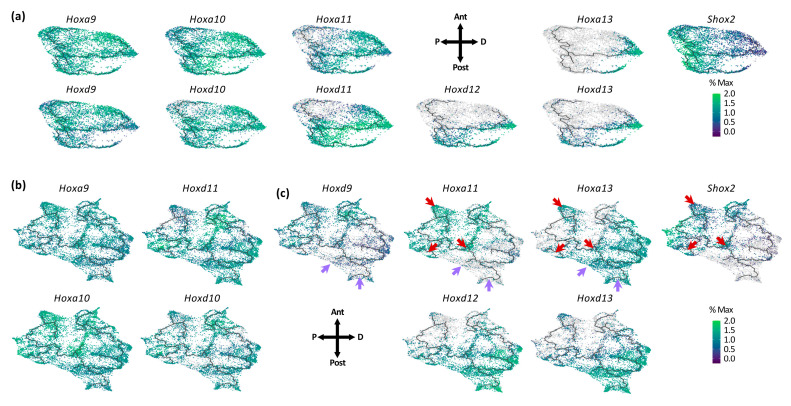
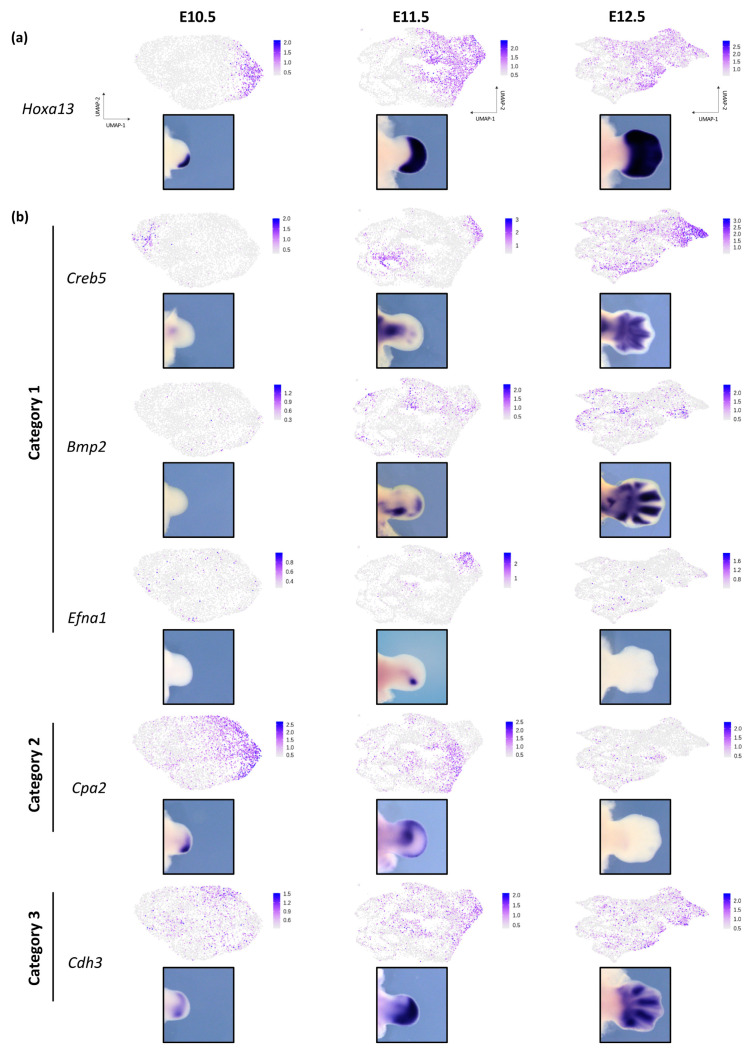
Limb patterning relies in large part on the function of the family of developmental genes. While the differential expression of genes shifts from the anterior-posterior (A-P) to the proximal-distal (P-D) axis around embryonic day 11 (E11), whether this shift coincides with a more global change of A-P to P-D patterning program remains unclear. By performing and analyzing the transcriptome of the developing limb bud from E10.5 to E12.5, at single-cell resolution, we have uncovered transcriptional trajectories that revealed a general switch from A-P to P-D genetic program between E10.5 and E11.5. Interestingly, all the transcriptional trajectories at E10.5 end with cells expressing either proximal or distal markers suggesting a progressive acquisition of P-D identity. Moreover, we identified three categories of genes expressed in the distal limb mesenchyme characterized by distinct temporal expression dynamics. Among these are and ( hereafter), which start to be expressed around E10.5, and importantly the binding of the HOX13 factors was observed within or in the neighborhood of several of the distal limb genes. Our data are consistent with previous evidence suggesting that the transition from the early/proximal to the late/distal transcriptome of the limb mesenchyme largely relies on HOX13 function. Based on these results and the evidence that HOX13 factors restrict expression to the proximal limb, in progenitor cells of the zeugopod, we propose that HOX13 act as a key determinant of P-D patterning.
肢体模式形成在很大程度上依赖于发育基因家族的功能。虽然基因的差异表达在胚胎第11天(E11)左右从前后(A-P)轴转移到近远(P-D)轴,但这种转移是否与A-P到P-D模式形成程序的更全面变化相吻合仍不清楚。通过在单细胞分辨率下对从E10.5到E12.5发育中的肢芽进行转录组分析,我们发现了转录轨迹,揭示了在E10.5和E11.5之间从A-P到P-D基因程序的总体转变。有趣的是,E10.5时所有的转录轨迹都以表达近端或远端标记的细胞结束,这表明P-D身份在逐渐获得。此外,我们鉴定出在远端肢体间充质中表达的三类基因,其特征在于不同的时间表达动态。其中包括 和 (以下简称 ),它们在E10.5左右开始表达,重要的是,在几个远端肢体基因内部或附近观察到HOX13因子的结合。我们的数据与先前的证据一致,表明肢体间充质从早期/近端转录组向晚期/远端转录组的转变在很大程度上依赖于HOX13的功能。基于这些结果以及HOX13因子将 表达限制在近端肢体的证据,在zeugopod的祖细胞中,我们提出HOX13作为P-D模式形成的关键决定因素。