High Speed 3D Printing Research Center, National Taiwan University of Science and Technology, Taipei, Taiwan.
Department and Graduate Institute of Veterinary Medicine, School of Veterinary Medicine, National Taiwan University, Taipei, Taiwan.
BMC Vet Res. 2020 Dec 9;16(1):478. doi: 10.1186/s12917-020-02691-y.
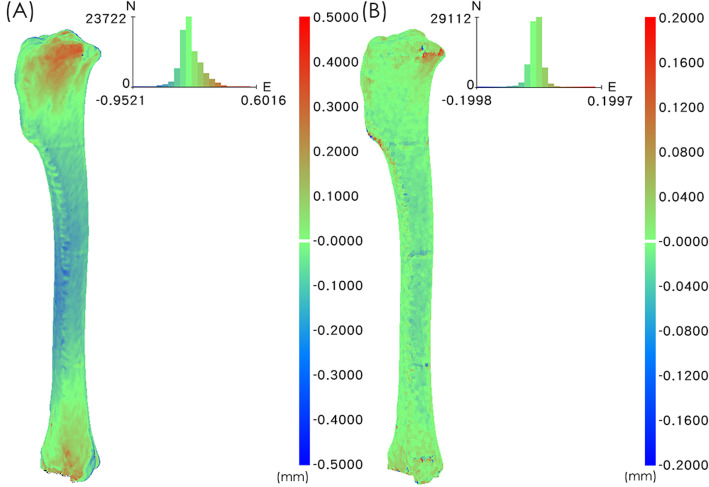
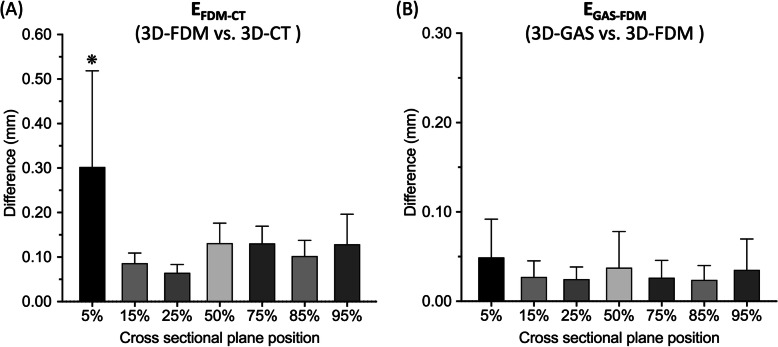
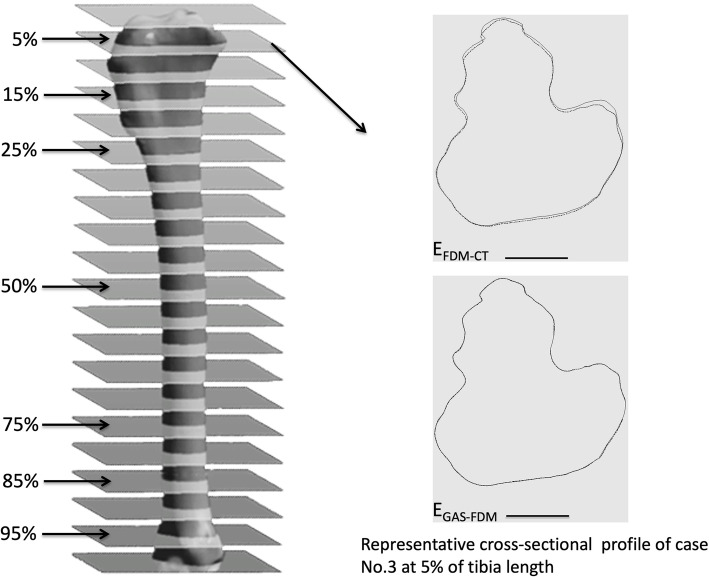
Three-dimensional (3D) printing techniques have been used to produce anatomical models and surgical guiding instruments in orthopaedic surgery. The geometric accuracy of the 3D printed replica may affect surgical planning. This study assessed the geometric accuracy of an acrylonitrile butadiene styrene (ABS) canine tibia model printed using fused deposition modelling (FDM) and evaluated its morphological change after hydrogen peroxide (HO) gas plasma sterilisation. The tibias of six canine cadavers underwent computed tomography for 3D reconstruction. Tibia models were fabricated from ABS on a 3D printer through FDM. Reverse-engineering technology was used to compare morphological errors (root mean square; RMS) between the 3D-FDM models and virtual models segmented from original tibia images (3D-CT) and between the models sterilised with HO gas plasma (3D-GAS) and 3D-FDM models on tibia surface and in cross-sections at: 5, 15, 25, 50, 75, 85, and 95% of the tibia length.
The RMS mean ± standard deviation and average positive and negative deviation values for all specimens in E (3D-FDM vs. 3D-CT) were significantly higher than those in E (3D-GAS vs. 3D-FDM; P < 0.0001). Mean RMS values for E at 5% bone length (proximal tibia) were significantly higher than those at the other six cross-sections (P < 0.0001). Mean RMS differences for E at all seven cross-sections were nonsignificant.
The tibia models fabricated on an FDM printer had high geometric accuracy with a low RMS value. The surface deviation in E indicated that larger errors occurred during manufacturing than during sterilisation. Therefore, the model may be used for surgical rehearsal and further clinically relevant applications in bone surgery.
三维(3D)打印技术已被用于生产矫形外科中的解剖模型和手术导向器械。3D 打印复制品的几何精度可能会影响手术计划。本研究评估了使用熔丝制造(FDM)技术打印的丙烯腈-丁二烯-苯乙烯(ABS)犬胫骨模型的几何精度,并评估了其在过氧化氢(HO)气体等离子体灭菌后的形态变化。六具犬尸体的胫骨进行了 3D 重建的计算机断层扫描。通过 FDM 在 3D 打印机上用 ABS 制造胫骨模型。使用逆向工程技术比较了 3D-FDM 模型与从原始胫骨图像分割的虚拟模型(3D-CT)之间以及经 HO 气体等离子体(3D-GAS)灭菌的模型与 3D-FDM 模型之间的形态误差(均方根;RMS),在胫骨表面和横截面上:5、15、25、50、75、85 和 95%的胫骨长度处。
所有标本 E(3D-FDM 与 3D-CT 比较)的 RMS 均值 ± 标准差和平均正负偏差值均显著高于 E(3D-GAS 与 3D-FDM 比较;P < 0.0001)。E 在 5%骨长(胫骨近端)处的平均 RMS 值显著高于其他六个横截面上的 RMS 值(P < 0.0001)。E 在所有七个横截面上的 RMS 差值均无统计学意义。
用 FDM 打印机制造的胫骨模型具有较高的几何精度和较低的 RMS 值。E 处的表面偏差表明,在制造过程中会出现比在灭菌过程中更大的误差。因此,该模型可用于手术预演和进一步在骨外科中进行临床相关应用。