Sydney School of Public Health, Faculty of Medicine and Health, University of Sydney, Sydney, New South Wales, Australia
Department of Biostatistics and Medical Demography, University of Public Health, Yangon, Myanmar.
BMJ Glob Health. 2020 Dec;5(12). doi: 10.1136/bmjgh-2019-002169.
Early access to adequate antenatal care (ANC) from skilled providers is crucial for detecting and preventing obstetric complications of pregnancy. We aimed to assess factors associated with the utilisation of the new WHO ANC guidelines including the recommended number, on time initiation and adequate components of ANC contacts in Myanmar.
We examined data from 2943 mothers aged 15-49 years whose most recent birth occurred in the last 5 years prior to the 2015-2016 Myanmar Demographic and Health Survey. Factors associated with utilisation of the new WHO recommended ANC were explored using multinomial logistic regression and multivariate models. We used marginal standardisation methods to estimate the predicted probabilities of the factors significantly associated with the three measures of ANC.
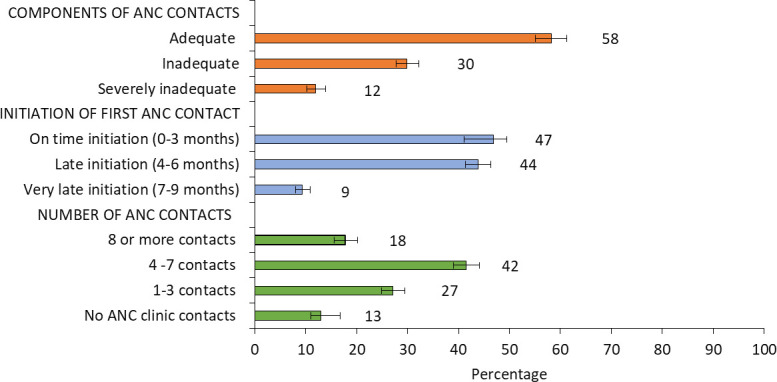
Approximately 18% of mothers met the new WHO recommended number of eight ANC contacts. About 58% of the mothers received adequate ANC components, and 47% initiated ANC within the first trimester of pregnancy. The predicted model shows that Myanmar could achieve 70% coverage of adequate components of ANC if all women were living in urban areas. Similarly, if ANC was through private health facilities, 63% would achieve adequate components of ANC. Pregnant women from urban areas (adjusted risk ratio (aRR): 4.86, 95% CI 2.44 to 9.68) were more than four times more likely to have adequate ANC components compared with women from rural areas. Pregnant women in the highest wealth quintile were three times more likely to receive eight or more ANC contacts (aRR: 3.20, 95% CI 1.61 to 6.36) relative to mothers from the lowest wealth quintile. On time initiation of the first ANC contact was fourfold for mothers aged 30-39 years relative to adolescent mothers (aRR: 4.07, 95% CI 1.53 to 10.84).
The 2016 WHO ANC target is not yet being met by the majority of women in Myanmar. Our results highlight the need to address health access inequity for women who are from lower socioeconomic groups, or are younger, and those living in rural areas.
早期获得熟练提供者的充分产前保健(ANC)对于检测和预防妊娠产科并发症至关重要。我们旨在评估与利用新的世界卫生组织 ANC 指南相关的因素,包括在缅甸建议的 ANC 接触次数、及时开始和充分的 ANC 接触内容。
我们检查了 2943 名年龄在 15-49 岁之间的母亲的数据,她们最近的一次分娩发生在 2015-2016 年缅甸人口与健康调查之前的五年内。使用多项逻辑回归和多变量模型探讨了与利用新的世界卫生组织推荐的 ANC 相关的因素。我们使用边缘标准化方法估计与 ANC 三个措施显著相关的因素的预测概率。
大约 18%的母亲符合新的世界卫生组织建议的 8 次 ANC 接触次数。大约 58%的母亲接受了充分的 ANC 内容,47%的母亲在怀孕的第一个三个月内开始 ANC。预测模型表明,如果所有妇女都居住在城市地区,缅甸可以实现 70%的充分 ANC 内容覆盖。同样,如果 ANC 是通过私人卫生设施进行的,那么 63%的人将获得充分的 ANC 内容。与来自农村地区的妇女相比,来自城市地区的孕妇(调整后的风险比(aRR):4.86,95%CI 2.44 至 9.68)更有可能获得充分的 ANC 内容。与来自最贫困五分之一的母亲相比,最高财富五分位数的孕妇接受 8 次或更多 ANC 接触的可能性是其三倍(aRR:3.20,95%CI 1.61 至 6.36)。对于 30-39 岁的母亲来说,第一次 ANC 接触的及时开始是青春期母亲的四倍(aRR:4.07,95%CI 1.53 至 10.84)。
大多数缅甸妇女尚未达到 2016 年世界卫生组织 ANC 目标。我们的研究结果强调,需要解决卫生服务获取方面的不平等问题,这些不平等问题存在于社会经济地位较低的妇女、较年轻的妇女以及居住在农村地区的妇女中。