Kushioka Junichi, Kaito Takashi, Okada Rintaro, Ishiguro Hiroyuki, Bal Zeynep, Kodama Joe, Chijimatsu Ryota, Pye Melanie, Narimatsu Masahiro, Wrana Jeffrey L, Inoue Yasumichi, Ninomiya Hiroko, Yamamoto Shin, Saitou Takashi, Yoshikawa Hideki, Imamura Takeshi
Department of Orthopaedic Surgery, Osaka University Graduate School of Medicine, 2-2 Yamadaoka, Suita, Osaka, 565-0871, Japan.
Bone and Cartilage Regenerative Medicine, The University of Tokyo, 7-3-1, Hongo, Bunkyo-ku, Tokyo, 113-8655, Japan.
Bone Res. 2020 Nov 23;8(1):41. doi: 10.1038/s41413-020-00115-z.
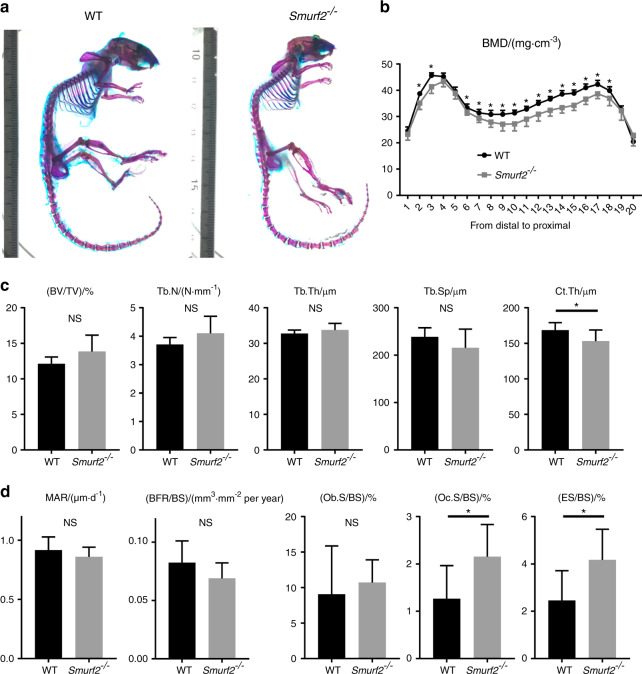
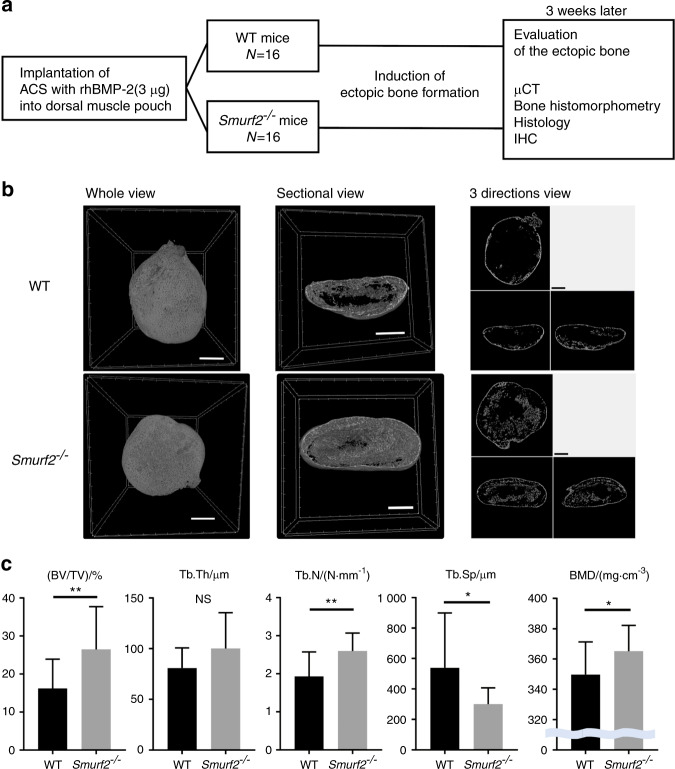
Transforming growth factor-β (TGF-β) and bone morphogenetic protein (BMP) play important roles in bone metabolism. Smad ubiquitination regulatory factors (Smurfs) regulate TGF-β/BMP signaling via ubiquitination, resulting in degradation of signaling molecules to prevent excessive activation of TGF-β/BMP signaling. Though Smurf2 has been shown to negatively regulate TGF-β/Smad signaling, its involvement in BMP/Smad signaling in bone metabolism has not been thoroughly investigated. In the present study, we sought to evaluate the role of Smurf2 in BMP/Smad signaling in bone metabolism. Absorbable collagen sponges containing 3 μg of recombinant human BMP2 (rhBMP2) were implanted in the dorsal muscle pouches of wild type (WT) and Smurf2 mice. The rhBMP2-induced ectopic bone in Smurf2 mice showed greater bone mass, higher mineral apposition and bone formation rates, and greater osteoblast numbers than the ectopic bone in WT mice. In WT mice, the ectopic bone consisted of a thin discontinuous outer cortical shell and scant inner trabecular bone. In contrast, in Smurf2 mice, the induced bone consisted of a thick, continuous outer cortical shell and abundant inner trabecular bone. Additionally, rhBMP2-stimulated bone marrow stromal cells (BMSCs) from Smurf2 mice showed increased osteogenic differentiation. Smurf2 induced the ubiquitination of Smad1/5. BMP/Smad signaling was enhanced in Smurf2 BMSCs stimulated with rhBMP2, and the inhibition of BMP/Smad signaling suppressed osteogenic differentiation of these BMSCs. These findings demonstrate that Smurf2 negatively regulates BMP/Smad signaling, thereby identifying a new regulatory mechanism in bone metabolism.
转化生长因子-β(TGF-β)和骨形态发生蛋白(BMP)在骨代谢中发挥重要作用。Smad泛素化调节因子(Smurfs)通过泛素化调节TGF-β/BMP信号通路,导致信号分子降解,以防止TGF-β/BMP信号通路过度激活。尽管Smurf2已被证明对TGF-β/Smad信号通路起负调节作用,但其在骨代谢中对BMP/Smad信号通路的影响尚未得到充分研究。在本研究中,我们试图评估Smurf2在骨代谢中对BMP/Smad信号通路的作用。将含有3μg重组人BMP2(rhBMP2)的可吸收胶原海绵植入野生型(WT)小鼠和Smurf2基因敲除小鼠的背部肌肉袋中。与WT小鼠的异位骨相比,Smurf2基因敲除小鼠中rhBMP2诱导的异位骨表现出更大的骨量、更高的矿物质沉积和骨形成率,以及更多的成骨细胞数量。在WT小鼠中,异位骨由一层薄的、不连续的外层皮质壳和少量的内部小梁骨组成。相比之下,在Smurf2基因敲除小鼠中,诱导形成的骨由一层厚的、连续的外层皮质壳和丰富的内部小梁骨组成。此外,rhBMP2刺激的Smurf2基因敲除小鼠骨髓间充质干细胞(BMSCs)显示出成骨分化增加。Smurf2诱导Smad1/5的泛素化。在用rhBMP2刺激的Smurf2基因敲除BMSCs中,BMP/Smad信号通路增强,而抑制BMP/Smad信号通路则抑制了这些BMSCs的成骨分化。这些发现表明,Smurf2对BMP/Smad信号通路起负调节作用,从而确定了骨代谢中的一种新的调节机制。