Evaxion Biotech, Bredgade 34E, 1260, Copenhagen, Denmark.
Department of Health Technology, Technical University of Denmark, 2800, Lyngby, Denmark.
Nat Commun. 2020 Dec 9;11(1):6305. doi: 10.1038/s41467-020-20166-4.
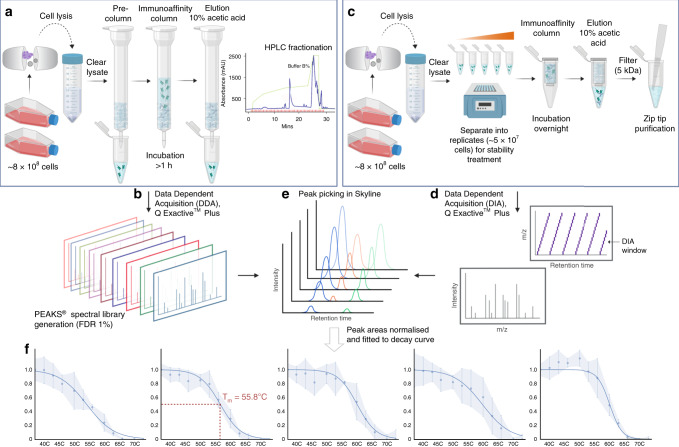
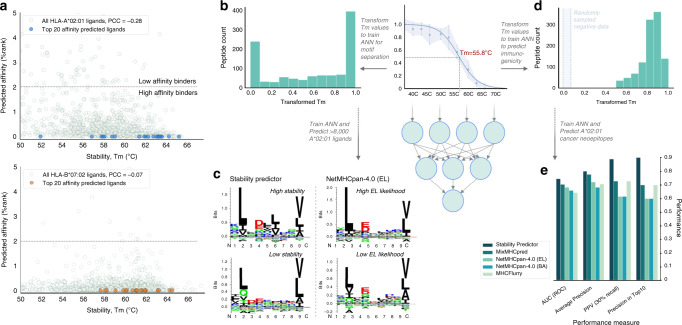
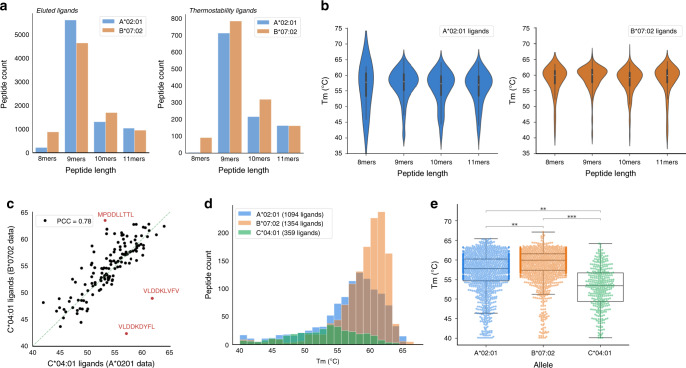
The features of peptide antigens that contribute to their immunogenicity are not well understood. Although the stability of peptide-MHC (pMHC) is known to be important, current assays assess this interaction only for peptides in isolation and not in the context of natural antigen processing and presentation. Here, we present a method that provides a comprehensive and unbiased measure of pMHC stability for thousands of individual ligands detected simultaneously by mass spectrometry (MS). The method allows rapid assessment of intra-allelic and inter-allelic differences in pMHC stability and reveals profiles of stability that are broader than previously appreciated. The additional dimensionality of the data facilitated the training of a model which improves the prediction of peptide immunogenicity, specifically of cancer neoepitopes. This assay can be applied to any cells bearing MHC or MHC-like molecules, offering insight into not only the endogenous immunopeptidome, but also that of neoepitopes and pathogen-derived sequences.
肽抗原的免疫原性特征尚未得到很好的理解。尽管已知肽-MHC(pMHC)的稳定性很重要,但目前的检测方法仅针对分离的肽评估这种相互作用,而不是在天然抗原加工和呈递的背景下评估。在这里,我们提出了一种方法,该方法通过质谱(MS)同时对数千种单个配体进行全面且无偏的 pMHC 稳定性测量。该方法允许快速评估 pMHC 稳定性的等位内和等位间差异,并揭示出比以前认识到的更广泛的稳定性谱。数据的附加维度促进了模型的训练,该模型提高了对肽免疫原性的预测,特别是对癌症新抗原的预测。该测定法可应用于任何携带 MHC 或 MHC 样分子的细胞,不仅提供了对内源性免疫肽组的深入了解,还提供了对新抗原和病原体衍生序列的了解。